

Compilation
Pergularia edulis
1 Images see all
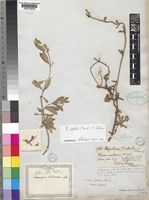
Name
Identification
Pergularia edulis Thunb. [family ASCLEPIADACEAE ] Fockea glabra Decne. [family ASCLEPIADACEAE ] Fockea edulis (Thunb.) K.Schum. [family ASCLEPIADACEAE ] (stored under name); Verified by Court, G.D., Fockea capensis Endl. [family ASCLEPIADACEAE ] Ceropegia suberose Spr. [family ASCLEPIADACEAE ]
Related name
- Fockea edulis
- Fockea capensis
- Pergularia edulis
- Ceropegia suberose
- Fockea glabra
Flora
Entry for FOCKEA glabra Decne [family ASCLEPIADACEAE]
Herbarium
Royal Botanic Gardens, Kew (K)
Collection
Flora Capensis
Resource Type
Reference Sources
Entry From
Flora Capensis, Vol 4, page 518, (1909) Author: By N. E. BROWN.
Names
FOCKEA glabra Decne [family ASCLEPIADACEAE], in DC. Prodr. viii. 545
FOCKEA edulis K. Schum. [family ASCLEPIADACEAE], in Engl. Jahrb. xvii. 146, in note, and in Engl. and Prantl, Pflanzenfam. iv. ii. 296; Schlechter in Journ. Bot. 1898, 487, partly.
Pergularia edulis Thunb. [family ASCLEPIADACEAE], Prodr. 38; in Nov. Act. Acad. Petrop. xiv. (1805) 519; Fl. Cap. ed. 2, ii. 151 (edalis), and ed. Schultes, 233; Willd. Sp. Pl. i. 1247; Pers. Syn. Pl. i. 271; Schultes, Syst. Veg. vi. 56; G. Don, Gen. Syst. iv. 133.
Chymocormus edulis Harv. [family ASCLEPIADACEAE], in Hook. Lond. Journ. Bot. i. 1842, 24.
Information
rootstock partly above ground, very large, up to 2 ft. in diam. (Burchell), more or less tuberculate, light brown; stems up to 2 ft. or more long, twining, procumbent or straggling, often branched, minutely puberulous on the younger parts; leaves often with leaf-tufts or very short leafy branchlets in their axils, usually spreading, sometimes deflexed; petiole 1/2–2 lin. long; blade 1/2–1 1/2 in. long, 1/6– 1/2 in. broad, elliptic, lanceolate, oblong, oblanceolate or more or less obovate, acute, or obtuse or rounded and shortly apiculate at the apex, cuneate or rounded at the base, often wavy at the margins, glabrous on both sides, subcoriaceous; cymes subsessile or on puberulous peduncles up to 1/8 in. long, 2–6-flowered, lateral at the nodes; bracts minute; pedicels 1 1/4–2 lin. long, minutely puberulous, as are the 3/4–1 lin.-long lanceolate acute sepals; corolla puberulous outside and within, dull light yellow; tube 1–1 1/4 lin. long, campanulate; lobes recurved-spreading, about 1/3 in. long, 3/4 lin. broad at the base, linear-attenuate, obliquely subtruncate at the apex, with recurved margins and more or less twisted; corona arising near the base of the corolla, 2 1/2–3 lin. long, white, the lower half tubular and longer than the corolla-tube, divided above into 5 trifid segments alternating with 5 minute entire or bifid lobules or 5 pairs of minute teeth, with the middle tooth of the trifid segments filiform or linear-subulate, shorter than or about equalling the tube and 3–4 times as long as the lateral teeth, which are decurrent as keels within the tube; between the keels at the middle of the tube arise 5 filiform teeth or processes connivent-erect over the white anther-appendages, which reach to the top of the corona-tube. null
Distribution
COAST REGION Mossel Bay Div.; Gouds (Gauritz) River, herb. Thunberg! Uitenhage Div.; near Uitenhage, Burchell, 4443! 4457! near the Zwartkops Salt-pan and River, Thunberg! Zeyher, 965! Ecklon and Zeyher, 10!SOUTH AFRICA without locality, Zeyher, 239 ex Decaisne, and cultivated specimens!
Notes
Partly described from a living plant cultivated at Kew. The large tuberous rootstock is eaten by the natives, and, according to Zeyher, has a milky, somewhat sweetish juice.