

Compilation
Peponium usambarense
1 Images see all
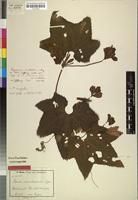
Name
Identification
Peponium usambarense Engl. [family CUCURBITACEAE ] Verified by Not on sheet, Peponium vogelii (Hook.f.) Engl. [family CUCURBITACEAE ] (stored under name); Verified by Not on sheet,
Related name
- Peponium usambarense
- Peponium vogelii
Flora
Entry for PEPONIUM vogelii (Hook. f.) Engl. [family CUCURBITACEAE]
Herbarium
Royal Botanic Gardens, Kew (K)
Collection
Flora of Tropical East Africa
Resource Type
Reference Sources
Entry From
Flora of Tropical East Africa, page 1, (1967) Author: C. Jeffrey
Names
PEPONIUM vogelii (Hook. f.) Engl. [family CUCURBITACEAE], in E. & P. Pf., Nachtr.: 318 (1897); F.W.T.A. 1: 183 (1927) & ed. 2, 1: 215 (1954); C. Jeffrey in K.B. 15: 359 (1962); R. & A. Fernandes in Mem. Junta Invest. Ultram., sér. 2, 34: 52 (1962). Types: Fernando Po, Vogel 8 & Nigeria, Barter 20169 (both K, syn.!)
Cucurbita cucullata Hook. f. [family CUCURBITACEAE], in F.T.A. 2: 527 (1871). Type: Zanzibar I., Bojer (K, holo.!)
Peponia vogelii Hook. f. [family CUCURBITACEAE], in F.T.A. 2: 526 (1871)
Peponia vogelii (Hook. f.) Cogn. var. cucullata [family CUCURBITACEAE], in DC., Monogr. Phan. 3: 407 (1881)
Peponia bojeri Cogn. [family CUCURBITACEAE], in DC., Monogr. Phan. 3: 410 (1881). Type: Zanzibar I., Bojer (W, holo. †)
Peponia kilimandscharica Cogn. [family CUCURBITACEAE], in Engl., Hochgebirgsfl. Trop. Afr.: 406 (1892). Type: Tanganyika, Kilimanjaro, Meyer 360 (B, holo. †)
Peponia kilimandscharica Cogn. var. holstii [family CUCURBITACEAE], in E.J. 21: 210 (1895). Types: Uganda, without precise locality, Stuhlmann 1242 (B, syn. †) & Tanganyika, Bukoba District, Ihangiro, Stuhlmann 922 (B, syn. †) & Lushoto District, Mlalo, Holst 552 (B, syn. †, BR, isosyn.!) & Lutindi, Holst 3450 (B, syn. †, BR, HBG, K, isosyn.!)
Peponia usambarensis Engl. [family CUCURBITACEAE], P.O.A. C: 399 (1895). Types: Tanganyika, Lushoto District, Mlalo, Holst 326 (B, syn. †, BR, isosyn.!) & Bulua [? Bulwa], Holst 4323 (B, syn. †, HBG, K, M, Z, isosyn.!)
Peponium bojeri (Cogn.) Engl. [family CUCURBITACEAE], in E. & P. Pf., Nachtr.: 318 (1897)
Peponium kilimandscharicum (Cogn.) Engl. [family CUCURBITACEAE], in E. & P. Pf., Nachtr.: 318 (1897), non P. sp. cf. P. kilimandscharicum sensu A. Meeuse in Bothalia 8: 95 (1962)
Peponium usambarense (Engl.) Engl. [family CUCURBITACEAE], in E. & P. Pf., Nachtr.: 318 (1897); A. Zimm., Cucurbitac. 2: 3, 18, 21, 25, 47, 58, 59, 60, 67, 72, 82, 99, 114, 122, 131, 135, 138, figs. 15/6–7, 31/1, 42/3, 56, 75/1–9, 82/13, 85/1–2, 86, 87, 88, 99/1 (1922)
Peponia macroura Gilg [family CUCURBITACEAE], in E.J. 34: 344 (1904). Types: Tanganyika, Lushoto District, Muafa, Buchwald 211 & Kwai, Albers 244 & Eick 64 (all B, syn. †)
Peponia rufotomentosa Gilg [family CUCURBITACEAE], in E.J. 34: 345 (1904). Type: Tanganyika, Goetze (B, holo. †)
Peponium adpressipilosum A. Zimm. [family CUCURBITACEAE], Cucurbitac. 2: 184, 21, 114, fig. 99/3 (1922); T.T.C.L.: 175 (1949). Type: Tanganyika, Lushoto District, Amani, Zimmermann (EA, lecto.!)
Peponium macrourum (Gilg) A. Zimm. [family CUCURBITACEAE], Cucurbitac. 2: 21 (1922)
Peponium rectipilosum A. Zimm. [family CUCURBITACEAE], Cucurbitac. 2: 184,3,99, 114, fig. 99/2 (1922); T.T.C.L.: 176 (1949). Type: Tanganyika, Lushoto District, Amani, Zimmermann (EA, lecto.!)
Peponium rufotomentosum (Gilg) A. Zimm. [family CUCURBITACEAE], Cucurbitac. 2: 21 (1922)
Peponium kilimandscharicum (Cogn.) Cogn. var. holstii [family CUCURBITACEAE], in E.P. IV. 275 (2): 221 (1924)
Peponium vogelii (Hook. f.) Cogn. var. cucullatum [family CUCURBITACEAE], in E.P. IV. 275(2): 214 (1924)
Cucurbitaceae indeterminatae [family ], sensu Summerh. in Trans. Linn. Soc. Lond., Zool. ser. 2, 19: 279 (1931)
Peponia cucullata (Hook. f.) Jex-Blake [family CUCURBITACEAE], W.F.K.: 27 (1948)
Information
Climber or trailer to 8 m.; stems hispid-hairy or densely shortly or shaggy-hairy with colourless hairs. Leaf-blade ovate-, broadly reniform-, suborbicular-, or pentagonal-cordate in outline, sparsely to densely short- to long-hairy above and especially on the nerves beneath, becoming hispid or scabrid especially above, sinuate-toothed, often sharply so, 51–180 mm. long, 70–260 mm. broad, palmately 5-lobed; lobes triangular, broadest below, or ovate or ovate-elliptic, narrowed below and then often themselves 3-lobulate, acute to obtuse and apiculate; petiole hispid-hairy, 18–130 mm. long. Probracts sessile, oblanceolate-spathulate, cucullate, up to 12–18 mm. long and 8 mm. broad. Male flowers solitary or 4–13 in an 80–360 mm. long bracteate raceme, sometimes a solitary flower and a raceme coaxillary; peduncle of raceme 30–210 mm. long; pedicels of racemose flowers 3–25 mm. long, of solitary flowers 39–250 mm. long; bracts broadly obovate to lanceolate, cucullate, inrolled at the margins, 8–31 mm. long, 5–22 mm. broad, pale greenish-yellow; flowers 40–80 mm. in diameter, sweet-scented, night-flowering; receptacle-tube sparsely hairy, cylindrical or obconic-cylindrical, often slightly bulbous at the base, 15–32 mm. long; lobes linear-lanceolate, 6–13 mm. long; petals white to pale yellow, obovate-apiculate, 19–48 mm. long, 14–40 mm. broad. Female flowers on 10–55 mm. long stalks; ovary densely white-hairy or woolly, pale green, ellipsoid, 15–26 mm. long, 10–14 mm. across; receptacle-tube obconic-cylindrical, 11–22 mm. long; lobes linear-lanceolate, 6–13 mm. long; petals 26–38 mm. long, 20–22 mm. broad. Fruit on an 18–68 mm. long stalk, elongated-ellipsoid to ovoid or almost spherical, 42–141 mm. long, 29–50 mm. across, bright red and sparsely setose or ± lanate. Seeds elliptic in outline, smooth, lenticular, blackish, 6–10 × 3–5 × 1–1.5 mm. Fig. 11/1–7.
Range
DISTR. U2–4; K1, 3–7; T1–3, 5–8; Z west and central tropical Africa from Ghana eastwards to Ethiopia and southwards through the Congo Republic to Angola; Mozambique; Seychelles
Altitude range
80–2440 m.
Distribution
KENYA Uasin Gishu District Kipkarren, Oct. 1931, Brodhurst-Hill 537!KENYA N. Kavirondo District Kakamega Forest, 8 Dec. 1956, Verdcourt 1636!KENYA Lamu District Mambosasa, just N. of Witu, 29 Jan. 1958, Verdcourt 2121!TANGANYIKA Arusha, 24 July 1956, Milne-Redhead & Taylor 11406!TANGANYIKA Uluguru Mts., Tegetero, 20 Mar. 1953, Drummond & Hemsley 1724!TANGANYIKA Songea District Matengo Hills, Luwiri, Kitesa Forest, 25 Oct. 1956, Semsei 2549!UGANDA Kigezi District Luhiza, June 1951, Purseglove 3684!UGANDA Busoga District Jinja, May 1931, Joanna in Napier 1181!UGANDA Masaka District Sese Is., Bugala I., Sozi, Dec. 1922, Maitland 425!ZANZIBAR Zanzibar I., near Kidichi, 17 May 1930, Vaughan 1310! & Kisimbani, 27 May 1961, Faulkner 2842!
Notes
Plants from drier areas in the range tend to have the leaf-lobes narrowed towards the base, while those from rain-forest areas have rather uniform leaves with broadly triangular lobes; these differences have been used for specific distinction in the past, but although undoubtedly genetic seem to be of varietal order. However, some degree of heterophylly has been d in the material examined, and it seems that leaf-shape is not a reliable character for the establishment of taxonomic units. The shape and hairiness of the mature fruit and seed-size may prove of more value in defining variants, if indeed discontinuity of variation exists, but more material of these organs needs to be examined before definite conclusions can be drawn. Further collecting and field observations are very desirable, but in the meantime it seems better to treat all the variants within one species unit, rather than to try to define variants on leaf-shape alone.