JSTOR Global Plants Home
  • Home
  • Browse
  • About
  • Access
  • Account
    • Saved Items
    • Profile
  • Log in

Global Plants

Skip to Main Content
  • JSTOR Global Plants Home
  • Global Plants

    • Browse
    • About
    • Access
    • Account
      • Saved Items
      • Profile
Log in
  • Browse
  • About
  • Access
  • Account
    • Saved Items
    • Profile
Advanced Search

Compilation
Pentanisia parviflora

4 Images see all

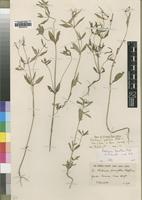
Isotype of Pentanisia parviflora Stapf ex Verdc. [family RUBIACEAE]
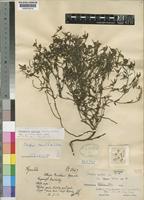
Holotype of Otiophora parviflora Verdc. var. stolzii Verdc. [family RUBIACEAE]
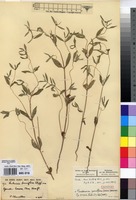
Isotype of Pentanisia parviflora Stapf ex Verdc. [family RUBIACEAE]
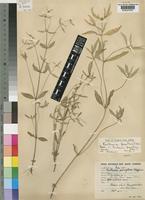
Paraknoxia parviflora (Stapf ex Verdc.) Verdc. ex Bremek. [family RUBIACEAE]
Previous
Next

Name

Identification
Isotype of Pentanisia parviflora Stapf ex Verdc. [family RUBIACEAE ] (stored under name);
Related name
  • Pentanisia parviflora
  • Paraknoxia parviflora

Flora

Entry for PARAKNOXIA parviflora (Verdc.) Bremek. [family RUBIACEAE]
Herbarium
Royal Botanic Gardens, Kew (K)
Collection
Flora of Tropical East Africa
Resource Type
Reference Sources
Entry From
Flora of Tropical East Africa, page 1, (1976) Author: B. VERDCOURT
Names
PARAKNOXIA parviflora (Verdc.) Bremek. [family RUBIACEAE], in K.B. 8: 439 (1953); U.K.W.F.: 405, fig. (1974). Type: Uganda, Teso District, Serere, Chandler 672 (EA, holo.!, BM, K, iso.!)
Pentanisia parviflora Verdc. [family RUBIACEAE], in K.B. 6: 383 (Jan. 1952) & in B.J.B.B. 22: 263, fig. 31/H, I (1952)
Paraknoxia ruziziensis Bremek. [family RUBIACEAE], in B.J.B.B. 22: 77 (June 1952). Type: Zaire, Ruzizi plain, Germain 6684 (BR, holo.!, EA, iso.)
Paraknoxia parviflora (Verdc.) Verdc. [family RUBIACEAE], in B.J.B.B. 22: 265 (1952) (nomen eventuale)
Information
Erect herb 4–38 cm. tall; stems slender, often branched, hairy. Leaf-blades narrowly elliptic, lanceolate, linear or linear-oblanceolate or ovate-elliptic, 1.3–4.2 cm. long, 0.2–1(–1.7) cm. wide, ± acute at the apex, cuneate at the base, covered with short hairs; petioles up to 3 mm. long; stipules with ± 3–7 deltoid segments 1–2 mm. long from a pale chestnut-coloured base 1–1.5 mm. long. Inflorescences ± 2–4 mm. wide, supported by the apical leaf pair; there are usually 2 axillary flowering branchlets which overtop the true terminal one. Calyx-tube 1 mm. long, covered with small scaly hairs; foliaceous lobe 0.8 mm. long, 0.5 mm. wide or absent, the others very minute, crowned with hairs. Corolla white or tinged bluish mauve; tube ± 1.75–4 mm. long, dilated in long-styled flowers to 1–1.5 mm. wide for the apical third, glabrous outside; lobes ± 1.3–1.5 mm. long, 0.4–0.9 mm. wide, hairy outside. Style 3.3 mm. long in long-styled flowers, tomentose; stigma-lobes 0.6–0.8 mm. long, papillate. Fruit 1.3–1.75 mm. long, 1.25 mm. wide, somewhat acute at the apex, densely covered with scaly hairs. Seeds chestnut-coloured, 0.8–0.9 mm. long. Fig. 17, p. 165.
Range
DISTR. U2–4; K3, 5; T1, 4, 7, 8
Altitude range
840–2280 m.
Distribution
KENYA Trans-Nzoia District ENE. slope of Mt. Elgon, 23 Sept. 1962, Lewis 5967! & Kitale Grassland Research Station, 2 Oct. 1959, Verdcourt 2454!KENYA N. Kavirondo District Kitosh area, 25 July 1951, Greenway & Doughty 8523!TANZANIA Mbeya District 261 km. S. of Iringa, between Igawa and Chimala on Great North Road, 2 Apr. 1962, Polhill & Paulo 1986!TANZANIA Iringa, just E. of College of National Education, 30 Mar. 1972, Pedersen 893!TANZANIA Songea District about 5 km. E. of Songea, Unangwa Hill, 22 Mar. 1956, Milne-Redhead & Taylor 9281!UGANDA Teso District Serere, Dec. 1931, Chandler 61! & same locality, July 1926, Maitland 1310!UGANDA Mengo District Kipayo Estate, Dec. 1913, Dummer 557!
Distribution (external)
Central African Republic
Zaire
Malawi
Rhodesia
Angola
Notes
Chandler 794 (Uganda, Teso District, Serere, July 1931) is a remarkably robust form with stouter stems and very much wider leaf-blades up to 4 × 1.7 cm.

Related Materials

  • Terms and Conditions
  • Privacy Policy
  • Cookie Policy
  • Cookie Settings
  • Accessibility
  • Help
  • Contact Us
  • Facebook
  • Twitter
ITHAKA

JSTOR is part of ITHAKA, a not-for-profit organization helping the academic community use digital technologies to preserve the scholarly record and to advance research and teaching in sustainable ways.

©2000-2026 ITHAKA. All Rights Reserved. JSTOR®, the JSTOR logo, JPASS®, Aluka®, and ITHAKA® are registered trademarks of ITHAKA.

╳