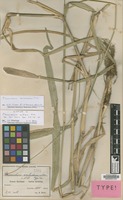
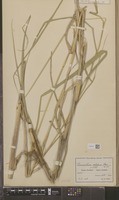
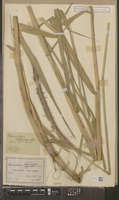
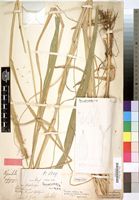
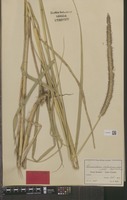
Perennial; rhizome stout, at first clothed with striate glabrous cataphylls, at length naked. Culms erect or nearly so, up to 7 ft. or more high, stout and up to 3 1/2 lin. in diameter at the base, terete, whitish, up to 10-noded, branched, appressedly silky-pilose at the nodes, scaberulous and finely striate below the middle and upper nodes and towards the inflorescence, otherwise glabrous and smooth. Leaf-sheaths loose, mostly longer than the internodes, ciliate on the margins near the bearded mouth or glabrescent, the lower up to 10 in. long, spongy, smooth, finely nerved with cross veins, at length breaking up and exposing the culms, the upper finely and closely striate, smooth or the uppermost minutely scaberulous; ligule reduced to a densely ciliate rim with long silky hairs; blade linear-lanceolate, gradually tapering to an acute tip, up to 2 ft. long and 10 lin. wide, flat, firm, green below, glaucous-green above, glabrous or with a few long white hairs above, scaberulous, midrib prominent on the lower surface towards the sheath, slightly depressed on the upper, lateral nerves very slender, up to 5 on each side of the midrib. False spike cylindric, dense, about 8 1/2 in. long, 4 1/2–5 1/2 lin. wide (exclusive of the bristles), purplish or pale green; rhachis finely ribbed, very minutely pubescent, closely beset with the minute hispidulous stumps of the deciduous involucres; involucres sessile, spreading; bristles 16–30 to each involucre, very slender, free to the base, scaberulous, of unequal length, one stouter than the others and up to 7 lin. long, the remainder varying in length and up to 4 1/2 lin. long. Spikelets solitary, sessile within the involucre, lanceolate to lanceolate-oblong, acute, 2–2 1/4 lin. long, glabrous. Glumes lanceolate to ovate, acute, 1-nerved, thinly membranous; lower mucronulate, up to 1 lin. long; upper mucronate, up to 1 1/4 lin. long (including the mucro). Lower floret ♂ or barren and reduced to the valve: valve when flattened ovate-elliptic to ovate-oblong, acute, 1 3/4–2 lin. long, membranous, 5-nerved, minutely scaberulous upwards; valvule suppressed or more often present and lanceolate-oblong, deeply 2-fid, as long as the valve or shorter, keels scaberulous. Upper floret hermaphrodite, lanceolate, acute: valve when flattened broadly elliptic-ovate, acute, mucronulate, as long as the spikelet, membranous, 5-nerved, minutely scaberulous above the middle; valvule slightly shorter than the valve. Lodicules minute. Anthers 1 lin. long, with glabrous tips. Styles connate.