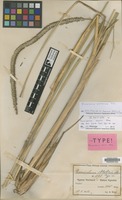
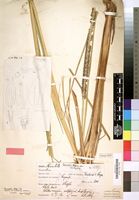
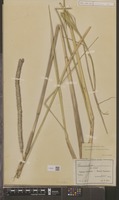
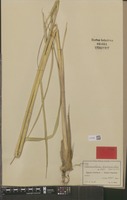
A robust cæspitose perennial, up to 5 ft. or more high; innovation buds extravaginal, clothed with glabrous coriaceous cataphylls. Culms erect, stout, terete, simple, several-noded, densely villous for some distance below the inflorescence with long soft white hairs, otherwise glabrous and smooth. Leaf-sheaths longer than the internodes, terete, prominently striate, the basal persistent, up to 1 ft. long, coriaceous, smooth and shining towards the base, hispid upwards with deciduous tubercle-based hairs, at length glabrescent, the intermediate tuberculate upwards, the upper glabrous and smooth; ligule reduced to a densely ciliolate rim; blade linear, tapering to a rigid callose tip, up to 2 ft. or more long and 5 lin. wide, flat or convolute when dry, erect, rigid, green, densely villous with long hairs just behind the ligule, sparsely hairy, prominently nerved and asperulous on the upper surface, scabrid near the spinously scabrid margins on the glabrous lower surface. False spike dense, cylindric, up to 10 in. long and 5 lin. wide (exclusive of the bristles), variegated with purple and pale green; rhachis rather stout, densely hispidulous, finely ribbed, studded with the minute clustered hispidulous stumps of the deciduous involucres; involucres sessile, spreading; bristles up to 20 to each involucre, very slender, free to the base, scaberulous, purple, one stouter than the rest and up to 5 lin. long, the remainder varying in length and up to 2 1/2 lin. long. Spikelets solitary, sessile within the involucre, lanceolate-oblong or oblong, acute, 2–2 1/2 lin. long, glabrous. Glumes oblate, truncate, hyaline, nerveless; lower up to 1/5 lin. long; upper 1/4– 1/3 lin. long. Lower floret barren: valve when flattened broadly lanceolate, acute, mucronulate, as long as the spikelet or shorter and up to 1 3/4 lin. long, membranous, 5-nerved, minutely scaberulous towards the apex; palea suppressed. Upper floret hermaphrodite, oblong-lanceolate and acute: valve when flattened broadly ovate-oblong, acute, as long as the spikelet, mucronulate, membranous, 5-nerved, scaberulous on the nerves towards the apex; valvule lanceolate, nearly as long as the valve. Lodicules 1/5 lin. long. Anthers 1–1 1/2 lin. long, with glabrous tips. Styles free to the base.