JSTOR Global Plants Home
  • Home
  • Browse
  • About
  • Access
  • Account
    • Saved Items
    • Profile
  • Log in

Global Plants

Skip to Main Content
  • JSTOR Global Plants Home
  • Global Plants

    • Browse
    • About
    • Access
    • Account
      • Saved Items
      • Profile
Log in
  • Browse
  • About
  • Access
  • Account
    • Saved Items
    • Profile
Advanced Search

Compilation
Pennisetum macrostachyum

7 Images see all

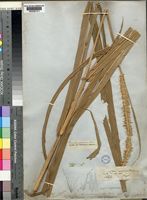
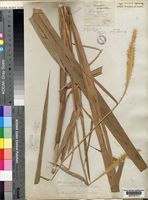
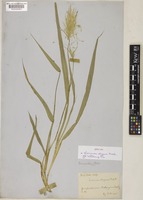
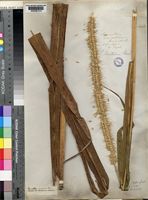
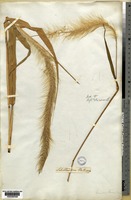
Syntype of Pennisetum macrostachyum Benth. [family POACEAE]
Holotype of Pennisetum rueppellii Steud. 1854 [family POACEAE]
Isotype of Sericura elegans Hassk. [family POACEAE]
Type of Pennisetum macrostachyum Fresen. [family POACEAE]
Type of Pennisetum macrostachyum (Brong.) Trin. [family POACEAE]
Syntype of Pennisetum macrostachyum Benth. [family POACEAE]
Previous
Next

Name

Identification
Pennisetum setaceum (Forssk.) Chiov. 1923 [family POACEAE ] (stored under name); Verified by Clayton, W.D., Pennisetum rueppellii Steud. 1854 [family POACEAE ] Verified by Not on sheet, Pennisetum macrostachyum Fresen. 1837 [family POACEAE ] Verified by Not on sheet,
Related name
  • Pennisetum purpureum
  • Pennisetum macrostachyum
  • Pennisetum setaceum
  • Pennisetum rueppellii
  • Pennisetum ruppellii

Flora

Entry for PENNISETUM setaceum (Forssk.) Chiov. [family POACEAE]
Herbarium
Royal Botanic Gardens, Kew (K)
Collection
Flora of Tropical East Africa
Resource Type
Reference Sources
Entry From
Flora of Tropical East Africa, page 451, (1982) Author: W. D. CLAYTON and S.A. RENVOIZE
Names
PENNISETUM setaceum (Forssk.) Chiov. [family POACEAE], in Bull. Soc. Bot. Ital. 1923: 113 (1923); F.T.A. 9: 1013 (1934); F.P.S. 3: 514 (1956); R.K.G.: 52 (1958); I.G.U.: 47 (1960); G.T.: 90 (1965); Clayton in F.W.T.A., ed. 2, 3: 461 (1972). Type: Egypt, Cairo, Forsskål (whereabouts uncertain, not C)
Phalaris setacea Forssk. [family POACEAE], Fl. Aegypt.-Arab.: 17 (1775)
Pennisetum phalaroides Schult. [family POACEAE], Syst. Veg. Mant. 2: 147 (1824), nom. superfl. Based on Phalaris setacea Forssk.
Pennisetum macrostachyum Fresen. [family POACEAE], in Mus. Senckenb. 2: 135 (1837), non (Brongn.) Trin. (1834). Type: Ethiopia, Halei to Temben, Ruppell (FR, holo.!)
Pennisetum spectabile Fig. & De Not. [family POACEAE], in Mem. Accad. Sci. Torino, Ser. 2, 12: 248 (1852). Type: Egypt, St. Catherina, Figari (whereabouts uncertain, not FI)
Pennisetum ruppellii Steud. [family POACEAE], Syn. Pl. Glum. 1: 107 (1854). Based on P. macrostachyum Fresen.
Pennisetum ruppellii Schweinf. var. depauperatum [family POACEAE], in Bull. Herb. Boiss. 2, App. 2: 96 (1894). Type: Ethiopia, Eritrea, Mahio, Schweinfurth 25 (Z, holo.!)
Pennisetum orientale Chiov. var. altissimum [family POACEAE], in Ann. 1st. Bot. Roma. 7: 66 (1897). Type: Ethiopia, Goelleb, Schimper 2130 (K, iso.!)
Pennisetum scoparium Chiov. [family POACEAE], in Ann. 1st. Bot. Roma 8: 38, fig. 3 (1903). Types: Ethiopia, Eritrea, Habab, Terracciano & Pappi 1597, 1601, 1602 & 1603 (all FI, syn.!)
Pennisetum erythraeum Chiov. [family POACEAE], in Ann. 1st. Bot. Roma 8: 39, fig. 4 (1903); F.T.A. 9: 1012 (1934); F.P.S. 3: 513 (1956). Type: Ethiopia, Eritrea, Assaorta, Terracciano & Pappi 3228 (FI, holo.!)
Pennisetum asperifolium [family POACEAE], [sensu auct. afr., non (Desf.) Kunth (1829), nom. superfl., based on Alopecurus hordeiformis L. (= Pennisetum alopecuroides (L.) Spreng.)]
Information
Densely tufted perennial; culms 20–130 cm. high. Leaf-blades up to 30 cm. long and 3 mm. wide, convolute with the midrib noticeably thickened on the upper surface, rigid, harsh, glaucous. Panicle linear, 6–30 cm. long; rhachis cylindrical with shallow angular ribs below the stumpless scars, glabrous to pilose; involucre borne upon a slender pubescent stipe 1–3 mm. long, enclosing 1–3 spikelets, one of them sessile the others shortly pedicelled; bristles, at least the inner, loosely plumose, the longest 16–40 mm. Spikelets lanceolate, 4.5–6.5 mm. long; lower glume occasionally ovate and up to 1/3 the length of the spikelet, usually shorter and subrotund, sometimes suppressed; upper glume 1/4–2/3 the length of the spikelet; lower lemma as long as the spikelet, ♂ or barren, acuminate; upper lemma similar to the lower; occasionally the. rhachilla prolonged beyond the upper lemma as a tiny bristle.
Range
DISTR. K1–4, 6, 7; T1, 2 Lebanon and Syria, through N. Africa, Arabia, Sudan, Ethiopia and Somalia; introduced to many warm countries as an ornamental
Altitude range
300–1600 m.
Distribution
KENYA Northern Frontier Province Dandu, 14 May 1952, Gillett 13190! & Latakwen, 8 Jan. 1959, Newbould 3486!KENYA W. Suk District Marich Pass, 12 Nov. 1953, Bogdan 3282!TANZANIA Maswa District Simba Kopjes, 8 Feb. 1968, Greenway, Kanuri, Lamprey & Braun 13152!TANZANIA Masai District W. side of Mt. Longido, 8 Jan. 1969, Richards 23661!TANZANIA Moshi District W. end of Lake Chala, 14 July 1968, Bigger 1991!
Notes
Very similar to the Middle Eastern species P. orientale Rich., which differs primarily in the absence of a thickened leaf-midrib, and also in the somewhat interrupted panicle with shorter bristles. It also closely resembles P. foemeranum Leeke from Namibia, which has shorter panicles and involucres (the longest bristle 7–15(–20) mm.). There is some resemblance to P. alopecuroides (L.) Spreng., but this Asiatic species grows in marshy ground and has glabrous involucral stipe and bristles.

Related Materials

  • Terms and Conditions
  • Privacy Policy
  • Cookie Policy
  • Cookie Settings
  • Accessibility
  • Help
  • Contact Us
  • Facebook
  • Twitter
ITHAKA

JSTOR is part of ITHAKA, a not-for-profit organization helping the academic community use digital technologies to preserve the scholarly record and to advance research and teaching in sustainable ways.

©2000-2026 ITHAKA. All Rights Reserved. JSTOR®, the JSTOR logo, JPASS®, Aluka®, and ITHAKA® are registered trademarks of ITHAKA.

╳