

Compilation
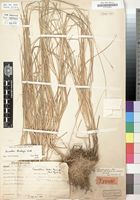
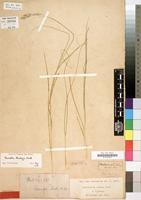
Pennisetum leekei
2 Images see all
Name
Identification
Pennisetum leekei Mez [family GRAMINEAE ] Verified by Not on sheet., Pennisetum thunbergii Kunth [family GRAMINEAE ] (stored under name); Verified by Not on sheet.,
Related name
- Pennisetum leekei
- Pennisetum thunbergii
Flora
Entry for PENNISETUM glabrum Steud. [family POACEAE]
Herbarium
Royal Botanic Gardens, Kew (K)
Collection
Flora of Tropical Africa
Resource Type
Reference Sources
Entry From
Flora of Tropical Africa, Vol 9, page 1, (1917) Author: (By O. STAPF.)
Names
PENNISETUM glabrum Steud. [family POACEAE], Syn. Pl. Glum. i. 104 (1854). —Schweinf. Beitr. Fl. Æthiop. 301; K. Schum. in Engl. Pflanzenw. Ost-Afr. C. 106; Chiov. in Ann. Istit. Bot. Roma, viii. 322; Leeke in Zeitschr. Naturwiss. lxxix. 38.
PENNISETUM depauperatum Schweinf. [family POACEAE], in Bull. Herb. Boiss. ii. App. 2, 26 (1894); Leeke in Zeitschr. Naturwiss. lxxix. 40.
PENNISETUM Schimperi A. Rich. var. pubiflora [family POACEAE], Tent. Fl. Abyss. ii. 381 (1851).
PENNISETUM Schimperi Durand & Schinz var. glabrum [family POACEAE], Consp. Fl. Afr. v. 784 (1894).
PENNISETUM Leekei Mez [family POACEAE], in Notizbl. Bot. Gart. Berlin, vii. 52 (1917).
PENNISETUM Leekei A. Peter var. leucostachys [family POACEAE], in Fedde, Repert. Beih. xl. Descr. 74 (1930); Fl. Deutsch-Ostafr. 247 (1931).
PENNISETUM Snowdenii C. E. Hubbard [family POACEAE], in Kew Bulletin, 1928, 133.
Gymnothrix glabra Hochst. [family ], in Flora, xxiv. i. Intell. 19 (1841), name only.
Panicum atrichum Steud. [family POACEAE], Nomencl. Bot. ed. 2, ii. 253 (1840), name only.
Information
Perennial from a moderately slender rhizome. Culms erect or geniculately ascending, 1/3–4 ft. high, compressed, slender, branched at the base or simple, up to 8-noded with the lower internodes short, minutely scaberulous below the inflorescence or quite glabrous and smooth. Leaf-sheaths compressed and keeled, glabrous or the lower loosely bearded at the mouth, smooth, the lower overlapping, the upper shorter than the internodes; ligule reduced to a densely ciliolate rim; blade linear, gradually passing into the sheath and tapering upwards to a subpungent tip, 1 1/2–12 in. long, folded or involute, up to 2 1/2 lin. wide when opened out, erect, rather rigid, glabrous or sparsely pilose towards the base, scaberulous near the apex or smooth. False spike cylindric, dense, flexuous or straight, pallid or purplish, 2/3–4 in. long, 2–3 1/2 lin. wide (exclusive of the bristles); rhachis finely ribbed, minutely hispidulous and scaberulous, closely studded with the minute clavate stumps of the deciduous involucres; involucres sessile, slightly spreading; bristles 5 to 10 to each involucre, very slender, scaberulous, of unequal length, free to the base, glabrous or rarely the inner with a few scattered hairs, pallid or purplish, one or two stouter than the rest and up to 7 lin. long, the remainder shorter and up to 4 lin. long. Spikelets usually solitary, sessile within the involucre, lanceolate or lanceolate-oblong, subobtuse and mucronate, 1 3/4–2 1/2 lin. long, glabrous. Lower glume absent, or oblong, truncate, 1/4– 1/2 lin. long, hyaline, nerveless; upper oblate or oblong, truncate, 1/3– 1/2 lin. long, hyaline, nerveless or 1-nerved. Lower floret barren and reduced to the valve: valve oblate or broadly elliptic or ovate at the base, usually with an acuminate-aristate tip from half as long to as long as the base, up to 1 3/4 lin. long, thinly membranous, minutely scaberulous at the tip, 1–3-nerved; valvule suppressed. Upper floret hermaphrodite, lanceolate or lanceolate-oblong, obtuse or subacute, mucronate: valve when flattened elliptic-oblong, obtuse or acute, as long as the spikelet, mucronate with the mucro up to 1/2 lin. long, membranous, minutely scaberulous towards the apex, 5-nerved; valvule lanceolate-oblong, obtuse, as long as the valve, membranous. Lodicules 0 or very minute. Anthers 1–1 1/4 lin. long, with glabrous or sparingly penicillate tips. Styles free or connate at the base. Grain oblong, dorsally compressed, about 3/4 lin. long.
Distribution
Tanganyika Mozamb. Dist. Pare District; Usangi, 4500 ft., Haarer, 859! 1254! Lukondo Valley, 6000 ft., Mildbraed, 698! Iringa Province; Njombe, Emson, 43! 93!Congo Mozamb. Dist. Mt. Sabinio-Mt. Mgahinga, in mountain meadows in bamboo woodland, 8300–8600 ft., Mildbraed, 1741!Eritrea Nile Land Amasen; Sala Dharo, 7600 ft., Pappi, 2294; Rassi, Pappi, 4990; Sarae; along the River Mareb, near Debarroa, 6300 ft., Pappi, 490; Adi Gana, 6300 ft., Pappi, 323; Adi Ugri, 6300 ft., Pappi, 38; Ocule Cusai; Saganeiti, Pappi, 2066; Soyra Mtns., Mt. Mamahot, towards the Arigot stream, 9300–10,000 ft., Pappi, 1158; Maragus: Adi Mabit, 5300 ft., Pappi, 944; Scimezana; Guna-Guna, 7300 ft., Pappi, 740.Abyssinia Nile Land Tigre; at the foot of Mt. Sholoda, near streams, Schimper, 11! Tigre or Begemeder, Schimper ! Begemeder; Guna Mtn., 9500 ft., Schimper ! Urahut, 9800 ft., Schimper, 1045! Lake Tana, Bahadur Gorges, in swampy ground, Grabham ! Addis Allem, 8000 ft., Cooper ! without precise locality, Schimper, 958!Uganda Nile Land Mt. Elgon, bamboo zone, in open places, 9000 ft., Dummer, 3600! Bulago, etc., in short grass-turf following cultivation, 6000–7000 ft., Snowden, 1181! Sipi, etc., 5500–7000 ft., Snowden, 1176! Ankole; Mitoma, in short grass-turf near roadsides, 5300 ft., Snowden, 1313! Kigezi; Mt. Mgahinga and near Mabungo, in short grass grazing-lands near bamboo woodland, also in plains in grassland, 7000–8000 ft., Snowden, 1492! Bufundi-Behungi road, also throughout Bufumbira County and Kabale, in short grass grazing-lands, 6000–8000 ft., Snowden, 1454! Bukunyi-Kigezi road, Liebenberg, 373!Kenya Nile Land Eldoret, swale in grassland, Hitchcock, 25026! without precise locality, Powell, 5!
Distribution (external)
Arabia (Yemen, Schweinfurth, 1471)
Notes
Vern. Names:— Paspas (Lugishu); Nabidulungu (Lugishu); Orutumbwe (Kigezi). Chiovenda in Ann. Istit. Bot. Roma, viii. 322 (1908), describes a var. filiformis, characterized by narrower spikes and dwarf habit (4–8 cm. high), based on specimens collected in Eritrea (Amasen; along the Mai Bela near Asmara, Pappi, 5061). This may be Pennisetum uliginosum, Hack. In Abh. Ges. Wiss. Göttingen, n.f. xiii. II. 46 (1928), A. Peter describes a new species, Pennisetum paucisetum from the South Pare Mountains in Tanganyika Territory. The brief description agrees very well with Pennisetum glabrum Steud. and it is probably synonymous with that species. Peter omits the new species from his “Flora von Deutsch-Ostafrika” (Fedde, Repert. Beih. xl.), but records P. Leekei, Mez (= P. glabrum Steud.) from the South Pare Mountains, possibly in place of P. paucisetum .