JSTOR Global Plants Home
  • Home
  • Browse
  • About
  • Access
  • Account
    • Saved Items
    • Profile
  • Log in

Global Plants

Skip to Main Content
  • JSTOR Global Plants Home
  • Global Plants

    • Browse
    • About
    • Access
    • Account
      • Saved Items
      • Profile
Log in
  • Browse
  • About
  • Access
  • Account
    • Saved Items
    • Profile
Advanced Search

Compilation
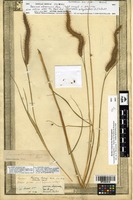
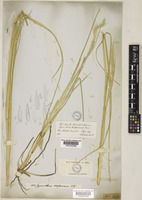
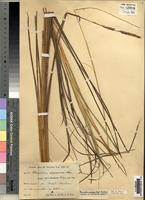
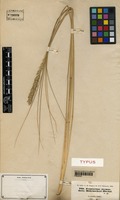
Pennisetum alopecuros

10 Images see all

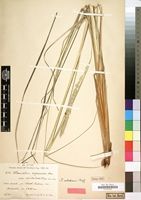
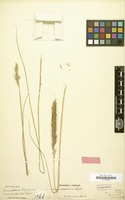
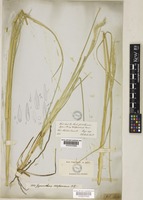
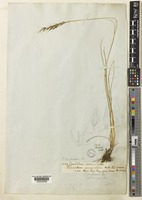
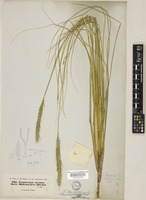
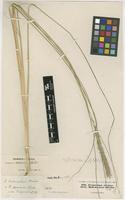
Isotype of Panicum alopecuros Lam. [family POACEAE]
Type of Pennisetum alopecuros Steud. [family POACEAE]
Isosyntype of Pennisetum alopecuros Steud. var. occidentale Pilger [family POACEAE]
Type of Pennisetum hohenackeri Hochst. [family POACEAE]
Type of Pennisetum alopecuros var. occidentalis Pilg. [family GRAMINEAE]
Type of Pennisetum alopecuros Nees ex Steud. non J.Jacq. [family GRAMINEAE]
Isotype of Pennisetum alopecuros Steud. [family POACEAE]
Type of Gymnotrix alopecuros Nees ex Steud. [family POACEAE]
Syntype of Pennisetum hohenackeri Hochst. ex Steud. [family POACEAE]
Type of Pennisetum hohenackeri Hochst. ex Steud. [family POACEAE]
Previous
Next

Name

Identification
Pennisetum alopecuros Not on sheet. [family GRAMINEAE ] Verified by Not on sheet., Pennisetum catabasis Stapf & C.E.Hubb. [family GRAMINEAE ] (stored under name); Verified by Not on sheet.,
Related name
  • Pennisetum catabasis
  • Pennisetum hohenackeri
  • Pennisetum alopecuros

Flora

Entry for PENNISETUM catabasis Stapf & C. E. Hubbard [family POACEAE]
Herbarium
Royal Botanic Gardens, Kew (K)
Collection
Flora of Tropical Africa
Resource Type
Reference Sources
Entry From
Flora of Tropical Africa, Vol 9, page 1, (1917) Author: (By O. STAPF.)
Names
PENNISETUM catabasis Stapf & C. E. Hubbard [family POACEAE], in Kew Bulletin, 1933, 281.
PENNISETUM alopecuros Pilger var. occidentale [family POACEAE], in Notizbl. Bot. Gart. Berlin, x. 271 (1928).
Information
A coarse perennial, forming large dense tussocks, with thick tough roots; innovations intravaginal. Culms erect or nearly so, 3–4 1/2 ft. high, stout, rigid and woody, compressed, usually branched upwards with the branches erect, rarely simple, scaberulous and sometimes pubescent below the inflorescence, otherwise glabrous and smooth, up to 9- or more-noded, with the lower internodes usually short. Leaf-sheaths very smooth, glabrous or usually loosely bearded at the mouth, the lower long, strongly compressed and keeled, closely imbricate and flabellate, broad, pallid or brownish, coriaceous with scarious margins, the upper narrower; ligule reduced to a densely ciliate rim; blade narrowly linear to linear, gradually passing into the sheath or narrower than it at the base, very gradually tapering upwards to an oblique subacute tip, up to 1 1/4 ft. or more long and 2 1/2 lin. wide, tightly folded or opening out, rather rigid, tough, glaucous or green, glabrous, prominently and closely nerved, scaberulous on the midrib and margins towards the apex. False spike cylindric, straight or flexuous, dense, 4–10 in. long, 3–5 1/2 lin. wide (exclusive of the bristles), pale green or tinged with purple; rhachis angular, scaberulous, loosely beset with the minute subcupular stumps of the deciduous involucres; involucres erect or slightly spreading, each with a very minute peduncle; bristles 12–20 to each involucre, very slender, scaberulous, of unequal length, free to the base, one stouter than the others and up to 10 lin. long, the remainder shorter. Spikelets solitary, sessile within the involucre, lanceolate, acute, 3 1/4–4 1/2 lin. long, pale green, glabrous. Lower glume oblate to ovate or oblong, obtuse or acute, 1/4–1 1/4 lin. long, hyaline, nerveless or 1-nerved; upper narrowly ovate to elliptic, obtuse, 1 1/2–2 1/4 lin. long, thinly membranous, 1–3-nerved. Lower floret barren: valve when flattened oblong to broadly ovate-oblong, obtuse, as long as the spikelet, firmly membranous, 7–11-nerved; valvule very much reduced and up to 3/4 lin. long, or more often absent. Upper floret hermaphrodite, lanceolate, acute: valve when flattened oblong to ovate-oblong and subacute or obtuse, as long as the spikelet, firmly membranous, 5–7-nerved; valvule lanceolate, acute, nearly as long as the valve. Lodicules minute. Anthers 2–2 1/2 lin. long, with acute penicillate tips. Styles connate or free towards the apex.
Distribution
Uganda Nile Land on the banks of the Asua River, between Lira and Kitgum, 3400 ft., Liebenberg, 26!Kenya Nile Land near Forest Station, in tussock grassland, 7300 ft., Fries, 655! Nakuru, 6300 ft., Taylor, 1296! low land near the lake, Hitchcock, 25096! Kinangop, in shallow black soil, 7000 ft., Edwards, 1457! Turner, 1574A! by the Gilgil River, 7000 ft., Dowson ! Scott Elliot, 6662! Nairobi, cultivated at the Scott Agricultural Laboratories, 5500 ft., McDonald, 931! Lyne Watt, 12! between Nairobi and Nanyuki, in grassland, Hitchcock, 24750! Kabete, 6200 ft., Walker, 35! Sotik, common tussock-grass in patches in park country, 6000 ft., McDonald, 1081! without precise locality, Powell, 9!
Notes
Very closely allied to the Indian Pennisetum Hohenackeri, Hochst. ex Steud. (P. Alopecuros, Steud. non Jacq.), which is a slightly shorter plant with usually simple culms and the tips of the anthers acuminate and glabrous. Vern. Name:— Kikutu (Kikuyu).

Related Materials

  • Terms and Conditions
  • Privacy Policy
  • Cookie Policy
  • Cookie Settings
  • Accessibility
  • Help
  • Contact Us
  • Facebook
  • Twitter
ITHAKA

JSTOR is part of ITHAKA, a not-for-profit organization helping the academic community use digital technologies to preserve the scholarly record and to advance research and teaching in sustainable ways.

©2000-2026 ITHAKA. All Rights Reserved. JSTOR®, the JSTOR logo, JPASS®, Aluka®, and ITHAKA® are registered trademarks of ITHAKA.

╳