JSTOR Global Plants Home
  • Home
  • Browse
  • About
  • Access
  • Account
    • Saved Items
    • Profile
  • Log in

Global Plants

Skip to Main Content
  • JSTOR Global Plants Home
  • Global Plants

    • Browse
    • About
    • Access
    • Account
      • Saved Items
      • Profile
Log in
  • Browse
  • About
  • Access
  • Account
    • Saved Items
    • Profile
Advanced Search

Compilation
Pectinaria arcuata

4 Images see all

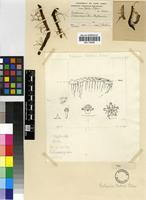
Holotype of Ophionella arcuata (N.E.Br.) Bruyns subsp. mirkinii (Pillans) Bruyns [family APOCYNACEAE]
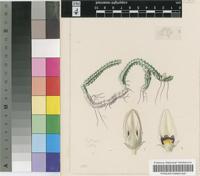
Pectinaria arcuata N.E.Br.
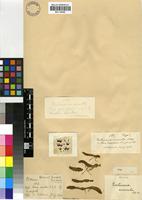
Type of Ophionella arcuata (N.E.Br.) Bruyns subsp. arcuata [family APOCYNACEAE]
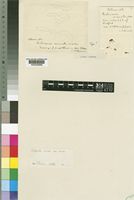
Type of Pectinaria arcuata N.E.Br. [family ASCLEPIADACEAE]
Previous
Next

Name

Identification
Pectinaria arcuata N.E.Br. [family APOCYNACEAE ]
Related name
  • Pectinaria arcuata

Flora

Entry for PECTINARIA arcuata N. E. Br. [family ]
Herbarium
Royal Botanic Gardens, Kew (K)
Collection
Flora Capensis
Resource Type
Reference Sources
Entry From
Flora Capensis, Vol 4, page 518, (1909) Author: By N. E. BROWN.
Names
PECTINARIA arcuata N. E. Br. [family ]
Information
stems 2–4 (or more) in. long, 3–5 lin. thick, arching-procumbent and then diving underground, sometimes rising again to the surface, but always finishing their growth underground, forming loops 1/2–1 in. high, very obtusely and somewhat obscurely 4-angled, with slightly flattened sides, somewhat tessellately tuberculate along the angles, with the tubercles varying from scarcely prominent to 3/4 lin. long, apiculate, glabrous, green, not glaucous, flowering along the sides or under the loops; flowers 1–3 in a fascicle; pedicels 1–1 1/2 lin. long, glabrous, green; sepals 1 lin. long, ovate, subulate-acuminate, recurved at the tips, glabrous; corolla in general outline acuminate from a short ovoid base, glabrous and smooth outside and within; tube 1 1/2 lin. long, cup-shaped or subhemispheric, straw-coloured or pale yellowish outside, dark purple within, the dark colour divided to half-way down into 5 ovate lobes or rounded crenations extending up the base of the lobes; lobes 3 1/2 lin. long, 1–1 1/4 lin. broad at the base, thence gradually tapering to the acute connate tips, not recurved at the margins, but separating so as to form narrow lanceolate openings between them, pinkish or pale purple-tinted on the back, creamy-white, spotted with purple at the tips on the inner face, not ciliate; outer and inner corona-lobes apparently in one series, bright yellow, with the 5 lobes alternating with the anthers (outer corona) minute, scarcely 1/4 lin. long, deltoid, acute, ascending-spreading, the other 5 (inner corona) 1/2 lin. long, more than 1/4 lin. broad and almost as thick, erect, subclavate-oblong, very obtuse or subtruncate, scarcely exceeding the level of the anthers, with their rounded backs projecting like 5 stout ribs beyond the outer lobes. null
Distribution
COAST REGION Bedford Div.; found under a bush about 9 miles south-south-east of Bedford, very rare, Pillans, 182!
Notes
The habit of this plant is extraordinary; several of the Stapelieæ produce underground shoots, but no other is known which seems to invariably finish the growth of its aerial shoots underground, as Mr. Pillans informs me (and as is the case in the cultivated plant seen) this one always does.

Related Materials

  • Terms and Conditions
  • Privacy Policy
  • Cookie Policy
  • Cookie Settings
  • Accessibility
  • Help
  • Contact Us
  • Facebook
  • Twitter
ITHAKA

JSTOR is part of ITHAKA, a not-for-profit organization helping the academic community use digital technologies to preserve the scholarly record and to advance research and teaching in sustainable ways.

©2000-2026 ITHAKA. All Rights Reserved. JSTOR®, the JSTOR logo, JPASS®, Aluka®, and ITHAKA® are registered trademarks of ITHAKA.

╳