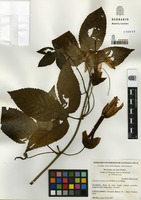
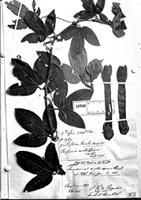
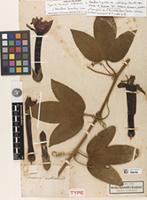
Climber to 20 m., perennial, subglabrous to densely pubescent throughout; stem terete, finely striate. Leaf-blades 3-lobed, the depth varying from about half-way to ± six-sevenths, in outline suborbicular, 5–11 by 6–13 cm., base truncate to cordate, 3(–5)-nerved from the base, membranous to thinly coriaceous, glabrous or subglabrous above, pubescent to various degrees beneath; lobes elliptic to lanceolate, 2.5–6 cm., top acute or up to 1.5 cm. acuminate; margin glandular serrate-dentate up to 2 mm.; petiole 0.7–2.5(–5) cm. Glands on petiole absent or mostly 2–5 pairs, minute, sessile or subsessile; blade-glands, except marginal glands and sometimes a small gland in the lobe-sinuses, absent. Stipules subcircular or obliquely reniform, either ± 2 mm. or ± 0.5(–0.9) cm. in diameter, finely glandular dentate, if small caducous. Inflorescences 1-flowered, the peduncle 1.5–5 cm., inserted beside a simple tendril 5–18 cm.; bracts and bracteoles 2–4 cm., acute-acuminate, connate for half-way to up to ± three-fourths, forming a tubiform involucre. Flowers 5–10 cm. in diameter, pinkish or pinkish red to pinkish orange. Hypanthium tubiform, (5–)6–9 by 0.5–1.5 cm.; sepals oblong, 2–5.5 cm., subobtuse, mucronate below apex. Petals oblong, 2–5 cm., obtuse. Corona a low lobulate edge at the throat of the hypanthium; operculum an inward curved membrane, at the base of the hypanthium. Androgynophore 6–10 cm.; filaments 10–15 mm., dilated; anthers 7–13 mm. Ovary oblong, 10–12 mm., pubescent; styles 10–15 mm. Fruit rather dry, ± ellipsoid, excluding the long gynophore 6–12 cm. long, softly pubescent, yellowish. Seeds many, ellipsoid, ± 6 mm.