

Compilation
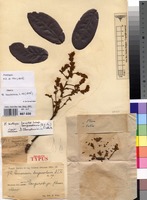
Parinari bangweolensis
1 Images see all
Name
Identification
Parinari bangweolensis R.E.Fr. [family CHRYSOBALANACEAE ] Verified by Not on sheet, Magnistipula butayei De Wild. [family CHRYSOBALANACEAE ] (stored under name); Verified by Champluvier D.,
Related name
- Magnistipula butayei
- Parinari bangweolensis
Flora
Entry for MAGNISTIPULA bangweolensis (R. E. Fries) R. Grah. [family CHRYSOBALANACEAE]
Herbarium
Royal Botanic Gardens, Kew (K)
Collection
Flora of Tropical East Africa
Resource Type
Reference Sources
Entry From
Flora of Tropical East Africa, page 1, (1960) Author: R. A. GRAHAM
Names
MAGNISTIPULA bangweolensis (R. E. Fries) R. Grah. [family CHRYSOBALANACEAE], in K.B. 1957: 230 (1957). Types: Northern Rhodesia, near Lake Bangweulu, Kawendimusi, Fries 780 (S, syn.) & Kamindas, Fries 780A (S, syn.) & R. Mano, Fries 732 (S, syn., K, isosyn.!)
Parinari bangweolensis R. E. Fries [family CHRYSOBALANACEAE], in F.R. 12: 540 (1913)
Hirtella bangweolensis (R. E. Fries) Greenway [family CHRYSOBALANACEAE], in K.B. 1928: 199 (1928); F.C.B. 3: 40 (1952)
Information
A large tree up to about 18 m. tall (sometimes more), with grey-brown coarsely reticulate bark and a dense rounded crown. Young branches velutinous with olive-golden hairs, later glabrescent and grey. Leaves broadly oblong-elliptic to obovate, up to 9.5–15 × 4.5–8.7 cm., rounded (sometimes emarginate) to shortly and obtusely acuminate, basally cordate, shining, brown and glabrous above except for the pubescent midrib, matt, yellow-green and pubescent beneath except when fully mature and then glabrous on the lamina; primary nerves very prominent beneath. Inflorescence paniculate, terminal or axillary, the racemes 4–6 cm. long, ± ascending; bracts linear-lanceolate, with the pedicels and calyx densely velutinous with olive-golden hairs. Calyx-tube ± 5 mm. long; the lobes ovate-deltoid to lanceolate. Petals white, oblong-elliptic, 5–5.5 mm. long. Fertile stamens 7–8, about 4 mm. long; filaments ± unevenly connate towards the base; anthers yellow; staminodes (1.0–)1.5–2.0 mm. long, irregularly connate in the lower half. Ovary sessile or nearly so, inserted dorsally near the receptacle-rim. Drupe velutinous, elliptic, 3.5 × 2 cm., very obtuse, slightly oblique-sided, olive-black. Fig. 8/1–4.
Range
DISTR. T4, 7
Altitude range
480–1500 m.
Distribution
TANGANYIKA Buha District Nyamgalika, Aug. 1950, Bullock 3199!;TANGANYIKA Mpanda District Kabungu, July 1948, Semsei 120!;TANGANYIKA Mbeya District Mbozi, Sept. 1932, Jessel 34!
Distribution (external)
; Northern Rhodesia
Nyasaland
Notes
It is possible that the relationship of M. bangweolensis to M. butayei De Wild. is closer than has been supposed. The characters for distinction are apparently not wholly reliable though the leaves of the latter (though not in its var. greenwayii) appear always to have a glabrous midrib on the undersurface. The differences in the number of staminodes, as given in various works, and in other flower characters do not hold strongly, and it is doubtful whether any such character can be reliably used for purposes of distinction. Apart from rather extreme material (which gives adequate distinction in leaf-shape), there is reason to suggest that both species should be more properly regarded in subspecific relationship to each other, but material to hand is as yet hardly adequate for a decisive treatment. Bullock 3253 (from Tanganyika, Kigoma District, 65 km. S. of Uvinza) has narrower leaves than the bulk of material of M. bangweolensis that has been examined, and its panicle is rather more open than is apparently normal for this species, but the leaves are pubescent below (though largely on the midrib), and on this character it is here left as M. bangweolensis. The genus requires investigation on a monographic basis.