JSTOR Global Plants Home
  • Home
  • Browse
  • About
  • Access
  • Account
    • Saved Items
    • Profile
  • Log in

Global Plants

Skip to Main Content
  • JSTOR Global Plants Home
  • Global Plants

    • Browse
    • About
    • Access
    • Account
      • Saved Items
      • Profile
Log in
  • Browse
  • About
  • Access
  • Account
    • Saved Items
    • Profile
Advanced Search

Compilation
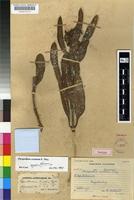
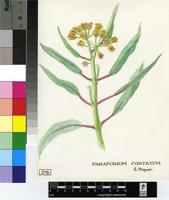
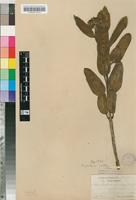
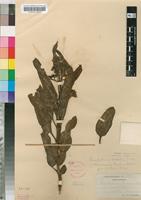
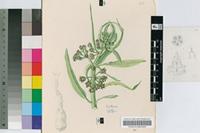
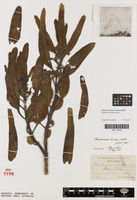
Parapodium costatum

7 Images see all

Cryptolepis oblongifolia (Meisn.) Schltr. [family ASCLEPIADACEAE]
Isotype of Parapodium costatum E.Mey. [family APOCYNACEAE]
Parapodium costatum E.Mey.
Isotype of Rhombonema luridum Schltr. [family APOCYNACEAE]
Parapodium costatum E.Mey.
Isotype of Rhombonema luridum Schltr. [family APOCYNACEAE]
Previous
Next

Name

Identification
Parapodium costatum E.Mey. [family APOCYNACEAE ]
Related name
  • Parapodium costatum

Flora

Entry for PARAPODIUM costatum E. Meyer [family ASCLEPIADACEAE]
Herbarium
Royal Botanic Gardens, Kew (K)
Collection
Flora Capensis
Resource Type
Reference Sources
Entry From
Flora Capensis, Vol 4, page 518, (1909) Author: By N. E. BROWN.
Names
PARAPODIUM costatum E. Meyer [family ASCLEPIADACEAE], Comm. 222;—Harv. Gen. S. Afr. Pl. ed. 1, 227; Decne in DC. Prodr. viii. 512; N. E. Br. in Hook. Ic. Pl. xxviii., in note under t. 2744; Rand in Journ. Bot. 1903, 336.
Metastelma costatum Dietr. [family ASCLEPIADACEAE], Syn. Pl. ii. 908.
Rhombonema luridum Schlechter [family ASCLEPIADACEAE], in Engl. Jahrb. xx. Beibl. 51, 41, and Journ. Bot. 1896, 418.
Information
stem 3–11 in. high, erect, simple, stout, bifariously puberulous, at least on the upper part; leaves in 6–8 pairs, coriaceous, very slightly fleshy, thick and rigid when dry; petiole 1/2–1 1/2 in. long, spreading or upcurved, stout, flattened and puberulous above; blade 2–5 1/2 in. long, 1/2–1 1/4 in. broad, ascending, sometimes almost making a bend at its junction with the petiole, elongated-oblong or lanceolate, acute or obtuse and apiculate at the apex, rounded or broadly cuneate at the base, flat or very slightly undulated, but not at all crisped on the margins, glabrous or slightly puberulous on the very stout midrib beneath; umbels 3–5, lateral at the nodes, pedunculate, 3–7-flowered; peduncles 2 1/2–8 lin. long, puberulous on one side; bracts 1 1/4–3 lin. long, linear-subulate or lanceolate, slightly pubescent; pedicels 3–5 lin. long, glabrous or puberulous; sepals ascending and nearly equalling the corolla, 3 1/2–4 1/2 lin. long, 3/4–1 1/3 lin. broad, lanceolate, acuminate, slightly pubescent or almost glabrous on the back; corolla subglobose or globose-campanulate, about 5 lin. in diam., obtusely 5-angled, lobed to 2/3 of the way down, glabrous, dull purple-brown or violaceous outside, dull green within; tube 1 1/2 lin. long, subhemispherical; lobes 3–4 lin. long, 1 1/2–1 3/4 lin. broad, oblong-lanceolate, subacaute, erect, closely contiguous and concave at the lower part, recurved or revolute and convex at the tips; corona-lobes fleshy, 1 1/4–1 1/3 lin. long, 1 1/2–2 lin. broad, broadly cuneate, truncate or rounded at the apex, adnate to the corolla up to the sinuses, spreading, closely contiguous, forming a short pentagonal truncate cup, with 5 rather stout keels, formed by the inflexed contiguous margins of the lobes composing it, white; in some flowers, between the subcontiguous margins of each pair of lobes, is an exceedingly narrow lobule channelled down its middle and also adnate to the corolla-tube; staminal column 2–2 1/4 lin. long, conical; anther-appendages 1 lin. long, ovate, oblong or more or less pandurate, acute or subobtuse, erect and applied to the sides of the stout conical style-apex; anther-wings somewhat hatchet-shaped, about half as broad just below the apex as they are at the hooked angular base, rounded on their outer margin; style-apex projecting 1/3–1 lin. beyond the anther-appendages, shortly bifid; follicles not seen. null
Distribution
CENTRAL REGION Aliwal North Div.; on the Wittebergen Range, Drège!KALAHARI REGION Orange River Colony; Rhenoster River, Burke! Transvaal; near Lydenburg, Wilms, 952! Vereeniging, 4750 ft., Gilfillan in Herb. Galpin, 6149! foot of the Magaliesberg Range, Schlechter, 3610! Modder-fontein, Conrath, 980! Veld north of Johannesburg, Rand, 965! near Pietersburg, Bolus, 11124! and without precise locality, Zeyher, 1163!
Notes
Partly described from fresh flowers in fluid. As stated by Schlechter in Engler's Jahrb. xxi. Beibl. 54, 3, the specimen in E. Meyer's Herbarium named Parapodium costatum, by E. Meyer himself, is a piece of Xysmalobium orbiculare. But it is evident that some error has been made in placing the label bearing that name (Drège, 3421) with that specimen, because E. Meyer's manuscript description of Parapodium placed with it, describes a totally different floral structure, and his dissected flower, which is also on the same sheet, agrees with his description and with the flowers of the plant I have above described as P. costatum. Specimens of it, collected by Drège, have been erroneously distributed as Pachycarpus rigidus, E. Meyer, so that great confusion seems to have been made in the distribution of these three species.

Related Materials

  • Terms and Conditions
  • Privacy Policy
  • Cookie Policy
  • Cookie Settings
  • Accessibility
  • Help
  • Contact Us
  • Facebook
  • Twitter
ITHAKA

JSTOR is part of ITHAKA, a not-for-profit organization helping the academic community use digital technologies to preserve the scholarly record and to advance research and teaching in sustainable ways.

©2000-2026 ITHAKA. All Rights Reserved. JSTOR®, the JSTOR logo, JPASS®, Aluka®, and ITHAKA® are registered trademarks of ITHAKA.

╳