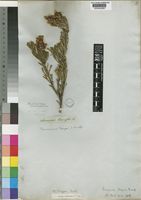
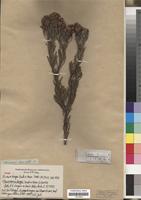
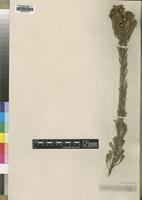
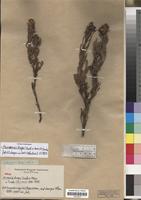
branches puberulous, at length becoming glabrous or nearly so; leaves all of one kind and divided, or if a few of the upper entire then they are linear, up to 3 in. long, pinnately divided in the upper half or in some specimens only 2–3-lobed, erect, coriaceous, glabrous except when young and then tomentose, the segments in the more divided leaves linear, obtuse, those of the less divided a little broader, all concave on the upper surface; heads 4-flowered, spicate; spikes sessile or subsessile, terminal, solitary or geminate, about 1 1/4 in. long, nearly 1 in. in diam., subcylindric; flowering axis tomentose, bearing ovate acuminate rigidly coriaceous shortly pubescent bracts about 3 lin. long and 2 lin. broad; floral bracts 4, imbricate, the outer 2 larger than the inner, up to 5 lin. long and 2 3/4 lin. broad, oblong, rounded at the apex, rigidly coriaceous, shortly woolly-tomentose outside, glabrous within; flowers surrounded at the base by numerous long hairs; perianth-tube 1 1/2 lin. long, nearly glabrous; segments about 7 lin. long; claws slightly recurved in the open flower, shortly tomentose; limb 1 1/2 lin. long, narrowly oblong-lanceolate, subacute, shortly and densely villous; hypogynous scales 1–1 1/2 lin. long, linear-filiform; ovary surrounded by a ring of long white hairs, puberulous; style 7 lin. long, rather slender, glabrous, gradually passing into the stigma which is 1 1/4 lin. long, cylindric, grooved; fruits 2 3/4 lin. long, ovoid-ellipsoid, tipped by a persistent portion of the style, brightly shining, surrounded by a ring of white hairs. null