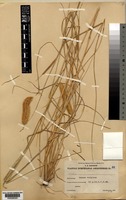
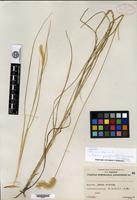
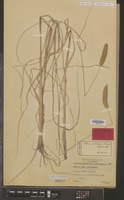
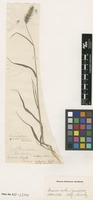
perennial; culms ascending from a branched, geniculate and often decumbent, many-noded base, 1 1/2–2 ft. long, smooth, glabrous, or scantily hairy, upper internodes more or less exserted, the uppermost much so, and very slender; leaves quite glabrous or sometimes with scattered fine stiff hairs; sheaths tight, the lower persistent, or at length decaying, leaving the internodes naked; ligule a very narrow densely ciliate rim; blades linear, long tapering to a setaceous point, 3–8 in. by 1 1/2–3 lin., usually flat, often flaccid, usually scaberulous above or along the margins; panicle spike-like, cylindric, dense, 1–4 in. by 4–6 lin., pallid or purplish, often flexuous; rhachis finely scaberulous like the very short pedicels; involucres of very numerous bristles, outer bristles fine scabrid, shorter or slightly longer than the spikelets, inner thickened towards the base, ciliate, much longer (about 1/2 in. long), one usually conspicuously exceeding all the rest; spikelets 3–1 within each involucre, lanceolate-oblong, 2–2 1/2 lin. long, pallid, glabrous; glumes hyaline, ovate, acute or acuminate, usually 1-nerved, upper about 1 lin. long, lower shorter sometimes nerveless; florets equal or subequal, lower ♂ or barren very rarely hermaphrodite; valves ovate-oblong, abruptly mucronate-acuminate, 5-nerved; pales subequal, truncate; lodicules 0; anthers slightly over 1 lin. long, tips acute, naked; styles free nearly from the base. null