JSTOR Global Plants Home
  • Home
  • Browse
  • About
  • Access
  • Account
    • Saved Items
    • Profile
  • Log in

Global Plants

Skip to Main Content
  • JSTOR Global Plants Home
  • Global Plants

    • Browse
    • About
    • Access
    • Account
      • Saved Items
      • Profile
Log in
  • Browse
  • About
  • Access
  • Account
    • Saved Items
    • Profile
Advanced Search

Compilation
Panicum tylanthum

3 Images see all

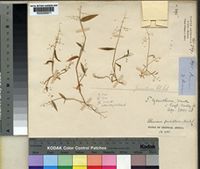
Isotype of Panicum tylanthum Hack. [family POACEAE]
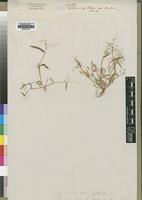
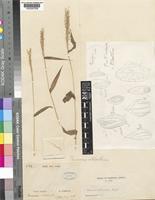
Type of Panicum sublaetum Stapf [family POACEAE]
Previous
Next

Name

Identification
Isotype of Panicum tylanthum Hack. [family POACEAE ] Panicum pusillum Hook.f. [family POACEAE ] (stored under name);
Related name
  • Panicum sublaetum
  • Panicum pusillum
  • Panicum tylanthum
  • Panicum gracilicaule

Flora

Entry for PANICUM pusillum Hook. f. [family POACEAE]
Herbarium
Royal Botanic Gardens, Kew (K)
Collection
Flora of Tropical Africa
Resource Type
Reference Sources
Entry From
Flora of Tropical Africa, Vol 9, page 1, (1917) Author: (By O. STAPF.)
Names
PANICUM pusillum Hook. f. [family POACEAE], in Journ. Linn. Soc., Bot., vii. 227. —Durand & Schinz, Consp. Fl. Afr. v. 760.
PANICUM tylanthum Hack. [family POACEAE], in Engl. Hochgebirgsfl. Trop. Afr. 118; Durand & Schinz, l.c. 766.
Information
Annual, growing in loosely tufted clumps, 3–6 in. high. Culms geniculately ascending, filiform, very weak, branched from most nodes with the lower branches interlacing and the upper short, but all ultimately flowering, terete or subangular, prominently striate, smooth and glabrous, nodes mostly exserted. Leaf-sheaths somewhat loose, subherbaceous, finely striate, softly hairy; ligule reduced to a fine ciliate membranous rim; blades lanceolate to lanceolate-linear from a gradually rounded and constricted base, acute, 1/4 to over 1 in. by less than 1 to 3 1/2 lin., flat, thin and soft, spreading more or less horizontally, loosely and softly hairy all over, midrib and primary lateral nerves (2 or 1 on each side) very fine or hardly differentiated, cross-veins none. Panicles exserted, or at least the lateral enclosed with their base in the supporting sheath, erect, broad-ovate in outline, from less than 1/2 to over 1 in. long and wide, rigidly open and loose, divided up to the third or fourth degree; common axis filiform, terete, glabrous, internodes 4–2 lin. long; primary branches like their divisions much spreading, to horizontal or deflexed, capillary; the ultimate divisions bearing 2 scattered spikelets; pedicels 1/2–1 1/2 lin. long, with truncate tips. Spikelets lanceolate to oblong, acute to acuminate, 1 lin. long, green, glabrous or loosely pubescent. Glumes thinly membranous, finely and prominently striate; lower lanceolate, acuminate, three-quarters to four-fifths the length of the spikelet, 3-nerved; upper corresponding in length and outline to the spikelet, 7-nerved. Lower floret barren; valve similar to the upper glume, but 5-nerved and sometimes slightly shorter; valvule more or less (sometimes much) reduced, linear, subobtuse, quite hyaline. Upper floret hermaphrodite, oblong, obtuse, 3/4 lin. long, whitish, polished: valve and valvule papery to subcoriaceous.
Distribution
Abyssinia Nile Land Tigre; Mount Hedja, 9000 ft., Schimper, 1095!Cameroons Upper Guinea Cameroon Peak, 7000–8000 ft., Mann, 2090!

Related Materials

  • Terms and Conditions
  • Privacy Policy
  • Cookie Policy
  • Cookie Settings
  • Accessibility
  • Help
  • Contact Us
  • Facebook
  • Twitter
ITHAKA

JSTOR is part of ITHAKA, a not-for-profit organization helping the academic community use digital technologies to preserve the scholarly record and to advance research and teaching in sustainable ways.

©2000-2026 ITHAKA. All Rights Reserved. JSTOR®, the JSTOR logo, JPASS®, Aluka®, and ITHAKA® are registered trademarks of ITHAKA.

╳