JSTOR Global Plants Home
  • Home
  • Browse
  • About
  • Access
  • Account
    • Saved Items
    • Profile
  • Log in

Global Plants

Skip to Main Content
  • JSTOR Global Plants Home
  • Global Plants

    • Browse
    • About
    • Access
    • Account
      • Saved Items
      • Profile
Log in
  • Browse
  • About
  • Access
  • Account
    • Saved Items
    • Profile
Advanced Search

Compilation
Panicum trichocladum

10 Images see all

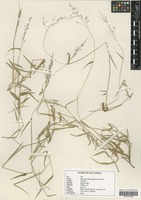
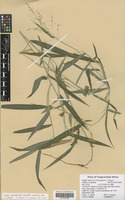
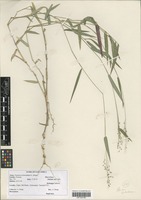
Holotype of Panicum trichocladum K.Schum. [family GRAMINEAE]
Filed as Panicum trichocladum Hack. ex Engl. [family POACEAE]
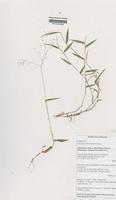
Filed as Panicum trichocladum K. Schum. [family POACEAE]
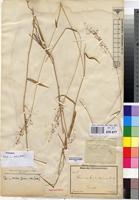
Isosyntype of Panicum trichocladum K.Schum. [family POACEAE]
Filed as Panicum trichocladum K. Schum. [family POACEAE]
[family ]
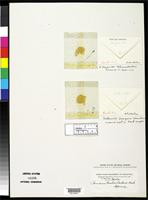
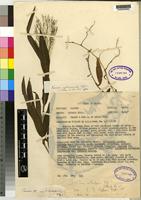
Isotype of Brachiaria umbratilis Napper [family POACEAE]
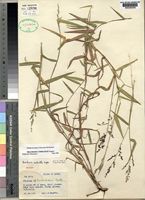
Filed as Panicum trichocladum Hackel, E. 1895 [family POACEAE]
Panicum trichocladum
Previous
Next

Name

Identification
Panicum trichocladum Hackel [family POACEAE ]
Related name
  • Panicum trichocladum

Flora

Entry for PANICUM trichocladum Hack. ex Engl. [family POACEAE]
Herbarium
Royal Botanic Gardens, Kew (K)
Collection
Flora of Tropical Africa
Resource Type
Reference Sources
Entry From
Flora of Tropical Africa, Vol 9, page 1, (1917) Author: (By O. STAPF.)
Names
PANICUM trichocladum Hack. ex Engl. [family POACEAE], Hochgebirgsfl. Trop. Afr. 119 (name); K. Schum. in. Engl. Pfl. Ost-Afr. C. 103. —Durand & Schinz, Consp. Fl. Afr. v. 766.
PANICUM trachycladum K. Schum. [family POACEAE], (sphalm.) in Engl. Pfl. Ost-Afr. A. 108.
Information
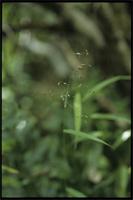
Perennial, rambling or climbing up to 8 ft. Culms slender, many-noded, branched, particularly from the prostrate much geniculate and sometimes rooting bases, terete or the lowest compressed, glabrous or sometimes finely pubescent or softly and spreadingly hirsute below the nodes, the older internodes often completely bared. Leaf-sheaths rather firm, terete, the lower frequently slipping off the culms or breaking away, the upper tight, all usually quite glabrous and smooth except at the mouth, rarely softly pubescent all over, beardless at the nodes; ligules reduced to a narrow membranous ciliolate rim; blades almost horizontally spreading, linear-lanceolate from a suddenly contracted and rounded base, tapering to a long fine point, 1 1/2–6 in. by 3–7 lin., thin, flat, green, more or less softly and shortly hairy, sometimes almost velvety, rarely quite glabrous, midrib very slender, whitish; primary lateral nerves 3–4 on each side, usually inconspicuous, margins scabrid to minutely spinulose, sometimes crisped. Panicle soon expanding and then usually permanently open and extremely loose, broad-oblong to ovate in outline, 2–6 in. by 2–3 in., divided to the second or third or low down to the fourth degree, all the divisions subcapillary to capillary, flexuous or wavy, finely scaberulous, like the very slender primary axis more or less beset with long fine spreading white hairs, or at least the principal towards their bases and the pedicels below their tips, hairs of the axis usually tubercle-based, primary branches solitary or irregularly approximate, the lower mostly divided from 3–4 lin. (rarely up to 1 in.) above the base; pedicels very slightly thickened upwards, frequently paired, those of a pair very unequal, the shorter from 1/2 (rarely) to 3 lin., the longer up to 8 lin. long. Spikelets oblong, obtuse, somewhat turgid, 1 1/4 to over 1 1/2 lin., pale green or flushed with purple, glabrous. Glumes very dissimilar, faintly nerved; lower very small, rounded, very obtuse, one-seventh to one-fifth (rarely one-third) the length of the lower floret, hyaline, nerveless; upper corresponding in size and shape to the spikelet, membranous, broadly rounded on the back, 5-nerved. Lower floret ♂: valve very like the upper glume, 5–6-nerved; valvule almost as long, oblong, subacute, with broad flaps throughout; anthers almost 1 lin. long. Upper floret hermaphrodite, oblong, acute, almost as long as the lower, whitish, smooth, slightly glossy; valve and valvule thinly crustaceous.
Distribution
Zanzibar Mozamb. Dist. rambling in shrubs, Hildebrandt, 1088! Kirk ! Last !German East Africa Mozamb. Dist. Tanga District; Amboni, Holst, 2680! Ukinga; Kyimbali, Stolz, 1176!Nyasaland Mozamb. Dist. Msalu, Allen, 117!Portuguese East Africa Mozamb. Dist. Zambesi Delta; “forming high masses resting on shrubs” on the sea coast near Luamo, Kirk ! right bank of Luabo, Kirk, 35!Uganda Nile Land Ruwenzori; Kabamaga, Scott Elliot, 7591! Entebbe, Fyffe, 17! edge of swamps, Kipayo, 4000 ft., Dummer, 2417! and without precise locality (Damia?) Scott Elliot, 7131!British East Africa Nile Land Aberdare Range, Dowson, 78! Rabai Hills, Taylor ! Ngatama, Taha plains, Gregory ! in sandy plains in the Sabaki Valley, Gregory !

Related Materials

  • Terms and Conditions
  • Privacy Policy
  • Cookie Policy
  • Cookie Settings
  • Accessibility
  • Help
  • Contact Us
  • Facebook
  • Twitter
ITHAKA

JSTOR is part of ITHAKA, a not-for-profit organization helping the academic community use digital technologies to preserve the scholarly record and to advance research and teaching in sustainable ways.

©2000-2026 ITHAKA. All Rights Reserved. JSTOR®, the JSTOR logo, JPASS®, Aluka®, and ITHAKA® are registered trademarks of ITHAKA.

╳