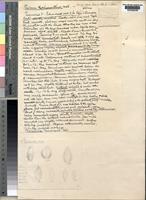
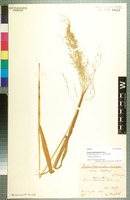
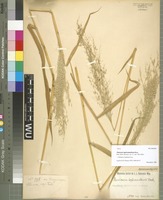
Perennial (?), up to over 2 ft. high. Culms erect, slender, terete, glabrous, internodes shortly exserted. Leaf-sheaths (upper only seen) tight, terete, smooth, glabrous except near the mouth and along the more or less tomentose junction with the blade and the long-bearded nodes; ligules short, membranous, ciliate; blades linear-lanceolate, gradually tapering to an acute point, 7 in. by 3/4 in., flat, somewhat soft, loosely and softly and sometimes very sparingly hairy, particularly below, hairs very fine from minute tubercles, margins cartilaginous, rigidly ciliolate, primary nerves about 5 on each side. Panicles ovate in outline from an acuminate base, about 10 in. by 4 in.; common axis subangular, smooth below, upwards scaberulous; lowest branches pseudo-verticillate, 4-nate, the following scattered or 3–2-nate, up to 5 in. long, obliquely erect, undivided for 1– 1/2 in., then bearing scattered lax racemes up to over 1 1/2 in. long, filiform, flexuous, scaberulous; pedicels subcapillary, unequal, the longest up to 6 lin. long, with fine white hairs below the slightly thickened tips. Spikelets elliptic to ovate-oblong in outline, acute to subobtuse, 1 1/2–1 3/4 lin. long, very pale, tomentose all over. Glumes very thin, densely covered with soft hairs; lower rotundate-ovate, obtuse, hyaline, one-third to half the length of the spikelet, faintly 1-nerved; upper corresponding to the spikelet in length and outline, finely 5-nerved. Lower floret barren (or ♂ ?): valve very similar to the upper glume; valvule oblong, subacute, shorter than the valve, with a few hairlets from the keels. Upper floret hermaphrodite, oblong, subacute, minutely hairy from the tip, 1 lin. long, straw-coloured: valve and valvule papery, faintly transversely rugose, the valve faintly 5-nerved; anthers 3/4 lin. long.