JSTOR Global Plants Home
  • Home
  • Browse
  • About
  • Access
  • Account
    • Saved Items
    • Profile
  • Log in

Global Plants

Skip to Main Content
  • JSTOR Global Plants Home
  • Global Plants

    • Browse
    • About
    • Access
    • Account
      • Saved Items
      • Profile
Log in
  • Browse
  • About
  • Access
  • Account
    • Saved Items
    • Profile
Advanced Search

Compilation
Panicum swynnertonii

3 Images see all

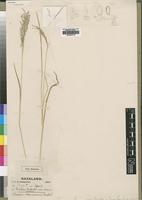
Holotype of Panicum swynnertonii Rendle [family POACEAE]
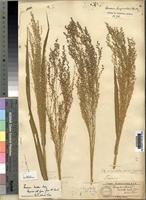
Isosyntype of Panicum merkeri Mez [family POACEAE]
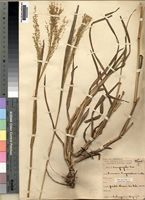
Panicum merkeri Mez [family POACEAE]
Previous
Next

Name

Identification
Panicum swynnertonii Rendle [family POACEAE ] Panicum coloratum L. [family POACEAE ] (stored under name);
Related name
  • Panicum swynnertonii
  • Panicum coloratum
  • Panicum radula
  • Panicum merkeri

Flora

Entry for PANICUM Swynnertonii Rendle [family POACEAE]
Herbarium
Royal Botanic Gardens, Kew (K)
Collection
Flora of Tropical Africa
Resource Type
Reference Sources
Entry From
Flora of Tropical Africa, Vol 9, page 1, (1917) Author: (By O. STAPF.)
Names
PANICUM Swynnertonii Rendle [family POACEAE], in Journ. Linn. Soc., Bot., xl. 230.
PANICUM coloratum Rendle var. cuanzense [family POACEAE], in Cat. Afr. Pl. Welw. ii. 178.
PANICUM Merkeri Mez [family POACEAE], in Engl. Jahrb. xxxiv. 144 (partly ?).
Information
Annual (?), 3–4 ft. high (base unknown). Culms slender, erect, soft, usually simple upwards or sparingly branched, more than 3- or 4-noded, terete, quite glabrous and smooth, internodes rather long-exserted. Leaf-sheaths tight, striate, glabrous or more rarely spreadingly hirsute, with tubercle-based hairs, prominently striate, nodes glabrous, dark; ligule a narrow membranous minutely ciliolate rim or quite obscure to obsolete; blades linear from a more or less constricted rounded base, tapering to a very long fine point, 5 to over 12 in. by 2–6 lin., flat, obliquely erect, green, glabrous or softly hirsute towards the base, smooth except upwards along the finely cartilaginous margins and dorsally towards the tips, midrib obscure or slender and whitish on the face, lateral nerves very numerous and close, 4–5 primary differentiated. Panicle oblong, mostly rather contracted, jubate, sometimes open, slightly flexuous or nodding, floribund, 6–10 in. long, divided to the fourth or fifth degree, all the divisions filiform to finely filiform, angular, finely scaberulous at least upwards; primary axis slender, terete or angular, striate, smooth below; primary branches usually in false whorls, at least in the lower part or solitary in weak panicles, the longest up to over three-quarters the length of the panicle, loosely divided from 1/2–2 in. above the base; secondary branches long, their divisions loosely contracted, the penultimate divisions 4–2-spiculate forming rather loose racemes with their spikelets distant by more than their length; pedicels with minutely discoid tips, the lateral 1–2, the terminal to over 3 lin. long. Spikelets oblong, acutely acuminate, 1 1/4 lin. long, greenish, the tips often purplish. Glumes very unequal; the lower broad-ovate from a clasping base, acute in profile, a quarter to almost half the length of the spikelet, subhyaline, 1- to sub-5-nerved, the lateral nerves short to very short; the upper as long as the spikelet, membranous, finely and prominently 7–9-nerved. Lower floret ♂: valve very similar to the upper glume; valvule slightly shorter than the valve, subacute, sharply keeled, with narrow flaps all along; anthers 2/3 lin. long. Upper floret hermaphrodite, elliptic-oblong, 3/4 to almost 1 lin. by 2/5 lin., pale yellowish, polished; valve and valvule thinly crustaceous.
Distribution
Angola Lower Guinea Pungo Andongo; Cuanze cataract near Condo, Welwitsch, 2833! and without precise locality, Welwitsch, 7355!Nyasaland Mozamb. Dist. Zomba, 2500–3500 ft., Whyte !Portuguese East Africa Mozamb. Dist. 30 miles below the Murchison Falls, Meller ! near Shupanga, Kirk ! below Mazzaro, in damp places, Kirk ! between Lupata and Tete, Kirk !Rhodesia Mozamb. Dist. Northern Melsetter, 2000–6000 ft., Swynnerton, 1702 a!
Notes
The type specimen is a rather weak plant as compared with the other specimens quoted above, but there is no structural difference. Mez's P. Merkeri was described from a plant collected by Merker in the neighbourhood of Kilimanjaro which I have not seen, and from Whyte's specimen quoted above. If the two plants should indeed be identical, Mez's name (1904) would have priority over P. Swynnertonii .

Related Materials

  • Terms and Conditions
  • Privacy Policy
  • Cookie Policy
  • Cookie Settings
  • Accessibility
  • Help
  • Contact Us
  • Facebook
  • Twitter
ITHAKA

JSTOR is part of ITHAKA, a not-for-profit organization helping the academic community use digital technologies to preserve the scholarly record and to advance research and teaching in sustainable ways.

©2000-2026 ITHAKA. All Rights Reserved. JSTOR®, the JSTOR logo, JPASS®, Aluka®, and ITHAKA® are registered trademarks of ITHAKA.

╳