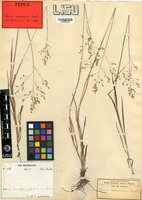
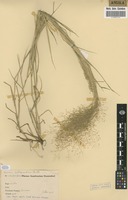
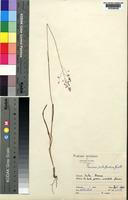
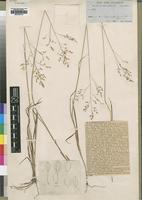
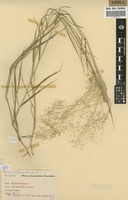
Perennial, over 2 ft. high. Culms suberect or geniculately ascending, slender, branched from the lowest and sometimes one or the other of the upper nodes, terete, glabrous, about 5-noded, lower internodes shortly, upper long-exserted. Leaf-sheaths terete, frequently rather loose, quite glabrous except along the ciliolate upper margins, very smooth, prominently striate; ligule a ciliolate transverse rim; blades narrowly linear from an equally wide base, tapering to a fine blunt point, 3–7 in. by 1 1/2–2 lin., flat or more often tightly convolute, rather rigid and firm, quite glabrous and smooth except on the scaberulous margins and sometimes the upper side, midrib very slender, more or less prominent below, lateral nerves numerous, close, hardly differentiated. Panicles erect and open, and rhomboidal or ovate in outline, or slightly nodding and subsecund, very long-exserted, 3–4 in. by 3/4–2 in., divided up to the third degree; common axis very slender, terete, smooth, finely striate, lowest internodes 3/4–1 lin. long; lower primary branches mostly solitary and undivided for 4–10 lin. from the base or sometimes divided at the base and 2-nate, the lowest internode but one usually 6–3 lin. long, the following much shorter, longest branches about half the length of the panicle, all finely filiform like all the other divisions, often coloured and very slightly scaberulous or smooth; ultimate divisions subcapillary, short, rather contracted; pedicels unequal, 3/4–1 1/2 lin. long, tips discoid. Spikelets plump, subglobose, obtuse or subacute, over 1 to 1 1/3 lin. long, pale green or straw-coloured, slightly variegated with purple (particularly at the tips and edges of the glumes) here and there with a metallic lustre. Glumes membranous, very concave, minutely acute, prominently nerved, the lower two-thirds the length of the spikelet, 3-nerved, the upper as long as the spikelet, 5-nerved. Lower floret ♂; valve very like the upper glume; valvule slightly shorter, keels almost smooth. Upper floret hermaphrodite, obovate-elliptic in outline, subacute, 4/5–1 lin. by 2/5 lin.; valve and valvule thinly papery, faintly purplish or whitish, verrucose, warts more or less depressed, globular.