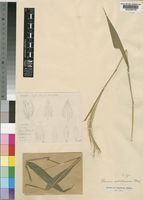
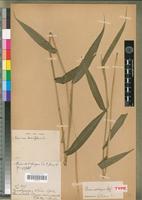
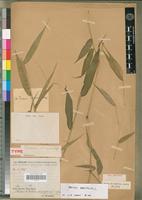
Annual (?), base unknown, apparently several ft. high. Culms many-noded, sparingly branched, slender, glabrous and smooth, intermediate internodes up to 6 in. long and bared at the base by the fall of the sheath, upper shorter. Leaf-sheaths tight, prominently striate, densely ciliate upwards, minutely pubescent in the grooves, those supporting branches thrust aside by the branch and ultimately thrown off, leaving an irregular cuff-like base behind; ligule a narrow membranous ciliolate rim; blades lanceolate to linear-lanceolate from a rounded and much constricted base, tapering to a long often linear acute acumen, 2–6 in. by 7–11 lin., obliquely erect, flat, thin, somewhat rigid, green, minutely and appressedly hairy to subglabrescent, with minutely tubercle-based hairs, margins scaberulous, midrib fine, whitish below, primary lateral nerves very fine, 3–4 on each side, distant, with 4–6 secondary nerves in the intervals and fine cross-veins. Panicle emerging from the uppermost sheath, widening out upwards, up to 6 in. long, divided to the fourth degree; common axis very slender, angular, smooth below, like all its divisions scaberulous to scabrid upwards with a few fine long hairs here and there; internodes short low down, then 3/4– 1/2 in. long; lower branches finely filiform, up to over 3 in. long, divided like the secondary branches from the base or some distance above it, the latter subcapillary, 3–4 lin. apart, its divisions up to 4 or 5 lin. long, bearing 4–1 much scattered spikelets or in the lower part of the panicle barren, with small arrested spikelets; pedicels capillary, 1/2–1 1/2 (rarely the terminal 3) lin. long. Spikelets acutely lanceolate to lanceolate-oblong in back view, slightly oblique in profile, 1 lin. long, pale or greyish-green, loosely pubescent from the glumes. Glumes equally long, thinly membranous, very finely and prominently nerved; lower broad-lanceolate, acuminate, 3-nerved; upper corresponding in length and outline to the spikelet (as seen in back view), rather concave, rounded on the back, 5-nerved. Lower floret barren: valve similar to the upper glume, but glabrous and less concave, equalling it or very slightly shorter; valvule more or less reduced, keels scaberulous. Upper floret hermaphrodite, lanceolate-oblong, acute, 3/4 lin. long, whitish, smooth.