

Compilation
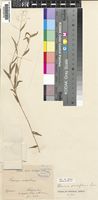
Panicum raripilum
1 Images see all
Name
Identification
Panicum raripilum Kunth [family POACEAE ] Verified by unknown, Panicum parvifolium Lam. [family POACEAE ] (stored under name); Verified by unknown,
Related name
- Panicum raripilum
- Panicum parvifolium
Flora
Entry for PANICUM parvifolium Lam. [family POACEAE]
Herbarium
Royal Botanic Gardens, Kew (K)
Collection
Flora of Tropical Africa
Resource Type
Reference Sources
Entry From
Flora of Tropical Africa, Vol 9, page 1, (1917) Author: (By O. STAPF.)
Names
PANICUM parvifolium Lam. [family POACEAE], Ill. i. 173 (?), and Encycl. iv. 742. —Roem. & Schult. Syst. ii. 445; Nees, Agrost. Bras. 224; Trin. Sp. Gram. Ic. et Descr. t. 236, Pan. Gen. 224, 225, and in Mém. Acad. Sc. St. Pétersb. 6me sér. iii. 312, 313; Steud. Syn. Pl. Glum. i. 88; Kunth, Enum. i. 109; Durand & Schinz, Consp. Fl. Afr. v. 758; Cheval. Sudania, 65.
PANICUM brasiliense Spreng. [family POACEAE], Syst, i. 321.
PANICUM raripilum Kunth [family POACEAE], Rév. Gram. ii. t. 114, and Enum. i. 109; Steud. Syn. Pl. Glum. i. 91; Durand & Schinz, Consp. Fl. Afr. v. 760.
Information
A loosely tufted perennial, with long trailing and rooting stolons from a very slender rhizome, the flowering culms rising 1/2–1 ft. above the leafy tufts. Culms filiform, many-noded, ascending, simple or sparingly branched, terete, smooth and glabrous, nodes mostly long-exserted. Leaf-sheaths tight, terete, finely striate, quite glabrous and smooth, usually much shorter than the internodes; ligule reduced to a fine ciliate membranous rim; blades lanceolate to linear-oblong from a rounded clasping base, acute, from less than 1/2 to over 3/4 in. by 1 1/4–2 1/2 lin., flat, firm, spreading or more or less deflexed, quite glabrous, smooth, midrib and primary lateral nerves (2 to 3 on each side) very fine and sometimes indistinct with 3–4 secondary nerves in the intervals, connected by cross-veins. Panicles very shortly exserted, erect, ovate in outline, from 1/2 to over 1 (rarely up to 3) in. long and broad, rigidly open and loose, divided up to the third degree; common axis angular, smooth; internodes irregularly short and long, in average panicles from 1–4 lin. long; primary branches like their divisions much spreading, to horizontal or deflexed, and bearing from some distance above the base 4–2 solitary spikelets or downwards 3–2-spiculate branchlets, finely filiform or like the pedicels capillary and smooth, the latter 1–2 lin. long, rarely longer, with truncate tips. Spikelets elliptic-oblong, subacute, 2/3 to almost 3/4 lin. long, somewhat plump, quite smooth. Glumes thinly membranous, finely but distinctly nerved, unequal; lower ovate, acute, about half the length of the spikelet, 3-nerved; upper corresponding to spikelet in length and outline, 5-nerved. Lower floret barren: valve like upper glume; valvule oblong, shorter. Upper floret hermaphrodite, broadly ovate-elliptic in outline, subapiculate, whitish, 1/2– 5/8 lin. long, polished; valve and valvule subcoriaceous; anthers 1/4 lin. long. Grain rotundate-elliptic in outline, almost 1/2 lin. long.
Range
in tropical South America.
Distribution
French Gaboon Lower Guinea Cape Lopez, Chevalier, 4319!Congo Lower Guinea Stanley Pool Distr.; Kimuenza, Gillet, 1784! between Dembo and Kisantu, Gillet, 1600! Leopoldville, Gillet, 2650! Kwango Distr.; Mukulu, Vanderyst, 3352! 3354! Aténé, Vanderyst, 3427!Senegambia Upper Guinea in fields near Albida, Leprieur !Sierra Leone Upper Guinea Mayoso, 350 ft., Thomas, 1503! Magbile, Thomas, 6277!Nigeria Upper Guinea Lagos; Ikoyi Plains, at the edge of pools, Dalziel, 1319! Opobo, Jeffreys, 17! Lagos Island, in swampy places, Barter, 20221! Aguku Distr., Thomas, 733!
Distribution (external)
Madagascar