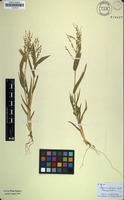
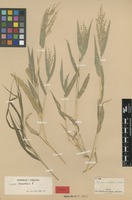
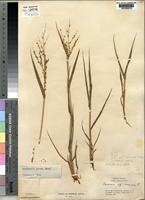
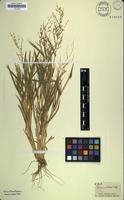
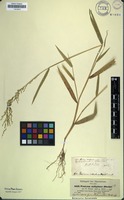
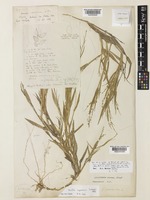
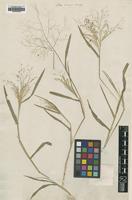
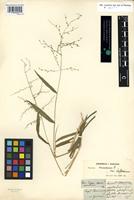
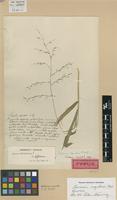
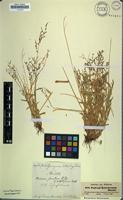
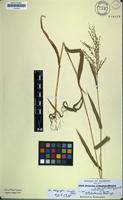
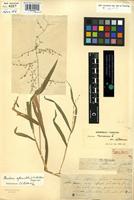
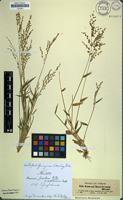
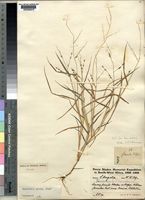
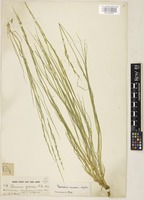
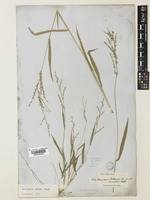
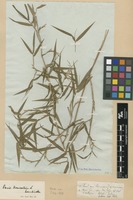
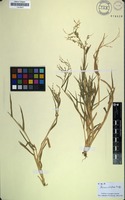
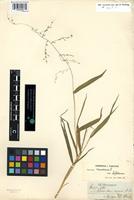
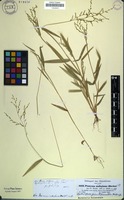
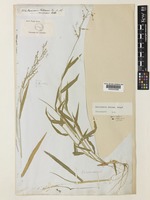
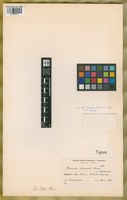
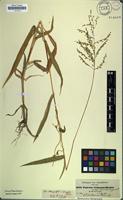
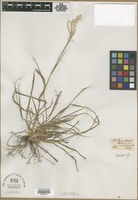
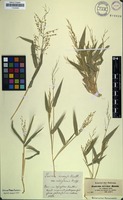
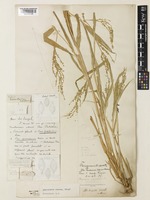
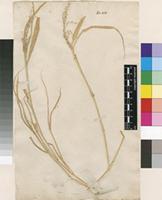
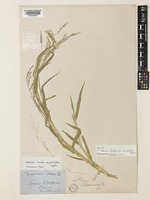
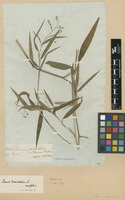
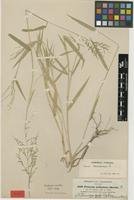
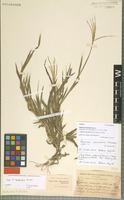
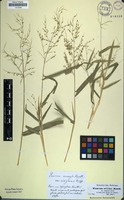
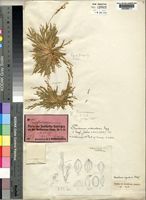
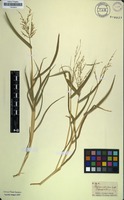
Annual, up to over 2 ft. high. Culms fascicled, slender, geniculate, suberect or more usually ascending from a frequently prostrate and rooting base, terete, 4-∞-noded, branched below, glabrous or softly and finely pubescent upwards. Leaf-sheaths somewhat thin, the lower loose and often slipping off the culm, finely striate, glabrous, with only a few marginal or submarginal cilia towards the mouth, to finely pubescent all over or at least upwards; ligules reduced to a line of short white hairs; blades linear-lanceolate from a rounded and often clasping base, long and finely acuminate, from less than 2 to 5 (occasionally 6) in. by 3–8 (occasionally 12) lin., flat, soft and usually flaccid, green, glabrous or finely pubescent on the back near the base or all over, margins sharply scabrid, primary lateral nerves 3–5 on each side with numerous very fine secondary ones between them, midrib slender. Panicle at length usually more or less exserted, narrowly oblong, 2–6 in. long, of 5 to many solitary downwards somewhat distant, upwards approximate or altogether irregularly approximate suberect or oblique spike-like racemes; common axis angular, channelled on the adaxillary side, terminating with a spikelet, scabrid along the edges of the channel, glabrous or very finely pubescent and sometimes here and there with longer hairs. Racemes moderately slender, the lower 1 1/2–2 1/2 in. long, the upper gradually shorter, straight or slightly flexuous, subsessile or the lowest shortly peduncled, simple or the longer frequently compound downwards or up to or beyond the middle, with very short secondary racemes; rhachis triquetrous, slightly wavy to straight, rarely over 1/4 lin. wide, scabrid along the angles, otherwise glabrous or very finely pubescent, with or without scattered long hairs; pedicels paired or fascicled (contracted secondary racemes) or upwards solitary, filiform, angular, scabrid, the longest of a pair or fascicle up to 1 lin. long, frequently with some long rigid hairs from near the tips. Spikelets (or pairs or clusters of spikelets) evenly distant by slightly less than their own length or sometimes irregularly approximate or rather remote downwards, ovoid, subacute or apiculate, somewhat turgid, 1 1/2 lin. long, greenish, at length pale straw-coloured. Glumes very unequal; the lower broad-ovate, obtuse to subacute, clasping at the base, 5–7- (rarely 3-) nerved, the inner or all nerves anastomosing; upper corresponding in shape and size to the spikelet, membranous, glabrous or finely pubescent, 7- (more rarely 5-) nerved, nerves distinct, green. Lower floret neuter: valve very similar to the upper glume, 5-nerved; valvule oblong, truncate, delicate, more or less reduced. Upper floret hermaphrodite, slightly shorter than the lower, ovate in outline, subacute, pale brown when mature; valve and valvule crustaceous, transversely rugose. Grain broad-elliptic in outline, flat or slightly depressed on both sides with broad rounded sides, up to 1 lin. by 8/10 lin.; scutellum ovate-oblong, equalling 2/3 of the grain.