

Compilation
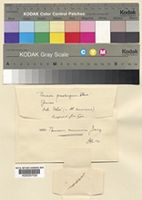
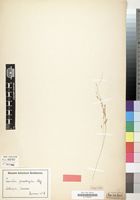
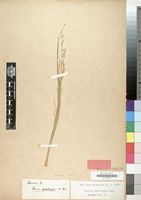
Panicum praelongum
3 Images see all
Name
Identification
Panicum praelongum Mez [family GRAMINEAE ] (stored under name); Verified by Not on sheet.,
Related name
- Panicum praelongum
- Panicum maximum
Flora
Entry for PANICUM maximum Jacq. [family POACEAE]
Herbarium
Royal Botanic Gardens, Kew (K)
Collection
Flora of Tropical East Africa
Resource Type
Reference Sources
Entry From
Flora of Tropical East Africa, page 451, (1982) Author: W. D. CLAYTON and S.A. RENVOIZE
Names
PANICUM maximum Jacq. [family POACEAE], Ic. Pl. Rar. 1: 2, t.13 (1781); F.T.A. 9: 655 (1920); E.A. Pasture Plants 1:138 (1926); Fl. Agrost. Congo Belge 2: 170 (1934); Ann. list grasses Ug.: 32 (1947); Imp. Grassl. Pl. Kenya: 48 (1951); F.P.N.A. 3: 100 (1955); F.P.S. 3: 497 (1956); R.K.G.: 37 (1958); Ann. list Nyasaland grasses: 51 (1958); I.G.U.: 44 (1960); G.T.: 63 (1965); Clayton in F.W.T.A., ed. 2, 3: 429 (1972). Type: Lesser Antilles, Guadeloupe, Jacquin (BM, iso.)
PANICUM polygamum Sw. [family POACEAE], Prodr. Veg. Ind. Occ: 24 (1788), non Forssk. (1775). Type: Jamaica, Browne 366 (whereabouts uncertain, not S or BM)
PANICUM jumentorum Pers. [family POACEAE], Syn. Pl. 1: 83 (1805). Based on P. polygamum Sw.
PANICUM sparsum Schumach. [family POACEAE], Beskr. Guin. Pl.: 84 (1827). Type: Ghana, Thonning (C, holo.!, S, iso.!)
PANICUM teff Desv. [family POACEAE], Opusc: 97 (1831). Type: Ethiopia (P-LAM, holo, K, microfiche!)
PANICUM maximum Nees var. commune [family POACEAE], Fl. Afr. Austr.: 36 (1841). Types: South Africa, Durban, Drège (K, isosyn.!) and several other syntypes
PANICUM maximum Nees var. glaucum [family POACEAE], Fl. Afr. Austr.: 36 (1841). Type: South Africa, Durban, Drège (whereabouts uncertain)
PANICUM maximum Nees var. laeve [family POACEAE], Fl. Afr. Austr.: 36 (1841). Type: South Africa, George District, Mund (B, holo.)
PANICUM confine A. Rich. [family POACEAE], Tent. Fl. Abyss. 2: 373 (1851) in synon. Based on P. jumentorum Pers.
PANICUM hirsutissimum Steud. [family POACEAE], Syn. Pl. Glum. 1: 72 (1854). Types: South Africa, Cape Province, Uitenhage, Ecklon & Zoutspansnek, Drège (whereabouts uncertain)
PANICUM praelongum Steud. [family POACEAE], Syn. Pl. Glum. 1: 73 (1854). Type: Senegal, Herb Lenormand (P, holo.)
PANICUM maximum (Steud.) Oliv. var. hirsutissimum [family POACEAE], in Trans. Linn. Soc, Bot., 29: 171 (1875)
PANICUM trichoglume Engl. [family POACEAE], Glied. Veg. Usambara: 38 (1894), nom. nudum
PANICUM maximum Kuntze var. altissimum [family POACEAE], Rev. Gen. Pl. 3: 362 (1898). Type: Mozambique, Beira (B, iso.)
PANICUM tephrosanthum Schinz [family POACEAE], in Bull. Herb. Boiss., sér. 2, 1: 766 (1901). Type: Mozambique, Boruma, Menyharth 898 (Z, holo.)
PANICUM giganteum Mez [family POACEAE], in E.J. 34: 143 (1904). Types: Kenya, Tana River District, Witu, F. Thomas 123 (K, isosyn.!) & Tanzania, Uzaramo, Stuhlmann 6533, 6712 & 6754 (all B, syn.)
PANICUM maximum (Nees) Peter subsp. commune [family POACEAE], in F.D.O.-A. 1: 184 & 194 (1930)
PANICUM maximum Peter var. pubiglume [family POACEAE], F.D.O.-A. 1: 185 & 195 (1930). Types: Tanzania, Usambara, Holst 8716 (K, isosyn.!) & Ugogo, Peter 33147 (B, syn.†)
PANICUM maximum Peter var. hirsutum [family POACEAE], F.D.O.-A. 1: 195 & Anh: 42 (1930). Type: Tanzania, Tabora District, Nagulu, Peter 34714 (B, holo.†)
PANICUM maximum Peter var. heterotrichum [family POACEAE], F.D.O.-A. 1, Anh.: 42 (1930). Type: Tanzania, Arusha District, Meru, Peter 42552 (B, holo.†)
PANICUM maximum Robyns var. trichoglume [family POACEAE], in Mém. Inst. Roy. Col. Belge, Sec. Sci. Nat. & Méd. 1, 6: 31 (1932). Type: Zaire, Vanderyst 27725 (BR, holo.!)
Information
Loosely to densely tufted perennial, occasionally annual; culms (25–)75–200(–450) cm. high, erect from a shortly rhizomatous pubescent base or geniculately ascending and rooting at the lower nodes, slender to robust, branched or simple, glabrous to hispid or pilose, the nodes glabrous or bearded with soft spreading hairs. Leaf-blades linear to narrowly-lanceolate, (6–)12–40(–100) cm. long, (4–)12–35 mm. wide, narrowed or straight at the base, flat, membranous or herbaceous, glabrous or sparsely pilose to pubescent, acuminate. Panicle oblong or pyramidal, 12–45(–60) cm. long, usually much branched, the branches ascending to spreading, the lowest arranged in a whorl; pedicels and secondary branches fine and flexuous to fairly stiff and contracted. Spikelets oblong, (2.5–)3–4.5(–5) mm. long, rounded on the back, glabrous or pubescent, blunt or acute, occasionally overtopped by long hairs from the tip of the pedicel; lower glume broadly ovate, 1/3–1/2 the length of the spikelet, 3-nerved, obtuse or acute; upper glume ovate-oblong, 5-nerved, acute; lower lemma ovate-oblong, 5-nerved, ♂, rarely sterile, its palea well developed; upper lemma and palea conspicuously transversely rugose.
Range
DISTR. U1–4; K1–7; T1–8; Z; P tropical to South Africa and Madagascar, introduced widely throughout the tropics
Altitude range
0–2400 m.
Distribution
KENYA Northern Frontier Province Moyale, 20 Apr. 1952, Gillett 12851!KENYA Masai District Endama, 22 June 1961, Glover, Gwynne, Samuel & Tucker 1898!KENYA Kwale District Lango ya Mwagandi area, 22 Mar. 1968, Magogo & Glover 395!TANZANIA Handeni District about 56 km. on Handeni–Kibaya road, Apr. 1966, Procter 3173!TANZANIA Iringa District Msembe, Ruaha National Park Headquarters, 21 Feb. 1970, Greenway& Kanuri 13914!TANZANIA Songea District 11 km. W. of Songea, 14 Feb. 1956, Milne-Redhead & Taylor 8696!TANZANIA Zanzibar I., Mazizini, 17 Apr. 1962, Faulkner 3027!TANZANIA Pemba I., between Chake Chake and Mtambile, 1 Oct. 1929, Burtt Davy 2503/29!UGANDA Karamoja District Loyoro, 9 June 1940, A.S. Thomas 3730! & Moruangaberu, 22 May 1956, Dyson-Hudson 1!UGANDA Ankole District near Mbarara, 15 June 1929, Snowden 1372!
Notes
Widely grown as a herbage grass in the tropics, often in the form of selected agricultural strains. See Bogdan, Tropical Pastures and Fodder Plants (1977), for a review of this species in tropical agriculture. A special form, with large stout panicles of tough erect branches bearing congested spikelets (P. giganteum), is grown in Kenya and Tanzania for making brushes and brooms.There is considerable variation in the size and indumentum of culms, leaves and panicles. In particular, specimens with pubescent spikelets have commonly been segregated as var. pubiglume or var. trichoglume. However these characters seem to vary continuously, affording no adequate basis for the recognition of formal taxa. The annual habit which occurs only in the southern part of the range, from Tanzania tc Transvaal, has likewise been disregarded, for it is not always easy to distinguish from the perennial state and is not correlated with other characters. P. funaense Vanderyst (P. spongiosum Stapf), from Zambia and Zaire, although resembling P. maximum in spikelet shape, is a marsh plant with soft stout culms and a smooth shiny upper lemma puberulous at the tip.