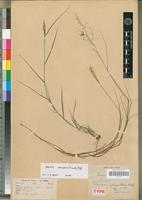
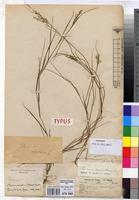
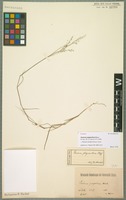
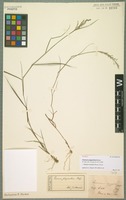
Perennial, up to 2 ft. high; innovations intravaginal. Culms geniculately ascending from a branched prostrate rooting base, or suberect, very slender, rather wiry below, many-noded, nodes exserted, quite glabrous. Leaf-sheaths tight, terete, quite glabrous except for the upwards ciliate margins, the basal more or less decaying and leaving the wiry internodes bare; ligule reduced to a very narrow membranous ciliolate rim; blades narrowly linear from an equally wide base, very gradually tapering to an acute point, 2–4 in. by up to over 1 lin., flat or more often setaceously convolute, glabrous or more or less appressedly hairy, smooth below and above, or like the margins slightly scaberulous, midrib very slender, whitish below, lateral nerves fine, not or imperfectly differentiated. Panicle shortly or laterally exserted from the uppermost sheath and often equalled or overtopped by the blade, narrow, 2–3 in. long, contracted (permanently?), divided up to the third degree; common axis very slender, striate, smooth, lower internodes up to 1 1/2 in. long; lower primary branches divided from low down, emerging with their lowest branchlets in fascicles from the sheath, finely filiform, angular and slightly rough; ultimate divisions subcapillary, flexuous; pedicels unequal, the lateral about 1/2 lin. long, the terminal 2 lin. long, with minute subdiscoid tips. Spikelets ovate- to lanceolate-oblong, acute, 4/5 lin. long, green, here and there with a faint metallic lustre, glabrous. Glumes thinly membranous, finely nerved, obliquely lanceolate in profile, acute or apiculate, the lower about three-quarters the length of the spikelet and 3-nerved, the upper equalling the spikelet and 5-nerved. Lower floret ♂; valve very similar to the upper glume; valvule shorter by a quarter, subacute; anthers 2/5 lin. long. Upper floret hermaphrodite, elliptic-oblong, subacute, up to over 1/2 lin. long; valve and valvule very thinly papery, very minutely verrucose; anthers as in the ♂ floret.