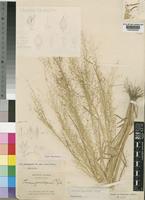
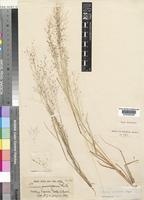
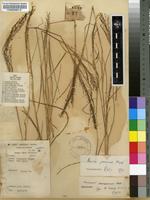
Annual, tufted, 1–2 ft. high. Culms erect or geniculate-suberect, very slender, glabrous, 1–2-noded, simple or sometimes branched from the lowest node, branches similar to the main culm, flowering. Leaf-sheaths thin, somewhat tight or the lowest at length loosened, striate, glabrous, shorter than the internodes, sometimes tinged with purple; ligule reduced to a narrow membranous ciliolate rim; blades linear from an equally wide or somewhat attenuated base, tapering to a slender point, 2–4 in. by 1–1 1/2 lin., flat or convolute when dry, subflaccid, glabrous except for a small beard at the junction with the sheath, midrib and primary lateral nerves (2–3 on each side) slightly prominent below, very slender, hardly differentiated above, margins scaberulous. Panicles mostly in tiers of 2–3, shortly or the primary at length long-exserted from the uppermost sheaths of the culm and its branches, open and very loose, oblong, up to over 1 ft. long by 1 1/2–2 in., quite glabrous, divided to the fourth degree, all divisions very slender to almost capillary, scaberulous except the bases of the primary, obliquely spreading; primary branches mostly solitary and scattered, rarely pseudoverticillate, with minute motile cushions at the base, divided from 3–6 lin. from the base, or occasionally quite low down, the longest up to 2 1/2 in. long, divisions distantly divided once or twice, 6–2-spiculate or the upper simple; pedicels 3–6 or occasionally 9 lin. long, tips slightly thickened and minutely discoid. Spikelets to over 1 1/4 lin. long, oblong, acutely acuminate, soon gaping, yellowish-green or tinged with purple. Glumes obliquely spreading but not divaricate, similar, thinly membranous, finely nerved; lower obliquely ovate to ovate-lanceolate in profile, acuminate, usually with a fine mucro, without the latter about two-thirds the length of the spikelet, 3-nerved, lateral nerves faint, midnerve slightly scaberulous; upper obliquely lanceolate-oblong, shortly acuminate, obscurely mucronulate, as long as the spikelet, 5-nerved, inner nerves prominent upwards. Lower floret ♂; valve very like the upper glume, but less acuminate and subacute; valvule almost as long as the valve, oblong, subacuminate, flaps broad downwards; anthers 3/5 lin. long. Upper floret hermaphrodite, oblong, obtuse, 3/4 lin. by 3/10 lin., white, very glossy and smooth.