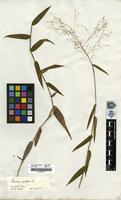
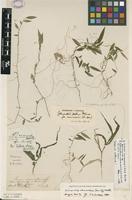
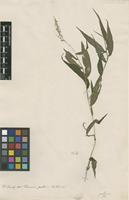
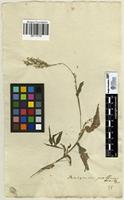
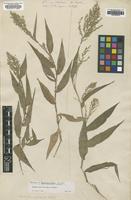
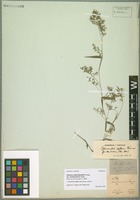
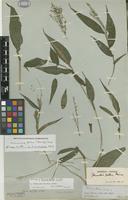
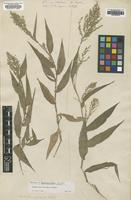
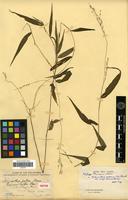
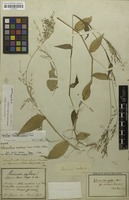
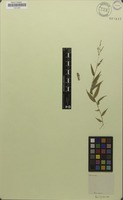
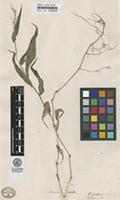
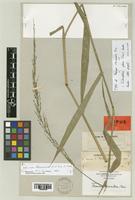
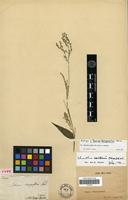
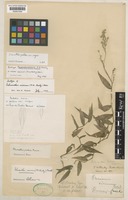
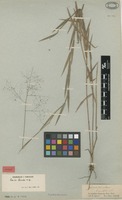
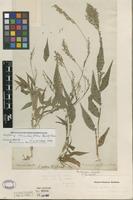
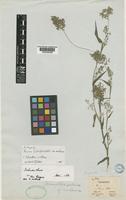
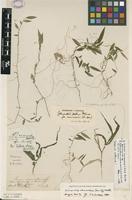
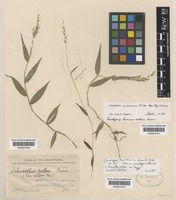
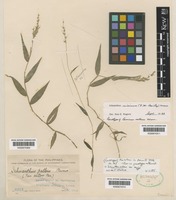
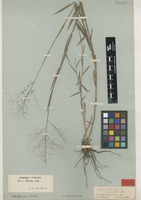
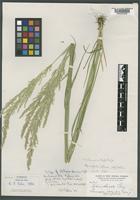
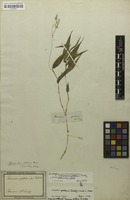
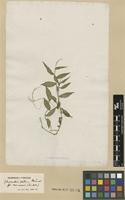
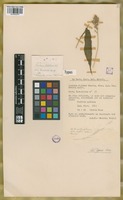
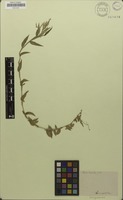
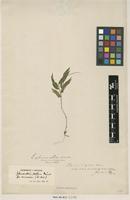
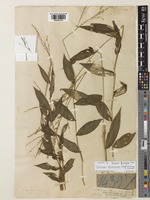
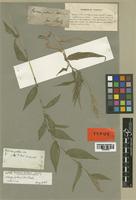
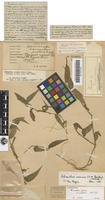
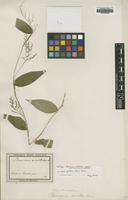
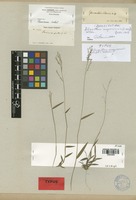
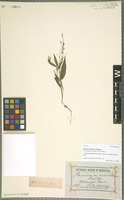
Perennial, up to 2 ft. high, with a creeping rooting base. Culms slender, geniculately ascending from the prostrate base, the upright portions 7–8-noded and sparingly branched, easily compressible, striate, with alternate pubescent lines, lowest internodes (particularly the prostrate) more or less compressed, the upper terete. Leaf-sheaths rarely over 1/2 in. long, much shorter than the internodes, tight, subherbaceous, densely ciliate along the margin, with a densely hairy transverse line at the junction with the blade, otherwise glabrous or loosely and usually very sparingly hairy, prominently finely striate; ligule a membranous ciliolate rim; blades lanceolate to ovate-lanceolate from a much constricted oblique base, acutely acuminate, 1 1/2–2 in. by 4–9 lin., flat, thinly papery, dark green above, quite glabrous or minutely and very sparingly hairy below, somewhat rough above, margins scaberulous, midrib hardly different from the distant primary lateral nerves, 3–4 on each side, secondary nerves about 5 in each interval, extremely fine, transverse veins numerous, delicate. Panicles terminal and lateral (from 1 or 2, rarely 3, uppermost leaves), very shortly exserted or with their base enclosed in the supporting sheath, 2–3 1/2 in. long, slightly nodding, narrow to very narrow, green, the terminal divided to the third or fourth degree, with 1–3 basal branches, the latter up to 3 in. long; common axis and primary branches filiform, more or less angular or compressed, glabrous, rarely pubescent downwards, smooth below, scaberulous upwards; lower primary branches distant (by up to more than 1 in.), the following much more approximate, solitary, erect or suberect, forming like the secondary branches of the lower part of the panicle shortly peduncled to sessile sparingly compound or simple racemes 15–6 lin. long, and loose or moderately contracted; pedicels unequal, where paired, one 1 lin. or less, the other up to over 2 lin. long, angular, scaberulous, truncate. Spikelets lanceolate, acutely acuminate, about 2 1/2 lin. long. Glumes glabrous or finely hairy along the margins, lower two-thirds to over three-quarters the length of the lower floret, lanceolate in profile, more or less setaceously acuminate, 5-nerved, upper as long as or sometimes slightly shorter or longer than the lower floret, similar to the lower glume, but broader and more oblong in profile with a shorter less narrow acumen or when flattened out shortly acute, prominently 7-nerved. Lower floret imperfectly ♂: valve similar to the upper glume but hardly acuminate, quite glabrous, 7-nerved, finely keeled upwards; valvule broad-oblong with wide flaps and scaberulous keels, more or less reduced; anthers rudimentary. Upper floret hermaphrodite, oblong, obtuse, 1 lin. by almost 1/2 lin., polished, white or pale brownish, on maturity with its median plane at right angles to that of the spikelet, the lower third of the margin occupied by a shallow whitish depression which on wetting swells out into a semitransparent narrow wing continued downwards along the supporting internode; valvule hardened towards the minutely saccate base.