JSTOR Global Plants Home
  • Home
  • Browse
  • About
  • Access
  • Account
    • Saved Items
    • Profile
  • Log in

Global Plants

Skip to Main Content
  • JSTOR Global Plants Home
  • Global Plants

    • Browse
    • About
    • Access
    • Account
      • Saved Items
      • Profile
Log in
  • Browse
  • About
  • Access
  • Account
    • Saved Items
    • Profile
Advanced Search

Compilation
Panicum nodosum

9 Images see all

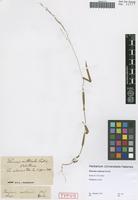
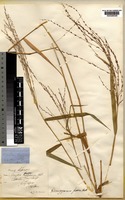
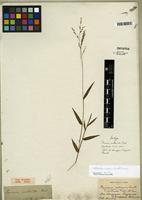
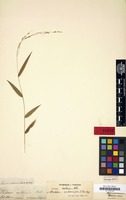
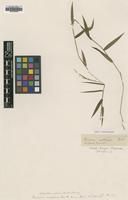
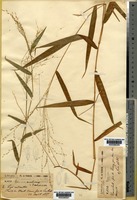
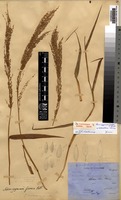
Type of Panicum nodosum Kunth [family POACEAE]
Paratype of Hemigymnia fusca Ridl. [family POACEAE]
Isotype of Ottochloa nodosa (Kunth) Dandy [family POACEAE]
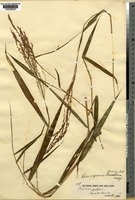
Type of Panicum nodosum Kunth [family GRAMINEAE]
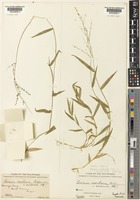
Type of Panicum nodosum Kunth [family POACEAE]
Isosyntype of Panicum ouonbiense Balansa [family POACEAE]
Paratype of Hemigymnia fusca Ridl. [family POACEAE]
Ottochloa nodosa (Kunth) Dandy [family POACEAE]
Previous
Next

Name

Identification
Ottochloa nodosa (Kunth) Dandy [family POACEAE ] (stored under name); Panicum nodosum Kunth [family POACEAE ]
Related name
  • Panicum multinode
  • Panicum nodosum
  • Ottochloa nodosa

Flora

Entry for HEMIGYMNIA arnottiana Stapf [family POACEAE]
Herbarium
Royal Botanic Gardens, Kew (K)
Collection
Flora of Tropical Africa
Resource Type
Reference Sources
Entry From
Flora of Tropical Africa, Vol 9, page 1, (1917) Author: (By O. STAPF.)
Names
HEMIGYMNIA arnottiana Stapf [family POACEAE]
Panicum arnottianum Nees ex Steud. [family POACEAE], Syn. Pl. Glum. i. 59.
Panicum nodosum Franch. [family POACEAE], Contr. Fl. Congo Franç. in Bull. Soc. Hist. Nat. Autun, viii. 346 (reprint, 38); Hook. f. Fl. Brit. Ind. vii. 43, and in Trim. Handb. Fl. Ceyl. 145; not of Kunth.
Panicum malabaricum Merrill [family POACEAE], in Philipp. Journ. Sc. iv. 248.
Information
Perennial, scrambling from an often decumbent rooting base, up to over 6 ft. high. Culms many-noded, much geniculate, branched below and here and there also upwards, terete, hard and more or less woody below, glabrous and very smooth; internodes shorter or longer than the sheaths. Leaf-sheaths tight, rather firm, terete, finely striate, quite smooth and glabrous except along the upwards ciliolate margins (African specimens) or sometimes hirsute with tubercle-based finally deciduous hairs, at length circumscissile at the base and deciduous; ligule a very obscure membranous rim; blades linear-lanceolate to lanceolate from a suddenly much constricted almost petioloid base and finally disarticulating there, acuminate with a subsetaceous point, 3–6 in. by 4 1/2–10 lin., flat, firmly papery, dark and often dull green, minutely puberulous at the constricted base, otherwise quite glabrous, rough near the tips, sharply serrulate-scabrid along the margins, midrib slender, prominent below, primary lateral nerves very slender, 4–5 on each side with very faint oblique and sometimes meandering transverse veins and pellucid dots or striæ (lacunæ in the parenchyma). Panicle terminal, erect, slightly flexuous, more or less exserted from the uppermost sheath or its base enclosed in it, 5–9 in. long, contracted and subfastigiate or widely open; common axis angular, smooth, lower internodes 3/4 to over 1 1/2 in. long, the following often irregularly decreasing; primary branches frequently 2-nate to pseudoverticillate or, particularly upwards, solitary, erect or spreading at an angle of 60° or more, up to three-quarters the length of the panicle, filiform, angular, scabrid, divided from the base but with the lowest divisions often quite rudimentary, the next often remote (in large panicles up to 2 in. from the base), the following usually irregularly distant or approximate, representing short racemes or fascicles, rarely long and again branched. Racemes sessile, up to 10-spiculate and over 3 lin. long, but mostly much shorter and often reduced to clusters of 6–3-spikelets; rhachis finely filiform, wavy, scabrid; pedicels very fine with discoid tips, scaberulous, 1/2–1 lin., or sometimes up to 2 lin. long and then flexuous. Spikelets ovate-anceolate to linear-oblong, acute or acuminate, 1 1/2–1 3/4 lin. long, quite glabrous (in the African specimens). Glumes similar, ovate to ovate-anceolate, acute, lower one-third to two-fifths the length of the spikelet, 3-nerved; upper slightly longer, 5- (rarely 7-) nerved. Lower floret: valve 7-nerved, nerves distinct. Upper floret hermaphrodite, pale, smooth; anthers 1 mm. long. Grain oblong-elliptic, obtuse, sides slightly thickened.
Range
Widely distributed in the Indo-Malayan region, as far as the Philippines.
Distribution
Congo Lower Guinea Bangui, Chevalier, 10956! Brazzaville, in woods along the Djowe river, Thollon, 4087! Mpila plain, Thollon, 386.Congo Lower Guinea Stanley Pool Distr.; Wombali, Vanderyst, 4518! 4519! Kibambeli, Vanderyst, 4153!
Notes
Apparently very variable as to size and lignification of the lower parts of the culms. All the African specimens examined have glabrous spikelets and leaves (except along the margins of the sheaths), whilst in the Indian material the glumes are frequently ciliolate and the leaves hairy. In the Philippine Journal of Science, iv. 248, Merrill identified this plant with Poa malabarica, Linn., and he named it consequently Panicum malabaricum. This was done on Munro's authority who had referred the original of Poa malabarica in the Linnean Herbarium to Panicum nodosum, and on the assumed identity of certain Philippine specimens with the plant figured in Rheede, Hort. Malab. xii. t. 45, and quoted by Linnæus with his original description of Poa malabarica. The comparison of Panicum nodosum (sensu lat. auct.) with the plate quoted—Merrill saw only a rough tracing of it—and the accompanying text shows, however, at a glance that the two plants are not identical, even generically. Linnæus must have come to the same conclusion; for in the second edition of his Species Plantarum the reference to Rheede is wanting. What Rheede's plate represents may be doubtful, but I would suggest that it was drawn from a specimen of Diplachne fusca. However, Linnæus' quotation is of little importance in this instance. His description was not made from it but from a specimen in his collection. This is still in excellent preservation and is evidently a member of the “ Panicum nodosum ” group but characterised by its small spikelets. No locality or collector is quoted, but from the two facts (1) that Osbeck in his Voyage to China and the East Indies, ii. 29 and 343, quotes Poa malabarica and (2) that the Linnean specimen is a perfect match of specimens collected since in Hongkong (Happy Valley Woods, Wilford, no. 254) we may safely assume that Linnæus had the grass from Osbeck who collected it near Canton on Dec. 17, 1751. The observation in Species Plantarum ed. i. “Habitat in Indiæ arenosis” may be explained either by the loose way in which the term India was used in those days or as a consequence of Linnæus' mistaken identification of the plant of Rheede who says of it (p. 83) “arenoso gaudens solo.”

Related Materials

  • Terms and Conditions
  • Privacy Policy
  • Cookie Policy
  • Cookie Settings
  • Accessibility
  • Help
  • Contact Us
  • Facebook
  • Twitter
ITHAKA

JSTOR is part of ITHAKA, a not-for-profit organization helping the academic community use digital technologies to preserve the scholarly record and to advance research and teaching in sustainable ways.

©2000-2026 ITHAKA. All Rights Reserved. JSTOR®, the JSTOR logo, JPASS®, Aluka®, and ITHAKA® are registered trademarks of ITHAKA.

╳