

Compilation
Panicum milanjianum
1 Images see all
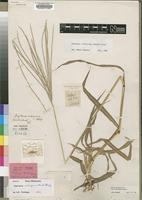
Name
Identification
Panicum milanjianum Rendle [family POACEAE ] Isotype of Digitaria milanjiana (Rendle) Stapf [family POACEAE ] (stored under name); Verified by Veldkam,J.F.,
Related name
- Digitaria milanjiana
- Panicum milanjianum
Flora
Entry for DIGITARIA milanjiana Stapf [family ]
Herbarium
Royal Botanic Gardens, Kew (K)
Collection
Flora of Tropical Africa
Resource Type
Reference Sources
Entry From
Flora of Tropical Africa, Vol 9, page 1, (1917) Author: (By O. STAPF.)
Names
DIGITARIA milanjiana Stapf [family ]
DIGITARIA sanguinalis Rendle var. ciliaris [family ], in Cat. Afr. Pl. Welw. ii. 163.
DIGITARIA sanguinalis Rendle var. extensa [family ], in Cat. Afr. Pl. Welw. ii. 163.
DIGITARIA Swynnertonii Rendle [family ], in Journ. Linn. Soc. Bot. xl. 227, t. 6, figs. 6–10.
Panicum milanjianum Rendle [family POACEAE], in Trans. Linn. Soc. ser. 2, Bot. iv. 56.
Panicum sanguinale Eyles var. ciliare [family POACEAE], in Trans. R. Soc. S. Afr. v. 301 (partly); not of others.
Information
Perennial, loosely cæspitose from rather slender descending or creeping rhizomes, stoloniferous; stolons covered with short ovate obtuse strongly nerved and appressedly hairy or glabrescent thin cataphylls, sometimes rather long and branching. Culms erect or subgeniculate or gently ascending, 1 to over 3 ft. high, slender to stout, glabrous, basal internodes often numerous, followed by 2 or 4 (rarely more) elongated internodes, the terminal by far the longest. Leaves usually numerous at the base, thin, subherbaceous, rather loose, the lower generally keeled and often distinctly laterally compressed, short or long, glabrous or hirsute to villous, the upper mostly glabrous or nearly so, more terete and tight; ligules scarious, truncate, crenulate, glabrous, up to 1 lin. long; blades linear to linear-lanceolate from an equally wide base, tapering to a fine point, 2 to over 1 ft. by 1 1/2–5 lin., the lowest often short, flat, rather firm, glaucous-green, glabrous or more or less appressedly hirsute to almost tomentose, margins finely cartilaginous, often crisped, slightly rough, midrib very slender, obscure above, prominent below, lateral nerves fine, close, often obscure. Racemes few to many (up to 15), suberect or oblique, digitate or subdigitate and sessile, on a more or less stout and angular mostly short common axis, rather stiff and dense, 3–5 or occasionally up to 9 in. long, green or tinged (sometimes richly) with purple; rhachis trigonous, slightly wavy, 1/4– 2/5 lin. wide, lateral angles narrowly winged or marginate, scabrid, internodes about 1 lin. long; pedicels 2-nate, filiform, angular, scaberulous, the longer 3/5– 3/4 (rarely 1) lin. long. Spikelets tightly appressed, imbricate to subimbricate, lanceolate-oblong to linear-lanceolate, acute or acutely acuminate, 1 1/4–1 1/2 lin. long, glabrous (at least apparently) or somewhat silky on the sides or ciliate-fimbriate. Lower glume a minute ovate acute or obtuse membranous scale; upper thin, lanceolate to linear-lanceolate, acute to acuminate, 6/10– 7/10 lin. long (excluding the apical hairs), 3-nerved, with usually appressed fine thin-walled obtuse-tipped hairs 1/5 lin. long (or if longer then also stiffer and subacute) between the nerves and along the margin. Lower floret corresponding in outline and size to the spikelet: valve rather firm, 7-nerved, nerves scaberulous, with fine lines of short hairs between the inner side-nerves and along the margins, the hairs often so closely appressed that the spikelets appear glabrous or the hairs of the inner lines mixed with or almost entirely replaced by yellowish acute at length rigidly spreading fine bristles up to over 1/2 lin. long; valvule and lodicules minute or the former up to 1/5 lin. long. Upper floret lanceolate, acutely acuminate, very slightly shorter than the lower, often purplish: valve thinly chartaceous. Anthers 1/2– 3/4 lin. long.
Distribution
Congo Lower Guinea Landana Hills, in sandy pastures, Gossweiler, 6054! Loanda, in sandy grassland, Gossweiler, 1567! 1579! 1610! Welwitsch, 7322! 7349! 7468! 7470! Barra do Dande; on the banks of the river Dande near Bombo, Welwitsch, 7280! Pungo Andongo (?), Welwitsch, 2855!Portuguese East Africa Mozamb. Dist. Shupanga, Kirk ! near Moramballa, Kirk ! between Lupata and Senna, Kirk ! Zinymbo Hills, 1500 ft., Swynnerton, 1554!Nyasaland Mozamb. Dist. Shire Highlands, Buchanan, 44! Mount Milanje, Whyte !Rhodesia Mozamb. Dist. near Mumbwa, Mrs. Macaulay, 43! Victoria Falls, Allen, 271! Mashonaland; North Mazoe District, Mundy ! Salisbury, Eyles, 629! 633! Mrs. Craster, 9! 24! Matabeleland; Bulawayo, Appleton, 26! Insiza District, Mundy ! Gazaland; Chirinda, Swynnerton, 1627!British East Africa Nile Land Rabai Hills near Mombasa, Taylor ! Tanaland, Linton, 210! Ukambani; in grass-land near Kibwezi, 3300 ft., Scheffler, 152!
Notes
A species of very varied habit and probably very plastic. The specimen from which it was originally described represents a rather robust state with erect or suberect culms 4 ft. high, rather long and glabrous or almost glabrous basal sheaths, and numerous long (5–8 in.) racemes. To it belong all the East African and Nyasaland specimens, and of the Angolan, Welwitsch, 2855, 7322 and 7349, and Gossweiler, 1610 and 6054. A curious form distinguished by radiating rather short culms, often long stolons, short and usually densely villous basal sheaths, and fewer and shorter (3–4 in.) racemes, was collected by Welwitsch (7468 and 7470) and Gossweiler (1567 and 1579) in the same area, mostly in sandy ground where according to Gossweiler the roots contribute considerably to the stabilization of the sand. The spikelets are rather uniform as to disposition, size and structure (apart from the presence or absence of setulæ).