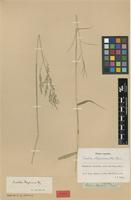
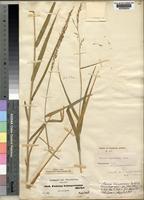
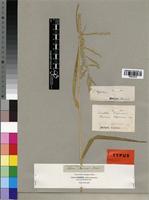
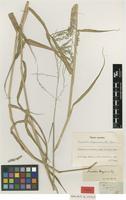
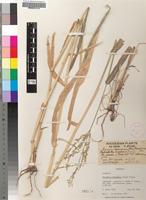
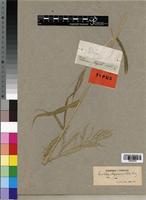
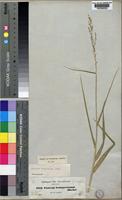
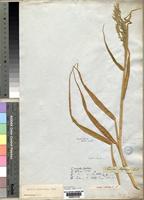
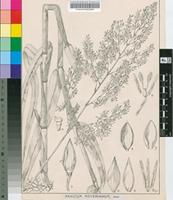
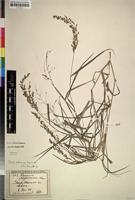
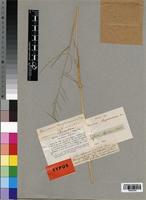
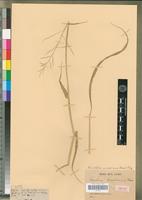
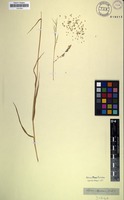
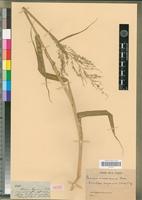
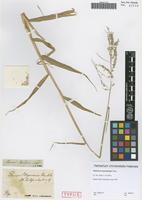
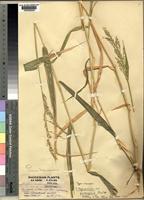
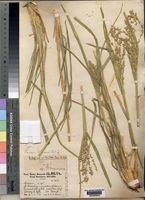
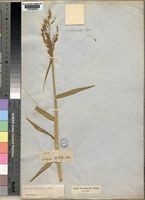
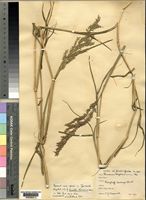
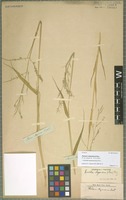
perennial; culms ascending from a decumbent branched rooting base (always?), rather stout, 2–3 ft. long, terete, glabrous, 5- to many-noded, sheathed all along or the upper 1–2 internodes exserted; leaves more or less glaucous; sheaths rather loose, glabrous, except at the pubescent nodes, or with scattered tubercle-based hairs; ligule a fringe of very short hairs; blades linear-lanceolate from a rounded contracted base, long tapering to a fine point, 4–8 in. by 3–6 lin., glabrous except at the minutely villous junction with the sheath; panicle subpyramidal, 3–6 in. long, up to 4 in. wide; axis very slender, angular, glabrous or pubescent below the nodes, angles scaberulous at least in the upper part; branches usually obliquely spreading, scattered or the lower opposite or subopposite, the upper simple or subsimple, racemose; the lower distantly branched almost from the finely tomentose base, more or less secund, filiform, scaberulous, the lowest up to 3 in. long; pedicels solitary or 2-nate, the longer up to 1 lin. long, filiform, scaberulous and usually with 1–3 fine long hairs, tips discoid; spikelets rather crowded, at least towards the tips of the branches and branchlets, ovate-oblong, acute to subacuminate, 1 1/2 lin. long, glabrous, glaucous, contracted at the base into a very short stalk; lower glume minute, truncate or apiculate, hyaline, white or purplish; upper membranous, oblong, acute to subacuminate, faintly 5-nerved; lower floret ♂; valve like the upper glume; pale equal to the valve, oblong; anthers 1/2 lin. long; hermaphrodite floret oblong, obtuse or minutely apiculate; valve subcoriaceous, 5-nerved, whitish, very finely pitted; anthers up to 3/4 lin. long. null