JSTOR Global Plants Home
  • Home
  • Browse
  • About
  • Access
  • Account
    • Saved Items
    • Profile
  • Log in

Global Plants

Skip to Main Content
  • JSTOR Global Plants Home
  • Global Plants

    • Browse
    • About
    • Access
    • Account
      • Saved Items
      • Profile
Log in
  • Browse
  • About
  • Access
  • Account
    • Saved Items
    • Profile
Advanced Search

Compilation
Panicum laticomum

14 Images see all

Panicum laticomum Nees
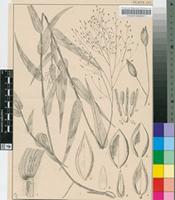
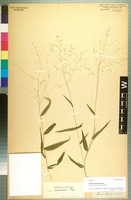
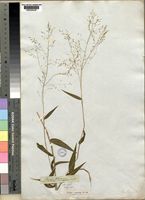
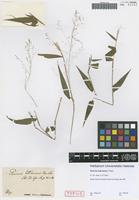
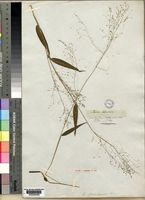
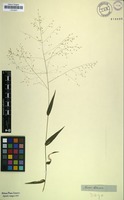
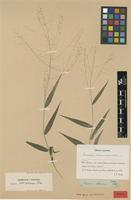
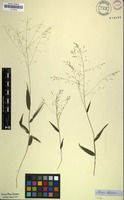
Isotype of Panicum laticomum Nees [family POACEAE]
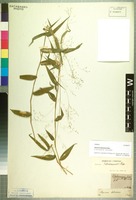
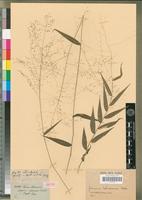
Type of Panicum laticomum Nees [family POACEAE]
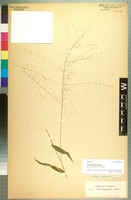
Isotype of Panicum laticomum Nees [family POACEAE]
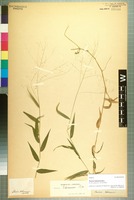
Type of Panicum laticomum Nees [family POACEAE]
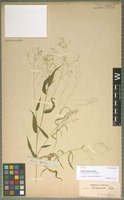
Isotype of Panicum laticomum Nees [family POACEAE]
Previous
Next

Name

Identification
Panicum laticomum Nees [family POACEAE ]
Related name
  • Panicum laticomum

Flora

Entry for PANICUM laticomum Nees [family POACEAE]
Herbarium
Royal Botanic Gardens, Kew (K)
Collection
Flora Capensis
Resource Type
Reference Sources
Entry From
Flora Capensis, Vol 7, page 310, (1900) Author: (By O. STAPF.)
Names
PANICUM laticomum Nees [family POACEAE], Fl. Afr. Austr. 43;—Steud. Syn. Pl. Glum. i. 84; Durand & Schinz, Consp. Fl. Afr. v. 752; K. Schum. in Engl. Pfl. Ost-Afr. B. 81.
Information
perennial, culms ascending, divided above the base into somewhat spreading long leafy flowering branches, slender, 1 1/2–2 ft. long, minutely hairy or glabrous, many-noded, internodes exserted; sheaths tight, thin, striate, hairy, often with tubercle-based hairs or glabrescent except at the nodes and near the junction with the blade; ligule a minutely ciliolate rim; blades spreading, lanceolate from a rounded base, acutely acuminate, 1 1/2–3 in. by 1/4– 1/2 in., flat, very thin, sparingly and finely hairy, margins scabrid; panicle erect, very lax, delicately and divaricately branched, about 1/2 ft. long; axis filiform, terete and smooth below, angular and finely scabrid above; branches in fascicles of 4–2 or solitary, unequal, at length spreading, finely filiform to capillary, very laxly divided, often from 1–2 in. above the base; branchlets and pedicels extremely fine, scaberulous, lateral pedicels 1–4 lin. long, tips scarcely thickened; spikelets oblong, acute at both ends, slightly more than 1 lin. long, glabrous, green; glumes, very thinly herbaceous, lower broadly ovate, subobtuse, 1/2 lin. long, 3-nerved; upper glume somewhat remote from the lower, oblong, acute, almost 1 lin. long, 5-nerved, middle nerve scaberulous above; lower floret barren; valve like the upper glume, but slightly longer; pale 1/2 the length of the valve; hermaphrodite floret oblong, obliquely apiculate or acute, equalling or slightly exceeding the upper glume; valve subcoriaceous, whitish, faintly 5-nerved; anthers 1/2 lin. long; grain obovoid, 1/2 lin. long, white. null
Distribution
EASTERN REGION Natal; shady woods near Durban, Drège, 4289! Coastland, Sutherland! and without precise locality, Gerrard, 89!
Notes
The fruiting florets often separate from the remainder of the spikelet, which remains for a while attached to the pedicel, but falls at length as a whole. The habit is not unlike that of Isachne albens, Trin.

Related Materials

  • Terms and Conditions
  • Privacy Policy
  • Cookie Policy
  • Cookie Settings
  • Accessibility
  • Help
  • Contact Us
  • Facebook
  • Twitter
ITHAKA

JSTOR is part of ITHAKA, a not-for-profit organization helping the academic community use digital technologies to preserve the scholarly record and to advance research and teaching in sustainable ways.

©2000-2026 ITHAKA. All Rights Reserved. JSTOR®, the JSTOR logo, JPASS®, Aluka®, and ITHAKA® are registered trademarks of ITHAKA.

╳