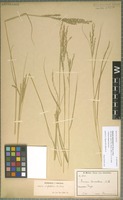
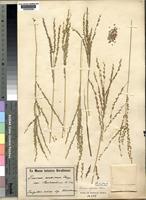
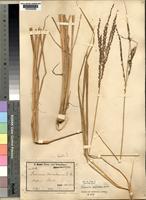
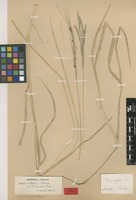
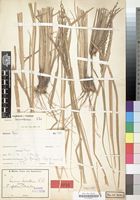
Perennial, up to over 4 ft. high, compactly tufted on a very short rhizome with intravaginal innovations. Culms erect or geniculately ascending, rather slender (not much over 1 lin. in diam.) 4–5-noded, sparingly branched with long erect branches, compressed below, terete above, usually softly hairy below the nodes, hairs spreading or subappressed, sometimes very long. Leaf-sheaths tight, the lower much compressed, strongly keeled, up to over 6 in. long, the upper terete below but keeled upwards, all finely striate or more strongly so at the base and more or less softly hirsute to almost villous, particularly towards the densely bearded nodes, or the uppermost glabrous upwards, but mostly with a band of hairs or a beard at the junction with the blade; ligules very short, membranous, truncate, silkily ciliate; blades erect, linear from a long and often much attenuated folded and keeled base, flat above the latter, tapering to a long slender point, up to 1 1/2 ft. long, from 1 lin. wide at the folded base to over 5 lin. at the flat middle, rather firm and flexuous, more or less hairy like the sheaths, midrib slender, but very prominent below from the keeled portion of the blade upwards, nerves fine and very close, the primary laterals hardly differentiated. Panicle 6–9 in. long, of 7–10 suberect fastigiate slender spiciform branches borne singly and at subequal or upwards shortened distances on a common axis, 3–4 in. long, slender, more or less terete and pubescent or beset with long spreading hairs below, angular and scabrid upwards; branches 3–5 in. long, the uppermost or at least some of them quite as long as the rest, filiform, upwards triquetrous, scabrid, bearing from the villosulous or pubescent base, or a short distance above it, 3–2-spiculate clusters or short racemes of spikelets, usually distant by less than their own length, the nodes usually with some long fine spreading white hairs; pedicels subcapillary, scaberulous, often with long spreading hairs from below the minutely cupular tips, those of a cluster very unequal, the longest rarely much over 1 lin. long. Spikelets oblong, acutely or mucronate-apiculate, from not quite 1 1/2 to over 1 3/4 lin. long, green or slightly tinged with purple, with usually black-purple tips, glabrous. Glumes very dissimilar, lower broad-ovate, subacute, about the length of the spikelet, subhyaline, faintly 3-nerved; upper corresponding in size and outline to the broad back, convex, membranous, faintly 5-nerved. Lower floret ♂: valve very like the upper glume, but the back depressed along the midnerve; valvule oblong, acute, flaps much widened downwards; anthers 3/4 lin. long. Upper floret hermaphrodite, oblong, obtuse, about 1–1 1/4 lin. long, whitish; valve and valvule thinly crustaceous, finely transversely rugose.