JSTOR Global Plants Home
  • Home
  • Browse
  • About
  • Access
  • Account
    • Saved Items
    • Profile
  • Log in

Global Plants

Skip to Main Content
  • JSTOR Global Plants Home
  • Global Plants

    • Browse
    • About
    • Access
    • Account
      • Saved Items
      • Profile
Log in
  • Browse
  • About
  • Access
  • Account
    • Saved Items
    • Profile
Advanced Search

Compilation
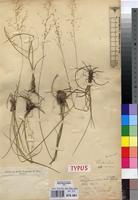
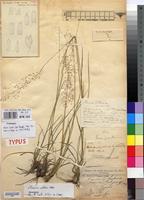
Panicum katentaniense

2 Images see all

Type of Panicum katentaniense Robyns [family POACEAE]
Previous
Next

Name

Identification
Panicum katentaniense Robyns [family POACEAE ] Verified by Not on sheet, Panicum ecklonii Nees [family POACEAE ] (stored under name); Verified by Not on sheet,
Related name
  • Panicum ecklonii
  • Panicum katentaniense

Flora

Entry for Panicum ecklonii Nees [family GRAMINEAE]
Herbarium
Royal Botanic Gardens, Kew (K)
Collection
Flora Zambesiaca
Resource Type
Reference Sources
Entry From
FZ, Vol 10, Part 3, (1989) Author: W. D. Clayton
Names
Panicum ecklonii Nees [family GRAMINEAE], Fl. Afr. Austr.: 43 (1841). — Clayton in F.W.T.A. 3: 429 (1972). — Clayton & Renvoize in F.T.E.A. Gramineae: 466 (1982). Type from S. Africa.
Panicum pectinatum Rendle [family GRAMINEAE], in Trans. Linn. Soc. Bot. 4: 54 (1894). — Stapf in F.T.A. 9: 719 (1920). — Jackson & Wiehe, Annot. Check List. Nyasal. Grass.: 52 (1958). Type: Malawi, Mt. Mulange (Milanje), Whyte (K, isotype).
Panicum catangense Chiov. [family GRAMINEAE], in Ann. Bot. Roma 13: 44 (1914). Type from Zaire (Shaba, Katanga).
Panicum katentaniense Robyns [family GRAMINEAE], in Mém. Inst. Col. Belge, Sec. Sci Nat & Med 1:57 pl 5 f A-F (1932). Type from Katanga.
Information
Caespitose perennial, usually densely pubescent at the base. Culms 15–80 cm. high, erect, simple. Leaves mostly basal, pilose with both simple and gland-tipped hairs; laminae 5–18(27) × 0.1–0.9 cm., linear to lanceolate, flat, bluntly to setaceously acute. Panicle 6–12(18) cm. long, oblong or ovate, glabrous or clavellate-hairy, moderately to much-branched, the branches ascending or spreading usually fine and flexuous. Spikelets 2.5–3.5 mm. long, oblong, glabrous except for the puberulous apex; inferior glume 1/5–1/2 the length of the spikelet, 3-nerved, pectinate; superior glume 1/2–3/4 the length of the spikelet, 5-nerved, pectinate; inferior lemma 3/4 to as long as the spikelet, 7-nerved, pectinate; sterile; superior lemma and palea glossy, puberulous at the apex.
Habitat
Grassland, in rocky places
Range
W. Africa eastwards to Zaire and southern Tanzania, southwards to S. Africa
Altitude range
1200–2700 m.
2700
1200
Distribution
Zambia N Mbala, 11.x.1966, “Comp. herb.”2248 (K).Zimbabwe E Nyanga (Inyanga) Nat. Park, 9.vii.1975 Cleghorn 3060 (K; SRGH).Malawi N Nyika Plateau, 23.xii.1977, Pawek 13342 (K; SRGH).Mozambique MS Beira Distr., vii.1971, Tinley 2133 (K; SRGH).Zambia W Mwinilunga Distr., SW. of Dobeka Bridge, 4.ix.1937, Milne-Redhead 3088 (K).Malawi S Mulanje, 6.xi.1972, Leach 14965 (K; SRGH).
Notes
A wide range of leaf lamina size has been admitted to this species. Very narrow forms were previously separated as Panicum pectinatum but the range of variation appears to be continuous and in the absence of any other distinguishing features this name is here included under Panicum ecklonii. Panicum omega Renv. from southern Tanzania is closely related to Panicum ecklonii, it is distinguished by its smaller spikelets 1.5–2 mm. long and the total absence of clavellate hairs.

Related Materials

  • Terms and Conditions
  • Privacy Policy
  • Cookie Policy
  • Cookie Settings
  • Accessibility
  • Help
  • Contact Us
  • Facebook
  • Twitter
ITHAKA

JSTOR is part of ITHAKA, a not-for-profit organization helping the academic community use digital technologies to preserve the scholarly record and to advance research and teaching in sustainable ways.

©2000-2026 ITHAKA. All Rights Reserved. JSTOR®, the JSTOR logo, JPASS®, Aluka®, and ITHAKA® are registered trademarks of ITHAKA.

╳