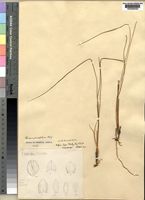
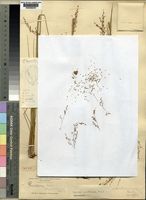
Perennial, cæspitose, up to over 2 ft. high, with extravaginal innovations rising close to the mother culm, cataphylls quite glabrous. Culms erect, slender, simple, terete, 1-noded, node faint, below the middle, glabrous and very smooth. Leaf-sheaths tight, firm, glabrous and smooth, striate, the bases of the lowest persistent; ligule obscure, reduced to a transverse line; blades junciform, very firm and rigid, erect, tapering to an acute point, deeply channelled with the margins touching, 1/3 to almost 1/2 lin. across, or flattened out upwards and then up to over 1 lin. wide, rarely flat all along, the basal up to over 1 ft. long, the cauline considerably shorter, glabrous, the upper (inner) side with about 1 or 2 very prominent primary lateral nerves on each side of the similar midrib, the lower side quite smooth. Panicle erect, oblong, open, but with the spikelets somewhat crowded along the branches, 5–8 in. by 1 1/2–4 in., divided to the third or fourth degree; common axis slender, terete, very smooth, lowest internodes 1–2 in. long; lower primary branches solitary, usually divided from the base, occasionally forming very unequal false whorls, the longest over half the length of the panicle, obliquely spreading or more erect, flexuous or somewhat stiff, filiform, quite terete and smooth, divided again from low down, with the ultimate divisions rather contracted and capillary; the rather short pedicels slightly unequal and mostly 1–1 1/2 lin. long, their tips discoid. Spikelets elliptic-oblong, subacute, about 1 lin. long, olive- or brownish-green, here and there with a faint metallic lustre, quite glabrous. Glumes membranous, finely and here and there prominently nerved, subobtuse, the lower narrower in profile, three-quarters the length of the spikelet or only slightly shorter than the spikelet, 3-nerved, upper much broader, deeply concave, 5-nerved. Lower floret ♂: valve very similar to the upper glume; valvule slightly shorter, keels faintly scaberulous; anthers 2/3 lin. long. Upper floret hermaphrodite, oblong, subacute, 2/3 lin. by 1/4 lin., whitish; valve and valvule very thinly papery, quite smooth or with a few extremely minute warts; anthers slightly smaller than in the ♂ floret.