JSTOR Global Plants Home
  • Home
  • Browse
  • About
  • Access
  • Account
    • Saved Items
    • Profile
  • Log in

Global Plants

Skip to Main Content
  • JSTOR Global Plants Home
  • Global Plants

    • Browse
    • About
    • Access
    • Account
      • Saved Items
      • Profile
Log in
  • Browse
  • About
  • Access
  • Account
    • Saved Items
    • Profile
Advanced Search

Compilation
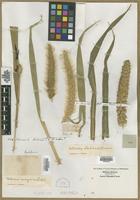
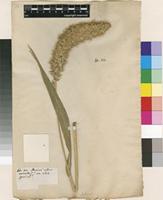
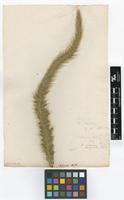
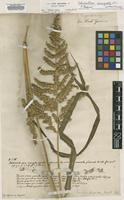
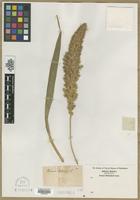
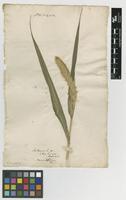
Panicum italicum

6 Images see all

Filed as Panicum italicum L. [family POACEAE]
Original material of Panicum italicum L. [family POACEAE]
Filed as Panicum italicum L. [family POACEAE]
Filed as Setaria italica (L.) P.Beauv. f. maxima longiseta [family POACEAE]
Filed as Setaria italica (L.) P.Beauv. [family POACEAE]
Previous
Next

Name

Identification
Panicum italicum L. [family POACEAE ] (stored under name); Panicum italicum L. [family POACEAE ] Verified by J. F. Veldkamp, Echinochloa crusgalli (L.) P.Beauv. [family POACEAE ] Verified by Elizabeth Fortson Wells,
Related name
  • Panicum italicum
  • Panicum not on sheet
  • Setaria italica
  • Echinochloa crusgalli

Flora

Entry for SETARIA italica Beauv. [family POACEAE]
Herbarium
Royal Botanic Gardens, Kew (K)
Collection
Flora Capensis
Resource Type
Reference Sources
Entry From
Flora Capensis, Vol 7, page 310, (1900) Author: (By O. STAPF.)
Names
SETARIA italica Beauv. [family POACEAE], Agrost. 51;—Kunth, Rév. Gram. i. 46; Enum. i. 153, Suppl. 108; Durand & Schinz, Consp. Fl. Afr. v. 773; K. Schum. in Engl. Pfl. Ost-Afr. B. 73, C. 105; Hook. f. Fl. Brit. Ind. vii. 78.
Panicum italicum Linn. [family POACEAE], Sp. Pl. 56; Host, Gram. Austr. iv, t. 14; Trin. Gram. Spec. Ic. t. 198; Pan. Gen. 135, and in Mém. Acad. Pétersb. sér. vi. iii. 223; Steud. Syn. Pl. Glum. i. 51; Koern. & Wern. Handb. Getreidebaues, i. 259.
Information
annual; culms fascicled, erect or geniculate, often stout, terete, 2–5 ft. long, simple or almost so, glabrous, smooth or scabrid below the panicle, 5–7-noded, sheathed all along or some internodes at length exserted; sheaths terete, striate, glabrous except at the finely villous or ciliate margins and a similar transverse line at the junction with the blade; ligule a densely hairy rim; blades linear, very long tapering to a setaceous point, 1/2–1 1/2 ft. by 3–10 lin., flat, flaccid, scaberulous, particularly above, glabrous, margins scabrid to spinulous; panicle often nodding or flexuous, spike-like, cylindric, stout, often lobed, 1 1/2–12 in. by 4–12 lin., rather dense to compact, shortly or long bristly; axis rather stout, usually tomentose; branches spirally arranged or more or less whorled, very short and branched from the base or the lower 1/2– 3/4 in. long, and undivided at the tomentose base; branchlets reduced to dense sessile or subsessile clusters; each spikelet usually subtended by a pair of scabrid green or purplish bristles, 1 1/2–4, rarely up to 8 lin., long, or the bristles more numerous owing to the reduction or suppression of some of the spikelets; spikelets oblong-ellipsoid to globose, obtuse, 1–1 1/4 lin. long, light green, glabrous; lower glume hyaline, broad, ovate, acute, 1–3-nerved, about 1/3 as long as the spikelet; upper glume thin, membranous, elliptic, concave, 5- to sub-7-nerved, 2/3– 3/4 as long as the spikelet; lower floret barren; valve similar to the upper glume, dorsally flattened, 5-nerved, equalling the upper (at least when in flower); pale hyaline, more or less arrested or 0; hermaphrodite floret ellipsoid to globose, obtuse or obscurely apiculate, 1–1 1/4 lin. long, whitish yellowish or reddish; valve papery to crustaceous, smooth or very obscurely wrinkled, 5-nerved; anthers 1/3 lin. long; grain ellipsoid or subglobose, about 3/4 lin. long, whitish. null
Range
Cultivated from South Europe to Japan, particularly in Northern China, occasionally also elsewhere.
Distribution
CENTRAL REGION Albert Div.; without precise locality, Cooper, 638!
Notes
Koernicke considers it as descended from S. viridis, Linn. As to the copious synonymy of this grass which is very rarely grown in Africa, see Hook f. Fl. Brit. Ind. l.c., and as to the numerous varieties Koernicke & Werner, l.c.

Related Materials

  • Terms and Conditions
  • Privacy Policy
  • Cookie Policy
  • Cookie Settings
  • Accessibility
  • Help
  • Contact Us
  • Facebook
  • Twitter
ITHAKA

JSTOR is part of ITHAKA, a not-for-profit organization helping the academic community use digital technologies to preserve the scholarly record and to advance research and teaching in sustainable ways.

©2000-2026 ITHAKA. All Rights Reserved. JSTOR®, the JSTOR logo, JPASS®, Aluka®, and ITHAKA® are registered trademarks of ITHAKA.

╳