JSTOR Global Plants Home
  • Home
  • Browse
  • About
  • Access
  • Account
    • Saved Items
    • Profile
  • Log in

Global Plants

Skip to Main Content
  • JSTOR Global Plants Home
  • Global Plants

    • Browse
    • About
    • Access
    • Account
      • Saved Items
      • Profile
Log in
  • Browse
  • About
  • Access
  • Account
    • Saved Items
    • Profile
Advanced Search

Compilation
Panicum holubii

4 Images see all

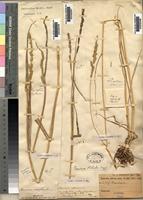
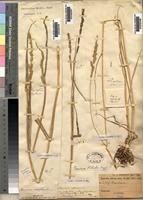
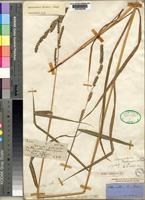
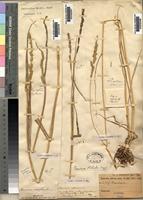
Syntype of Panicum holubii Stapf [family POACEAE]
Echinochloa pyramidalis (Lam.) Hitchc. & Chase [family POACEAE]
Previous
Next

Name

Identification
Panicum holubii Stapf [family POACEAE ] Echinochloa pyramidalis (Lam.) Hitchc. & Chase [family POACEAE ] (stored under name); Panicum colonum L. [family POACEAE ] Echinochloa holubii (Stapf) Stapf [family POACEAE ] Verified by Stapf, O.,
Related name
  • Echinochloa pyramidalis
  • Echinochloa holubii
  • Panicum holubii
  • Panicum colonum
  • Echinochloa crus-galli

Flora

Entry for PANICUM Holubii Stapf [family POACEAE]
Herbarium
Royal Botanic Gardens, Kew (K)
Collection
Flora Capensis
Resource Type
Reference Sources
Entry From
Flora Capensis, Vol 7, page 310, (1900) Author: (By O. STAPF.)
Names
PANICUM Holubii Stapf [family POACEAE]
Information
perennial; culms erect or geniculate from a slender rhizome, 2–3 ft. long, terete, glabrous, 4–5-noded, sheathed all along or the upper internodes exserted; leaves glabrous; sheaths rather loose, terete, striate, bases of the lowest persistent, breaking up into fibres; ligule a fringe of fine hairs; blades linear, scarcely narrowed or constricted at the base, long-tapering to a fine point, 4–10 in. by 2–3 lin., more or less glaucous, smooth except in the upper part, margins finely cartilaginous, smooth or scabrid; false spikes adpressed to the slender compressed scabrid axis of a linear usually interrupted erect panicle from 4–6 in. long, compact, 4-ranked, 1/3– 3/4 in. long; rhachis slender, scabrid, slightly wavy, villous at the base: pedicels 2–3-nate, extremely short, tips discoid; spikelets oblong, subacute or cuspidate, 1 1/4–1 1/2 lin. long, pallid or variegated with purple; glumes very thin; lower broadly ovate, cuspidate, about 1/2 the length of the spikelet, 5-nerved, finely woolly-ciliate on the sides; upper oblong, very concave, tips short, slightly compressed, 5- or (at the tips) 7-nerved, nerves scantily or minutely hispid, margins very shortly woolly; lower floret ♂; valve very like the upper glume; pale subequal to the valve, keels scabrid; anthers 1/2 lin. long; hermaphrodite floret equalling the ♂, elliptic-oblong, shortly acuminate or cuspidate, light straw-coloured, back strongly convex; valve subcoriaceous, 5-nerved; anthers slightly over 1/2 lin. long. null
Range
Also on the upper Zambesi (Holub).
Distribution
COAST REGION King Williamstown Div.; Amatola Mountains, Buchanan, 1!KALAHARI REGION Bechuanaland; Kuruman, Burchell, 2128/7! Transvaal; Bosh Veld at Klippan, Rehmann, 5369; and without precise locality, Holub!
Notes
Burchell's specimen was grown in England from seeds collected by him near Kuruman. It is, in all parts, larger, the leaves attaining more than 1 ft. in length, and the false spikes almost to 2 in. The spikelets are distinctly cuspidate, and the anthers up to 1 lin. long.

Related Materials

  • Terms and Conditions
  • Privacy Policy
  • Cookie Policy
  • Cookie Settings
  • Accessibility
  • Help
  • Contact Us
  • Facebook
  • Twitter
ITHAKA

JSTOR is part of ITHAKA, a not-for-profit organization helping the academic community use digital technologies to preserve the scholarly record and to advance research and teaching in sustainable ways.

©2000-2026 ITHAKA. All Rights Reserved. JSTOR®, the JSTOR logo, JPASS®, Aluka®, and ITHAKA® are registered trademarks of ITHAKA.

╳