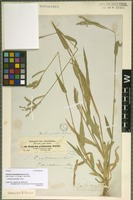
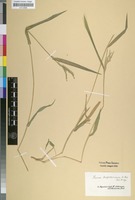
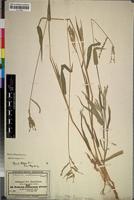
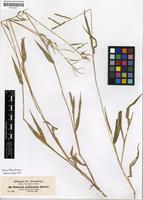
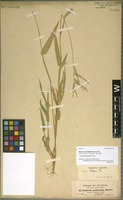
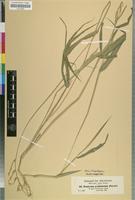
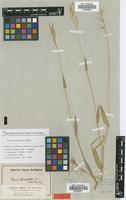
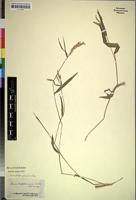
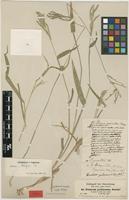
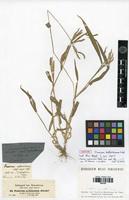
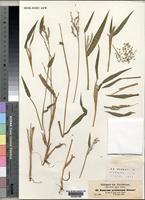
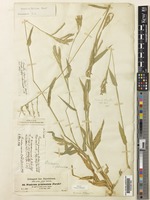
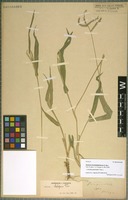
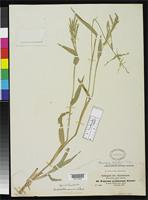
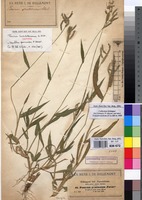
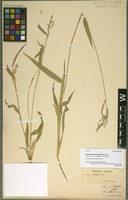
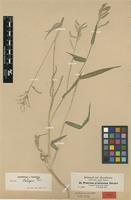
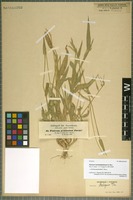
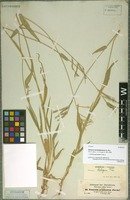
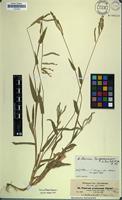
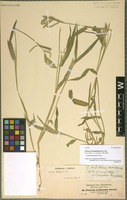
annual; culms suberect or ascending from a geniculate, sometimes decumbent and rooting, base, 1–2 ft. long, glabrous, striate, 4- to many-noded, branched or simple except at the base; leaves more or less finely hirsute with tubercle-based hairs, rarely glabrescent or glabrous; sheaths rather lax, pubescent to villous at the nodes, ciliate above; ligules very short, membranous, fimbriate; blades linear-lanceolate to lanceolate from a broad rounded or cordate base, acute to acuminate, 2–4 in. by 3–8 lin., flat, flaccid, margins often wavy, scabrid or fimbriate; false spikes 3–12, rather distant on a compressed or angular, scabrid and often pubescent common axis, suberect or spreading, secund, 2-ranked; rhachis linear, 1/4– 1/2 lin. broad, flat on the back, with a very prominent midrib on the face, scabrid or spinulously ciliate, and often with scattered fine long tubercle-based bristles as well; pedicels usually solitary, very short, stout, scabrid, pubescent, with or without 2–3 bristles near the thickened tips; spikelets contiguous or subimbricate, ovate to ovate-oblong, acute, 2–2 1/2 lin. long, pallid, glabrous; lower glume turned away from the rhachis, broadly ovate, clasping, obtuse, equalling 1/4– 1/3 of the spikelet, hyaline, 3–5-nerved; upper glume membranous, ovate to ovate-oblong, subacute to subacuminate, prominently 7–9-nerved; lower floret ♂ or barren; valve ovate, acuminate, 5–7-nerved; pale equal, subacute; hermaphrodite floret elliptic, rounded at both ends, 1 1/2 lin. long, pallid; valve with a scabrid mucro, up to 1/2 lin. long, transversely wrinkled, 5-nerved; anthers scarcely 1/2 lin. long; grain elliptic, dorsally compressed; embyro 3/4 the length of the grain. null