JSTOR Global Plants Home
  • Home
  • Browse
  • About
  • Access
  • Account
    • Saved Items
    • Profile
  • Log in

Global Plants

Skip to Main Content
  • JSTOR Global Plants Home
  • Global Plants

    • Browse
    • About
    • Access
    • Account
      • Saved Items
      • Profile
Log in
  • Browse
  • About
  • Access
  • Account
    • Saved Items
    • Profile
Advanced Search

Compilation
Panicum hippothrix

6 Images see all

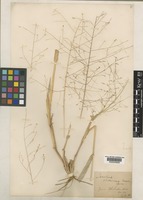
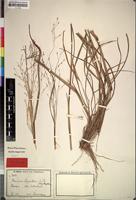
Panicum hippothrix K. Schum. ex Engl. [family POACEAE]
Isotype of Panicum hippothrix K.Schum. [family POACEAE]
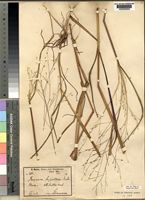
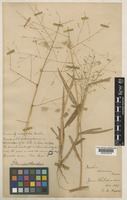
Type of Isachne obscurans Woodrow [family POACEAE]
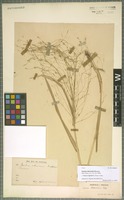
Panicum hippothrix K. Schum. ex Engl. [family POACEAE]
Isotype of Panicum hippothrix K. Schum. [family GRAMINEAE]
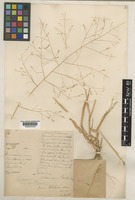
Panicum hippothrix K. Schum. ex Engl. [family POACEAE]
Previous
Next

Name

Identification
Isotype of Panicum hippothrix K.Schum. [family POACEAE ] (stored under name); Verified by Schumann,
Related name
  • Panicum hippothrix

Flora

Entry for PANICUM hippothrix K. Schum. [family POACEAE]
Herbarium
Royal Botanic Gardens, Kew (K)
Collection
Flora Somalia
Resource Type
Reference Sources
Entry From
Flora Somalia, Vol 4, (1995) Author: by T. A. Cope [updated by M. Thulin 2008]
Names
PANICUM hippothrix K. Schum. [family POACEAE], (1895).
Information
Coarse robust annual up to 100 cm high; leaves linear, 15–50 cm x 2–8 mm, straight at the base. Panicle often incompletely exserted from the uppermost sheath, ovate to oblong, 25–40 cm long, the spikelets sparsely distributed on stiff wiry spreading or ascending branches. Spikelets narrowly ovate, 3.5–4.5 mm long, acuminate; lower glume ovate, 2/3–3/4 the length of the spikelet, 5-nerved, acuminate; upper lemma pallid, glossy.
Range
S3
Distribution
SOMALIA Rose Innes 766.
Distribution (external)
Kenya
Tanzania

Related Materials

  • Terms and Conditions
  • Privacy Policy
  • Cookie Policy
  • Cookie Settings
  • Accessibility
  • Help
  • Contact Us
  • Facebook
  • Twitter
ITHAKA

JSTOR is part of ITHAKA, a not-for-profit organization helping the academic community use digital technologies to preserve the scholarly record and to advance research and teaching in sustainable ways.

©2000-2026 ITHAKA. All Rights Reserved. JSTOR®, the JSTOR logo, JPASS®, Aluka®, and ITHAKA® are registered trademarks of ITHAKA.

╳