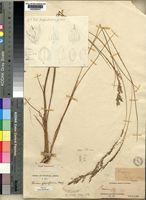
Perennial, densely cæspitose, over 2 ft. high, with intravaginal innovations and stout root-fibres. Culms erect, very slender, terete, 3–4-noded, simple, glabrous, smooth, internodes more or less exserted, the uppermost (peduncle) at length very long and grooved. Leaf-sheaths terete, tight, quite glabrous or sparingly ciliolate or ciliate towards the mouth and there slightly bearded, the lowest 1–2 1/2 in. long, more or less persistent; ligule reduced to a small ciliolate rim; blades very narrow, setaceously convolute with a fine subacute point, 4–7 in. by 1/2 or (when flattened out) 1 lin., rigid, glabrous or with some fine hairs towards the base, smooth except along the scaberulous margins and towards the tip, closely nerved, midrib slender, primary lateral nerves 2–3 on each side, slightly differentiated. Panicle slightly nodding, very narrow, 5–7 in. by 1/2– 2/3 in., contracted, divided up to the third degree, quite glabrous, all the divisions finely filiform to almost capillary and like the primary axis scaberulous; primary branches rather distant to beyond the middle and shorter or not very much longer than the internodes, then rapidly shorter and overlapping, hence the panicle subinterrupted below and rather dense upwards; pedicels slightly thickened at the tips, the lateral very short to 1/2 lin. long. Spikelets more or less gaping, 7/8 lin. long, slightly turgid, slightly variegated with purple, glabrous. Glumes similar but unequal, membranous, finely nerved; lower obliquely lanceolate in profile, acuminate, mucronulate, three-quarters the length of the spikelet, sub-5-nerved, lateral nerves short, midnerve and mucro scaberulous, tip standing off; upper obliquely oblong, acuminate, acumen involute or laterally compressed, usually very slightly recurved, nerves 5. Lower floret ♂: valve very similar to the upper glume and almost or quite as long, but broader downwards and much less acuminate, 5-nerved; valvule almost as long as the valve, subacute; anthers 1/2 lin. long. Upper floret hermaphrodite, oblong, obtuse, 3/4 lin. long, yellowish-white, glossy and smooth.