JSTOR Global Plants Home
  • Home
  • Browse
  • About
  • Access
  • Account
    • Saved Items
    • Profile
  • Log in

Global Plants

Skip to Main Content
  • JSTOR Global Plants Home
  • Global Plants

    • Browse
    • About
    • Access
    • Account
      • Saved Items
      • Profile
Log in
  • Browse
  • About
  • Access
  • Account
    • Saved Items
    • Profile
Advanced Search

Compilation
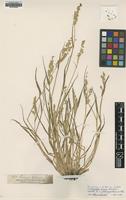
Panicum glabrescens

5 Images see all

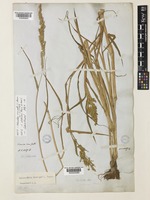
Syntype of Echinochloa glabrescens Munro ex Hook.f. [family POACEAE]
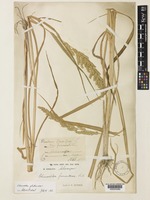
Holotype of Echinochloa glabrescens unrecorded var barbata Kon. [family POACEAE]
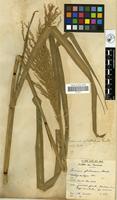
Filed as Panicum subalbidum Kunth [family GRAMINEAE]
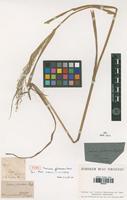
Type of Panicum glabrescens Steud. [family POACEAE]
Isotype of Echinochloa micans Kossenko [family POACEAE]
Previous
Next

Name

Identification
Panicum glabrescens Steud. [family GRAMINEAE ] Verified by Not on sheet, Panicum subalbidum Kunth [family GRAMINEAE ] (stored under name); Verified by S. Diop, 2008
Related name
  • Panicum glabrescens
  • Panicum subalbidum

Flora

Entry for PANICUM subalbidum Kunth [family POACEAE]
Herbarium
Royal Botanic Gardens, Kew (K)
Collection
Flora of Tropical East Africa
Resource Type
Reference Sources
Entry From
Flora of Tropical East Africa, page 451, (1982) Author: W. D. CLAYTON and S.A. RENVOIZE
Names
PANICUM subalbidum Kunth [family POACEAE], Rév. Gram. 2: 397 (1831); F.P.N.A. 3: 105 (1955); G.T.: 62 (1965); Clayton in F.W.T.A., ed. 2, 3: 434 (1972). Type: Senegal, Walo, Leprieur (P, holo.!)
PANICUM glabrescens Steud. [family POACEAE], Syn. Pl. Glum. 1: 71 (1854); Ann. list grasses Ug.: 31 (1947); F.P.S. 3: 505 (1956); R.K.G.: 39 (1958); Ann. list Nyasaland grasses: 50 (1958); I.G.U.: 46 (1960). Type: Senegal, Leprieur (whereabouts uncertain, not P)
PANICUM proliferum Stapf var. longijubatum [family POACEAE], in Fl. Cap. 7: 406 (1899). Types: South Africa, Natal, Williamson 21, Buchanan 247, Drège & Cape Province, Flanagan (all K, syn.!)
PANICUM longijubatum (Stapf) Stapf [family POACEAE], in F.T.A. 9: 718 (1920); Fl. Agrost. Congo Belge 2: 206 (1934)
PANICUM kermesinum Mez [family POACEAE], in E.J. 57: 189 (1921). Type: Cameroun, Adamoua, Ledermann 4115 (B, holo.!)
PANICUM ingens Peter [family POACEAE], F.D.O.-A. 1, Anh.: 40: t. 24/2 (1930). Type: Tanzania, Tabora District, Ngulu, Peter 34926 (B, holo.†)
PANICUM longiramum Peter [family POACEAE], F.D.O.-A. 1, Anh.: 44, t. 29/1 (1930). Type: Tanzania, Tabora District, Ngulu, Peter 34539 (B, holo.†)
Information
Robust annual or short lived perennial; culms 60–200 cm. high, 5–10 mm. in diameter at the base, erect or decumbent, often rooting at the lower nodes, the lower leaf-sheaths papery, loose; nodes glabrous, sharply demarcated, usually dark, the pigment strictly confined to the node. Leaf-blades linear, 20–50 cm. long, 7–15 mm. wide, cordate to straight at the base, flat, lax, glabrous or sparsely pilose, acuminate. Panicle ovate or oblong, 20–50 cm. long, sparsely to moderately branched, spreading, the spikelets evenly dispersed. Spikelets ovate, 3–3.5 mm. long, acuminate; lower glume broadly ovate, 1/4–1/3 the length of the spikelet, membranous, 1–3-nerved, cuff-like, clasping the base of the spikelet, obtuse or acute; upper glume ovate, as long as the spikelet, membranous, 7–9-nerved, acuminate; lower lemma similar to the upper glume, sterile, its palea absent or poorly developed; upper lemma pale and glossy.
Range
DISTR. U2, 4; K1, 3–5; T1–8; Z throughout tropical Africa
Altitude range
200–3400 m.
Distribution
KENYA Northern Frontier Province Marsabit, 24 Mar. 1959, Bogdan 4786!KENYA Kiambu District Kikuyu area, 15 Oct. 1934, D.C. Edwards 2947!KENYA Kiambu District Limuru, Feb. 1915, Dummer 1514!TANZANIA Lushoto District Mkuzi, 21 Apr. 1953, Drummond & Hemsley 2180!TANZANIA Mpanda District near Tumba, 27 Jan. 1951, Bullock 3633!TANZANIA Songea District about 5.5 km. W. of Songea, 23 Feb. 1956, Milne-Redhead & Taylor 8876!TANZANIA Zanzibar I., Chemani, Mar. 1944, R.M. Davies 18!UGANDA Bunyoro District R. Kafu, 4 Sept. 1943, A.S. Thomas 3762! & Masindi, Lewys-Lloyd 245!UGANDA Ankole District Buhweju, 15 Aug. 1929, Snowden 1412!
Notes
P. subalbidum is very similar to P. porphyrrhizos, but is distinguished by its distinct nodes and generally more succulent habit; it also favours moister habitats and is commonly found standing in water. The robust culms are often rather soft in P. subalbidum, whereas in P. porphyrrhizos they tend to be tough and wiry.

Related Materials

  • Terms and Conditions
  • Privacy Policy
  • Cookie Policy
  • Cookie Settings
  • Accessibility
  • Help
  • Contact Us
  • Facebook
  • Twitter
ITHAKA

JSTOR is part of ITHAKA, a not-for-profit organization helping the academic community use digital technologies to preserve the scholarly record and to advance research and teaching in sustainable ways.

©2000-2026 ITHAKA. All Rights Reserved. JSTOR®, the JSTOR logo, JPASS®, Aluka®, and ITHAKA® are registered trademarks of ITHAKA.

╳