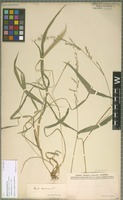
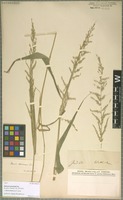
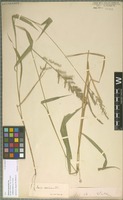
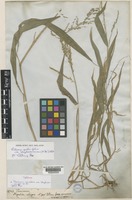
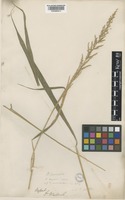
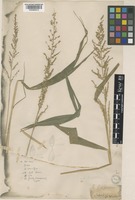
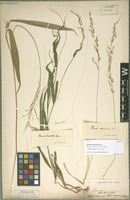
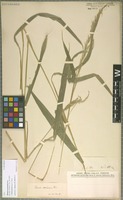
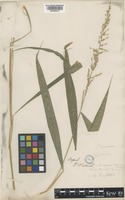
perennial; culms erect or ascending from a short, prostrate and rooting base, stout, 5–12 ft. high, compressed below, sometimes pubescent and scabrid close to the panicle, otherwise usually glabrous and smooth, 5- or more-noded, sheathed almost all along or upper internodes exserted; sheaths long, rather tight, glabrous or hirsute, the lowest strongly compressed, subpersistent; ligule a densely ciliate rim; blades lanceolate to linear-lanceolate from a long and much attenuate or even petioled base, tapering to an acute point, 1 1/2–3 ft. by 1–3 1/2 in., closely plicately folded when young, then opening out (folds very numerous), glabrous or hairy, scabrid above towards the tip; panicle linear or linear-oblong, usually interrupted, 1 to more than 2 ft. long, often nodding; axis angular, glabrous or puberulous, scaberulous above; branches solitary, irregularly approximate or almost whorled, 1/2–6 in. long, scabrid, spike-like, dense, bearing fascicles of spikelets below and solitary spikelets above, or the lower with similar more or less distant branchlets at the base; bristles solitary, fine, scaberulous, wavy, 1–8 lin. long, terminating the branches and branchlets and at the base of some or most of the lower and middle spikelets; pedicels very short, scabrid, tips subdiscoid; spikelets oblong, acute, 1 1/2 lin. long, glabrous, green or tinged with purple; glumes herbaceous-membranous, very broadly ovate, obtuse or subacute, lower 3-nerved, 1/3 to almost 1/2 as long as the spikelet, upper 5- to sub-7-nerved, 1/2– 2/3 as long as the spikelet; lower floret barren, rarely ♂, equalling the upper or almost so; valve ovate-oblong, acute, 5- to sub-7-nerved, of the same texture as the glumes; pale slightly shorter than its valve or more or less reduced; hermaphrodite floret oblong, acuminate, 1 1/2 lin. long, tips often recurved; valve subcoriaceous, 5-nerved, pale or finally brown particularly upwards, smooth or very obscurely wrinkled; anthers 2/3 lin. long. null