JSTOR Global Plants Home
  • Home
  • Browse
  • About
  • Access
  • Account
    • Saved Items
    • Profile
  • Log in

Global Plants

Skip to Main Content
  • JSTOR Global Plants Home
  • Global Plants

    • Browse
    • About
    • Access
    • Account
      • Saved Items
      • Profile
Log in
  • Browse
  • About
  • Access
  • Account
    • Saved Items
    • Profile
Advanced Search

Compilation
Panicum chrysanthum

11 Images see all

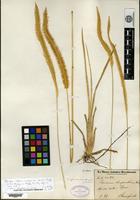
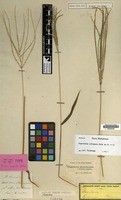
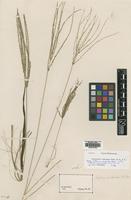
Isotype of Setaria anceps Stapf var. sericea Stapf ex R. E. Massey [family POACEAE]
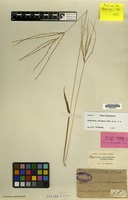
Isotype of Panicum chrysanthum Steud. [family POACEAE]
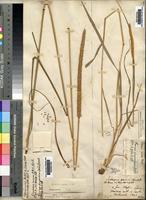
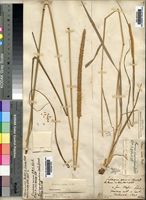
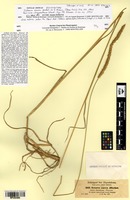
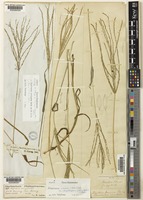
Syntype of Panicum chrysanthum Steud. [family GRAMINEAE]
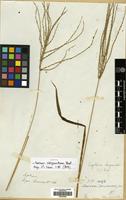
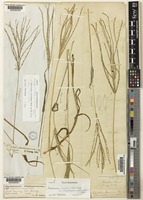
Isosyntype of Setaria aurea A.Braun [family POACEAE]
Setaria sphacelata (Schumach.) Stapf & C.E.Hubb. ex M.B.Moss [family POACEAE]
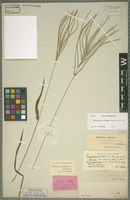
Isotype of Panicum chrysanthum Steud. [family GRAMINEAE]
Syntype of Panicum chrysanthum Steud. [family GRAMINEAE]
Isosyntype of Panicum chrysanthum Steud. [family POACEAE]
Isotype of Panicum chrysanthum Steud. [family POACEAE]
Digitaria setigera Roth ex Roem. & Schult. [family POACEAE]
Isotype of Panicum chrysanthum Steud. [family POACEAE]
Previous
Next

Name

Identification
Digitaria setigera Roth [family POACEAE ] (stored under name); Verified by J. F. Veldkamp, Isotype of Panicum chrysanthum Steud. [family POACEAE ] Verified by J. F. Veldkamp,
Related name
  • Setaria aurea
  • Setaria anceps
  • Digitaria
  • Panicum chrysanthum
  • Panicum aureum
  • Setaria glauca
  • Setaria sphacelata
  • Digitaria setigera

Flora

Entry for SETARIA aurea A. Braun [family POACEAE]
Herbarium
Royal Botanic Gardens, Kew (K)
Collection
Flora Capensis
Resource Type
Reference Sources
Entry From
Flora Capensis, Vol 7, page 310, (1900) Author: (By O. STAPF.)
Names
SETARIA aurea A. Braun [family POACEAE], in Flora, 1841, 276;—Walp. Ann. iii. 721; Engl. Hochgebirgsfl. Trop. Afr. 121; K. Schum. in Engl. Pfl. Ost-Afr. C. 104.
SETARIA sciuroidea C. Muell. [family POACEAE], in Bot. Zeit. 1861, 316.
SETARIA glauca Hook. f. [family POACEAE], Fl. Brit. Ind. vii. 78 (partly)
SETARIA glauca Kunth var. elongata [family POACEAE], Rév. Gram. ii. t. 118; Durand & Schinz, Consp. Fl. Afr. v. 773.
Panicum penicillatum Nees [family POACEAE], Fl. Afr. Austr. 56, not Agrost. Bras. 242. Steud. Syn. Pl. Glum. i. 50, not Willd.
Panicum chrysanthum Steud. [family POACEAE], Syn. Pl. Glum. i. 50; Oliv. in Trans. Linn. Soc. xxix. 172.
Information
perennial or annual or at least flowering the first year; rhizome short, oblique, covered with the remains of old scales and sheaths, sometimes with subglobose innovation buds; culms suberect or ascending, often geniculate, 2–6 ft. long, usually strongly compressed or even ancipitous below, strongly striate and scabrid or puberulous below the panicle, otherwise glabrous and smooth, 3–7-noded, internodes exserted except the lowest, uppermost usually very long and slender; sheaths striate, glabrous or softly hirsute, lower compressed, keeled, bases often persistent and breaking up into fibres; ligule a shortly and densely ciliate rim; blades linear, long tapering to an acute point, 1/2–1 1/2 ft. by 1 1/2–4 lin. or rarely 6 lin., flat, rather firm, sometimes rather rigid and more or less involute, glabrous or scantily hairy towards the base, scaberulous or almost smooth; panicle erect, straight or subflexuous, cylindric, 2 in. to more than 1 ft. long, 2 1/2–3 lin. thick (exclusive of the bristles), very dense, very bristly, usually orange-coloured or reddish; axis slender, minutely villous or puberulous; branches reduced to a subsessile one-sided involucre consisting of 6–10 slender scabrid bristles, 2–7 lin. long, yellowish to bright orange or reddish, and subtending usually 1 perfect and 1–2 arrested spikelets; spikelets obliquely ovate to ovate-oblong, subapiculate or obtuse, 1 1/4–1 1/2 lin. long, pallid or purplish at the tips, glabrous; glumes very thin, membranous, ovate, acute or subacute, whitish or purplish, lower 3-nerved, 1/3 as long as the spikelet, upper 5-nerved, 1/2 as long as the spikelet, nerves faint; lower floret ♂; valve equal or subequal to the spikelet, flat or depressed along the middle, similar to the upper glume; pale subequal to the valve; hermaphrodite floret equalling or slightly exceeding the ♂, plano-convex, oblong, usually minutely apiculate, pallid or purplish upwards; valve coriaceous, transversely wrinkled, 5-nerved; anthers 1/2–1 lin. long; grain depressed ellipsoid, 3/4 lin. long. null
Range
Distributed in slightly different forms throughout tropical Africa and Asia.
Distribution
CENTRAL REGION Var. β: Graaff Reinet Div.; among shrubs on mountain sides near Graaff Reinet, 3700 ft., Bolus, 675!COAST REGION Var. β: Alexandria Div.; Zuurberg Range, near Enon, 1000–2000 ft., Drège! Komgha Div.; near Komgha, Flanagan, 938!EASTERN REGION Natal; Impuzane, Sutherland! Nottingham, Buchanan, 70! Umpumulo, Buchanan, 170! and without precise locality, Gerrard, 473! Buchanan, 169!KALAHARI REGION Transvaal; Cave Mountains, Tabanas Kraal, Nelson, 19*! near Johannesburg, E.S.C.A. Herb., 310!
Notes
The mode of growth of var. pallida is rather distinct, resembling that of S. flabellata. Certain specimens of S. aurea from tropical Africa, however, come rather near it in this respect, and it is possible that this peculiarity is merely due to local conditions. Nees indicates his Panicum dasyurum also from the Zwartkops River (Uitenhage Div.) and from Addo (Alexandria Div.).

Related Materials

  • Terms and Conditions
  • Privacy Policy
  • Cookie Policy
  • Cookie Settings
  • Accessibility
  • Help
  • Contact Us
  • Facebook
  • Twitter
ITHAKA

JSTOR is part of ITHAKA, a not-for-profit organization helping the academic community use digital technologies to preserve the scholarly record and to advance research and teaching in sustainable ways.

©2000-2026 ITHAKA. All Rights Reserved. JSTOR®, the JSTOR logo, JPASS®, Aluka®, and ITHAKA® are registered trademarks of ITHAKA.

╳