JSTOR Global Plants Home
  • Home
  • Browse
  • About
  • Access
  • Account
    • Saved Items
    • Profile
  • Log in

Global Plants

Skip to Main Content
  • JSTOR Global Plants Home
  • Global Plants

    • Browse
    • About
    • Access
    • Account
      • Saved Items
      • Profile
Log in
  • Browse
  • About
  • Access
  • Account
    • Saved Items
    • Profile
Advanced Search

Compilation
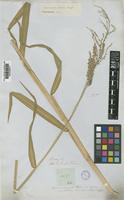
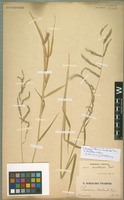
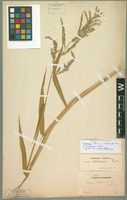
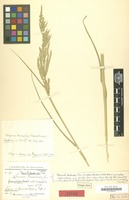
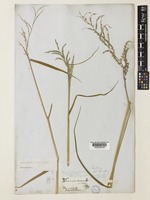
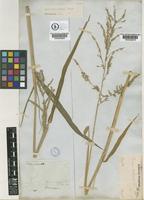
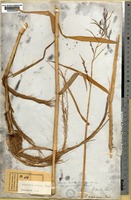
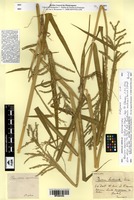
Panicum barbinode

16 Images see all

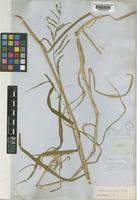
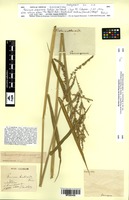
Brachiaria mutica (Forsk) Stapf [family POACEAE]
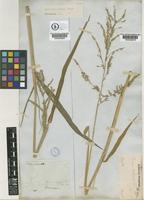
Isotype of Panicum barbinode Trin. [family POACEAE]
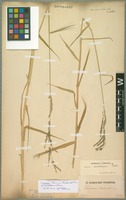
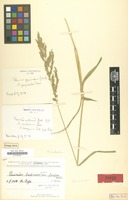
Type of Panicum barbinode f. pilifera Hack. ex Bornm. [family GRAMINEAE]
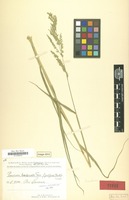
Brachiaria mutica (Forsk.) Stapf [family POACEAE]
Brachiaria mutica (Forsk.) Stapf. [family POACEAE]
Isotype of Panicum barbinode Trin. [family POACEAE]
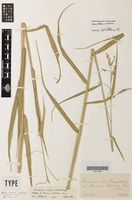
Isosyntype of Panicum equinum Steud. [family POACEAE]
Type of Panicum barbinode f. pilifera Hack. ex Bornm. [family GRAMINEAE]
Filed as Panicum barbinode Trinius, C.B. von 1832 [family POACEAE]
Type of Panicum punctulatum Arn. ex Steud. [family POACEAE]
Brachiaria mutica (Forsk.) Stapf [family POACEAE]
Isotype of Panicum amphibium Steud. [family POACEAE]
Isosyntype of Panicum equinum Steud. [family POACEAE]
Previous
Next

Name

Identification
Panicum barbinode Trin. [family POACEAE ] Panicum equinum Salzm. ex Steud. [family POACEAE ] Brachiaria mutica (Forsk.) Stapf. [family POACEAE ] (stored under name);
Related name
  • Brachiaria mutica
  • Panicum barbinode
  • Panicum equinum

Flora

Entry for BRACHIARIA mutica Stapf [family POACEAE]
Herbarium
Royal Botanic Gardens, Kew (K)
Collection
Flora of Tropical Africa
Resource Type
Reference Sources
Entry From
Flora of Tropical Africa, Vol 9, page 1, (1917) Author: (By O. STAPF.)
Names
BRACHIARIA mutica Stapf [family POACEAE]
Panicum muticum Forsk. [family POACEAE], Fl. Ægypt.-Arab. 20; Schult. Mant. ii. 225; Link, Hort. Berol. i. 206; Kunth, Enum. i. 93; Steud. Syn. Pl. Glum. i. 40; Kew Bulletin, 1894, 384, and 1897, 209; Hook. f. Fl. Brit. Ind. vii. 34, and in Trim. Handb. Fl. Ceyl. v. 140; Durand & De Wild. Mat. Fl. Congo, i. 91; De Wild. Not. Pl. Util. Congo, 509; Stapf in Johnston, Liberia, ii. 666; Cheval. Sudania, i. 34.
Panicum numidianum Lam. [family POACEAE], Ill. i. 172; Encycl. iv. 739; Desf. Fl. Atlant. i. 60, t. 11; Roem. & Schult. Syst. ii. 433; Nees, Agrost. Bras. 122; Trin. Pan. Gen. 156, and Sp. Gram. Ic. t. 174; Kunth, l.c. 92; Steud. l.c. 345; Schweinf. Beitr. Fl. Aethiop. 301; Doell in Mart. Fl. Bras. ii. ii. 187; Coss. & Dur. Fl. Alg. Expl. Scient. Alg. ii. 30; Boiss. Fl. Or. v. 438; Batt. & Trab. Fl. Algér (Monoc.) 36; Durand & Schinz, Consp. Fl. Afr. v. 757; Franch. Contr. Fl. Congo Franç. 38; Hack. in Bull. Herb. Boiss. iv. App. iii. 14; Rendle in Cat. Afr. Pl. Welw. ii. 172.
Panicum purpurascens Raddi ex Opiz [family POACEAE], in Flora, 1822, 266; Nees, Agrost. Bras. 240.
Panicum barbinode Trin. [family POACEAE], Sp. Gram. Ic. t. 318, and Pan. Gen. 168; Steud. l.c. 67; Duthie, List Grass. N.W. Ind. 2.
Panicum sarmentosum Benth. [family POACEAE], in Hook. Niger Fl. 561; not of Roxb.
Panicum equinum Steud. [family POACEAE], l.c.
Panicum punctulatum Steud. [family POACEAE], l.c. 62.
Panicum pictigluma Steud. [family POACEAE], l.c. 73.
Panicum molle Griseb. [family POACEAE], Fl. Brit. West Ind. 547 (excl. syn.); Baker, Fl. Maurit. 436; Durand & Schinz, Consp. Fl. Afr. v. 755; De Wild. Étud. Fl. Katanga, 11, and Not. Pl. Util. Congo, 507; not of Sw.
Information
Perennial, 3–6 ft., or occasionally to 8 ft. high. Culms ascending from a sometimes long prostrate and copiously rooting base, stout, terete, usually many-noded and sheathed high up, simple or sparingly branched, glabrous, often waxy pruinose below the nodes. Leaf-sheaths tight, terete, rather firm, those of the prostrate bases decaying, glabrous and smooth or hirsute with tubercle-based hairs, mostly copiously bearded at the nodes; ligules a ciliolate rim; blades linear from a shortly and slightly constricted base, long-tapering to a slender point, from a few inches to over 1 ft. by 1/4– 2/3 in., flat, somewhat rigid or flexuous, glabrous or, rarely, more or less hirsute, margins scabrid, midrib slender like the primary lateral nerves (up to over 6 on each side) but little conspicuous. Panicle oblong to ovate-oblong in outline, subsecund or almost quaquaversal, often slightly flaccid, 4–8 (mostly 6) in. long; common rhachis terete to semiterete and more or less deeply channelled or triquetrous upwards, scabrid along the angles, glabrous. Racemes numerous, solitary or irregularly approximate, sometimes paired or in false whorls, shortly peduncled (the lowest) or subsessile, obliquely spreading, usually more or less flexuous, 2- or irregularly pluriseriate, 3 (rarely 5) to 1 in. long, mostly compound and then frequently interrupted or the upper, rarely all, simple and more or less dense, glabrous, greenish or tinged with purple; rhachis flat, herbaceous with a slender raised midrib up to 1/2 lin. wide, with projecting scabrid angles, villosulous at the base, otherwise glabrous, internodes of the more evenly dense racemes 1/2–1 lin. long; secondary racemes usually very short and 6–3-spiculate, or of the lowest racemes occasionally up to 1 in. long; pedicels solitary or paired, all very short, or if paired then the longer up to 1/2 lin. long, scaberulous with smooth discoid tips, frequently with a few setules. Spikelets laterally contiguous or discontiguous, those of the secondary racemes frequently imbricate, oblong to lanceolate-oblong, acute, somewhat flat on the back, 1 1/2–1 3/4 lin. long, glabrous. Glumes dissimilar; the lower broad-ovate, acute to subacute, from less than a third to not quite half the length of the spikelet, membranous, faintly 3–5-nerved, often tinged with purple; upper corresponding in outline and size to the spikelet, 5–7-nerved with few faint cross-nerves towards the tips. Lower floret ♂: valve as long as the upper glume and similar to it, but 5-nerved and more or less depressed on the back; valvule narrowly oblong, subacute, almost as long as the valve, with narrow flaps; anthers 1 lin. long. Upper floret hermaphrodite, slightly shorter than the spikelet (mostly 1 1/2 lin. long), oblong, subacute or very minutely apiculate, pale yellowish; valve and valvule crustaceous, very finely transversely wrinkled or almost smooth; stigmas blackish-purple, very conspicuous.
Range
It is apparently a native of South America and West Africa, but introduced elsewhere.
Distribution
French Gaboon Lower Guinea Griffon de Bellay. Libreville, on the River Shire, Thollon, 164, 708.Congo Lower Guinea Stanley Pool District; Kunzulu, Vanderyst, 5182! Kisantu, Gillet, 630! 2322! between Leopoldville and Mombasi, Gillet, 2620! Cataracts District; Kimbambele, Vanderyst, 4326!Angola Lower Guinea Golunga Alto (?), Welwitsch, 2960!German East Africa Mozamb. Dist. Amani, Herb. Amani, 384!Sudan Nile Land near the White Nile, 12° 10′ N. lat., Schweinfurth, 1047!Senegal Upper Guinea Tivaouane, Chevalier, 2294!Niger Upper Guinea Sompi, Chevalier, 2295!Liberia Upper Guinea Grand Bassa, Vogel, 32!Nigeria Upper Guinea Nupe, in wet places, Barter, 1045! in wet places near Sokoto, Dalziel, 481!Cameroons Upper Guinea Victoria, Winkler, 32!
Notes
In accepting Forskal's name “ muticum ” for this species I have relied on Ascherson's identification (Asch. & Schweinf. Ill. Fl. Égypt. 160) of the type with the Algerian P. numidianum. Schweinfurth (Plante Utile Eritr. 53) says that according to the Abyssinians this is one of their best fodder grasses for milk, as its Tigre name “ sari-zaba ” (milk-grass) implies. He also adds that it is common in the lower region; but neither he nor the Italian collectors seem to have collected it in Eritrea, and there is no record of its occurrence in Abyssinia. It is no doubt an excellent fodder grass, grown in many parts of the tropics and known as “ Para grass ,” “ Mauritius grass ,” or “ Water grass .”

Related Materials

  • Terms and Conditions
  • Privacy Policy
  • Cookie Policy
  • Cookie Settings
  • Accessibility
  • Help
  • Contact Us
  • Facebook
  • Twitter
ITHAKA

JSTOR is part of ITHAKA, a not-for-profit organization helping the academic community use digital technologies to preserve the scholarly record and to advance research and teaching in sustainable ways.

©2000-2026 ITHAKA. All Rights Reserved. JSTOR®, the JSTOR logo, JPASS®, Aluka®, and ITHAKA® are registered trademarks of ITHAKA.

╳