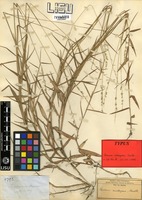
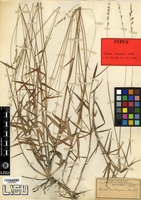
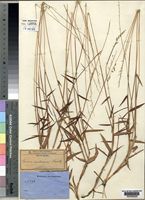
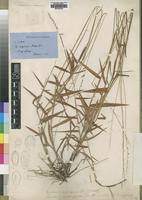
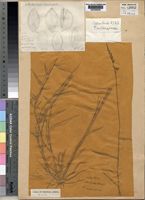
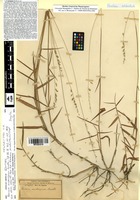
Perennial, about 2 1/2 ft. high, tufted from a short hard rhizome; innovations extravaginal, sometimes growing out into short stolons, covered with softly hairy rather thin cataphylls. Culms erect or geniculately ascending, slender, terete, many-noded, more or less branched below, with the branches erect. Leaf-sheaths rather tight, firm, shorter than the internodes except in the lower parts, striate, with hairy margins and mouth; ligules a ciliate narrow rim; blades linear-lanceolate from an equally wide base, tapering to a fine acute point, 1 1/2–3 1/2 in. by 2–4 lin., rigid, spreading, glabrous or the lowest loosely hairy, margins cartilaginous, crisped here and there, minutely spinulose, nerves fine, numerous but obscure, the uppermost blade very short. Inflorescence erect, secund, up to 2 1/2 in. long, of up to 8 short oblique dense subsessile spiciform racemes; common axis slender. Racemes simple, secund, 2-seriate, the lowest about 1/3 in. long and up to 8-spiculate, the following gradually shorter with fewer (to 2 or even 1) spikelets; rhachis very slender, wavy, subtriquetrous, up to 1/5 lin. wide, pubescent at the bare base, otherwise very minutely puberulous on the back, with or without some longer hairs from the angles; internodes 1/2 lin. long; pedicels very short, sparingly setulose, tips subdiscoid. Spikelets contiguous, broadly elliptic-oblong or elliptic in outline, subobtuse, turgid, 1 1/2–1 1/3 lin. long, pale greenish. Glumes very dissimilar, membranous, minutely hairy; lower broad-ovate, subobtuse, 3-nerved, between a third and half of the length of the spikelet; upper broad-elliptic, obtuse, very convex on the back, almost semi-elliptic in profile, distinctly shorter than the spikelet, sometimes equalling only three-fourths of the fertile floret, faintly 5-nerved. Lower floret ♂: valve corresponding in outline and size to the spikelet (in front view), depressed on the back, very narrow in profile, faintly 5-nerved, minutely hairy on the sides; valvule elliptic, obtuse, almost as long as the valve, keels slender, flaps narrow; anthers 3/4 lin. long. Upper floret hermaphrodite, elliptic-oblong, subacute, almost as long as the lower, the upper part more or less exposed, whitish: valve and valvules crustaceous, smooth or nearly so.