JSTOR Global Plants Home
  • Home
  • Browse
  • About
  • Access
  • Account
    • Saved Items
    • Profile
  • Log in

Global Plants

Skip to Main Content
  • JSTOR Global Plants Home
  • Global Plants

    • Browse
    • About
    • Access
    • Account
      • Saved Items
      • Profile
Log in
  • Browse
  • About
  • Access
  • Account
    • Saved Items
    • Profile
Advanced Search

Compilation
Panicum alopecuroides

8 Images see all

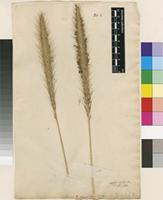
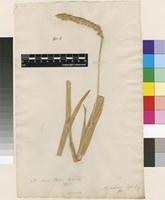
Lectotype of Panicum alopecuroides L. [family POACEAE]
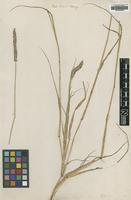
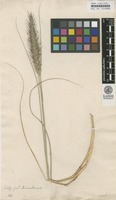
Type of Panicum alopecuroides Koenig [family POACEAE]
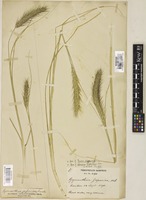
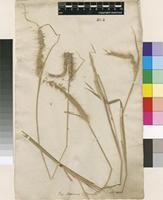
Pennisetum alopecuroides (L.) Spreng. [family POACEAE]
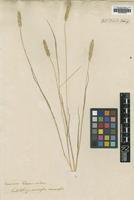
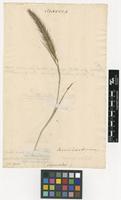
Type of Panicum alopecuroides Koenig [family POACEAE]
Filed as Panicum alopecuroides L. [family POACEAE]
Type? of Cenchrus purpurascens Thunb. [family POACEAE]
Filed as Panicum alopecuroides L. [family POACEAE]
Previous
Next

Name

Identification
Setaria glauca (L.) P.Beauv. [family POACEAE ] (stored under name); Panicum alopecuroides Koenig [family POACEAE ]
Related name
  • Penicillaria ciliata
  • Alopecurus indicus
  • Panicum alopecuroides
  • Pennisetum setosum
  • Cenchrus alopecuroides
  • Penicillaria cylindrica
  • Setaria glauca
  • Pennisetum alopecuroides
  • Pennisetum not on sheet

Flora

Entry for PENNISETUM typhoideum Rich. [family POACEAE]
Herbarium
Royal Botanic Gardens, Kew (K)
Collection
Flora Capensis
Resource Type
Reference Sources
Entry From
Flora Capensis, Vol 7, page 310, (1900) Author: (By O. STAPF.)
Names
PENNISETUM typhoideum Rich. [family POACEAE], in Pers. Syn. i. 72;—Delile, Fl. Égypte, 17, t. 8, fig. 3; Trin. Gram. Pan. 71; Pan. Gen. 96, and in Mém. Acad. Pétersb. sér. vi. iii. 184 (typhoides); Steud. Syn. Pl. Glum. i. 108; Hook. f. Fl. Brit. Ind. vii. 82.
PENNISETUM alopecuroides Spreng. [family POACEAE], Syst. i. 303.
PENNISETUM Linnæi Kunth [family POACEAE], Rév. Gram. i. 49.
PENNISETUM spicatum Koern. [family POACEAE], in Koern. & Wern. Handb. Getreidebaues, i. 284; Engl. Hochgebirgsfl. Trop. Afr. 126; Schweinf. in Bull. Herb. Boiss. ii. App. ii. 25; Durand & Schinz, Consp. Fl. Afr. v. 784; K. Schum. in Engl. Pfl. Ost-Afr. B. 51–59; Hack. in Bull. Herb. Boiss. iv. App. iii. 17.
PENNISETUM nigricans Durand & Schinz [family POACEAE], l.c. 781, 782.
PENNISETUM Nigritarum Durand & Schinz [family POACEAE], l.c. 781, 782.
PENNISETUM Plukenetii Durand & Schinz [family POACEAE], l.c. 781, 782.
Penicillaria spicata Willd. [family POACEAE], Enum. Hort. Berol. 1037; Jacq. Ecl. Gram. t. 17; Beauv. Agrost. 59, t. 13, fig. 4; Kunth, Enum. i. 165; Suppl. 120, t. 11, fig. 1.
Penicillaria ciliata Willd. [family POACEAE], l.c. 1037.
Penicillaria cylindrica Roem. & Schult. [family POACEAE], Syst. ii. 498.
Penicillaria Plukenetii Link [family POACEAE], Hort. Berol. 221; Nees, Fl. Afr. Austr. 72.
Penicillaria typhoidea Fig. & De Not. [family POACEAE], Mem. Acad. Tor. ii. xii. (1852), 371, 372.
Penicillaria fallax Fig. & De Not. [family POACEAE], Mem. Acad. Tor. ii. xii. (1852), 371, 372.
Penicillaria raddiana Fig. & De Not. [family POACEAE], Mem. Acad. Tor. ii. xii. (1852), 371, 372.
Penicillaria Nigritarum Schlechtend. [family POACEAE], in Linnæa, xxv. 561, 565.
Penicillaria sieberiana Schlechtend. [family POACEAE], in Linnæa, xxv. 561, 565.
Panicum americanum Linn. [family POACEAE], Sp. Pl. 56.
Panicum alopecuroides Thunb. [family POACEAE], Fl. Cap. ed. i. 387; ed. Schult. 102, not Linn.
Holcus spicatus Linn. [family POACEAE], Syst. ed. x. 1305.
Holcus racemosus Forsk. [family POACEAE], Fl. Aegypt.-Arab. 175.
Alopecurus indicus Linn. [family POACEAE], Syst. Veg. ed. xiii. Murr. 92 (excl. syn. Pluk.).
Cenchrus alopecuroides Thunb. [family POACEAE], Prod. 24.
Information
annual; culms erect, stout, 1 to several feet high, usually terete and simple, 5- or more-noded, hairy to villous below the panicle, otherwise usually glabrous; sheaths terete, glabrous except the bearded nodes and the often villous junction with the blade, rarely hirsute, usually slightly rough, rather shorter than the internodes; ligule a narrow long and densely ciliate rim; blades linear to linear-lanceolate from a rounded base, acute, 1/2–2 ft. by 1/3–1 1/2 in., flat, more or less rough, glabrous, rarely hirsute; panicle spike-like, cylindric, very dense, 4–8 in. by 5–9 lin. (in the South African specimens) or longer and thicker, often purplish; rhachis stout, villous; branchlets reduced to a peduncled involucrate cluster of 3–1 spikelets; peduncles villous, straight; 1–2 1/2 lin. long, often horizontally spreading or partly deflexed; involucre of very numerous ciliate often purplish bristles about as long as the spikelets; spikelets sessile or shortly pedicelled within the involucre, readily deciduous when ripe, oblong, 2–2 1/2 lin. long, pale or purplish upwards; glumes broadly ovate, obtuse, minute, hyaline, nerveless, ciliate, or larger (the upper to 1/2 the length of the spikelet), firmer and 3-nerved; florets similar, subequal, lower ♂ or reduced to a minute empty hyaline valve; valves broadly oblong, cuspidate or mucronate, 5–7-nerved, glabrous, ciliate or pubescent towards the margins or the tips; pales broad, oblong, truncate, glabrous, ciliate, or the flaps pubescent below; lodicules 0; anthers 1–1 1/4 lin. long, tips bearded; styles connate; grain ellipsoid to subglobose, equalling the gaping chartaceous very smooth valve and pale. null
Range
Cultivated in numerous forms in tropical Africa and in India.
Distribution
COAST REGION Cape Div.; in Mr. Hesse's garden at Cape Town, brought from Inhambane, Burchell, 755!EASTERN REGION Natal; near Durban, Drège; and without precise locality, Cooper, 3338! Delagoa Bay, Scott!KALAHARI REGION Orange Free State; without precise locality, Cooper, 3349! Transvaal; Cave Mountains, in Tabana's gardens, Nelson, 83*!SOUTH AFRICA without precise locality, Thunberg!
Notes
Numerous forms of this cereal have been described by A. Braun in Ind. Sem. Hort. Berol. 1855, App. 24; but it is hopeless to attempt to reduce the South African specimens to Braun's species, in the absence of the types. K. Schumann who has had access to them, has given up A. Braun's classification and attempted to break up the species into 2 subspecies: Willdenowii and Plukenetii, according to the length of the peduncles and the general shape of the spikelets, and to divide the subspecies Willdenowii into several varieties. I cannot, however, agree with him, and confine myself in this place to the statement, that all the South African specimens represent more or less the typical form, drawn in Delile's figure quoted above. Those where the lower floret appears reduced to a small and empty valve are evidently starved states.

Related Materials

  • Terms and Conditions
  • Privacy Policy
  • Cookie Policy
  • Cookie Settings
  • Accessibility
  • Help
  • Contact Us
  • Facebook
  • Twitter
ITHAKA

JSTOR is part of ITHAKA, a not-for-profit organization helping the academic community use digital technologies to preserve the scholarly record and to advance research and teaching in sustainable ways.

©2000-2026 ITHAKA. All Rights Reserved. JSTOR®, the JSTOR logo, JPASS®, Aluka®, and ITHAKA® are registered trademarks of ITHAKA.

╳