

Compilation
Pandiaka wildii
3 Images see all
Name
Identification
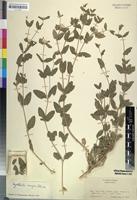
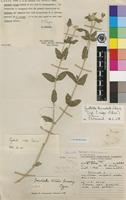
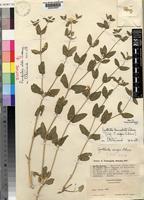
Cyathula lanceolata Schinz [family AMARANTHACEAE ] (stored under name); Verified by Townsend, C. C., Cyathula crispa Schinz [family AMARANTHACEAE ] Verified by Sussenguth, Isotype of Pandiaka wildii Suess. [family AMARANTHACEAE ]
Related name
- Cyathula crispa
- Cyathula lanceolata
- Pandiaka wildii
Flora
Entry for Cyathula lanceolata Schinz [family AMARANTHACEAE]
Herbarium
Royal Botanic Gardens, Kew (K)
Collection
Flora Zambesiaca
Resource Type
Reference Sources
Entry From
FZ, Vol 9, Part 1, page 28, (1988) Author: C. C. Townsend
Names
Cyathula lanceolata Schinz [family AMARANTHACEAE], in Engl. Bot. Jahrb. 21 : 188 (1895).—Podlech & Meeuse in Merxm. Prodr. Fl. SW. Afr. 33: 15 (1966).—Townsend in Publ. Cairo Univ. Herb 7 & 8 : 76 (1977). Type from “Ostafrika”
Cyathula crispa Schinz [family AMARANTHACEAE], in Engl. Bot. Jahrb. 21: 188 (1895). Type from Transvaal.
Cyathula merkeri Gilg [family AMARANTHACEAE], in Engl. Bot. Jahrb. 36: 207 (1905).—Baker & Clarke in F.T.A. 6, 1: 47 (1909). Type from Tanzania.
Pandiaka deserti N.E. Br. [family AMARANTHACEAE], in Kew Bull. 1909: 134 (1909). Type: Botswana, near Chukutsa salt-pan, Lugard 221 (K; holotype).
Pandiaka lanceolata Schinz C.B. Clarke [family AMARANTHACEAE], in F.T.A. 6, 1: 68 (1909). Type as for Cyathula lanceolata.
Cyathula hereroensis Schinz [family AMARANTHACEAE], in Viert. Nat. Ges. Zürich 66: 222 (1921).—Podlech & Meeuse in Merxm. Prodr. Fl. SW. Afr. 33: 15 (1966). Type from Namibia.
Cyathula deserti N.E. Br. Suesseng. [family AMARANTHACEAE], in Fedde, Repert. 44: 46 (1938). Type as for Pandiaka deserti.
Sericocomopsis lanceolata Schinz Peter [family AMARANTHACEAE], in Fedde, Repert. Beih. 40, 2: 229 (1932). Type as for Cyathula lanceolata.
Pandiaka wildii Suesseng. [family AMARANTHACEAE], in Mitt. Bot. Staatss. München 1: 63 (1950). Type: Zimbabwe, Lower Sabi, Wild 2313 (SRGH, holotype; K, isotype).
Information
Perennial herb, much branched from the base upwards, erect and bushy to prostrate and sprawling, 15–90 cm.; stem and branches strongly striate-sulcate, terete or some of the upper internodes tetragonous, whitish to green or the striae brown, subglabrous to pilose with softer and more or less appressed to patent and substrigose multicellular hairs or sometimes white-woolly; nodes slightly swollen, the stem and branches sometimes slightly shrunken above them. Leaves firm in texture, oblong to narrowly lanceolate-elliptic, 1.2–5.5 × 0.3–1.5 cm., acute to obtuse at the apex with a frequently deciduous, firm, horn-like mucro up to 2 mm. long, at the base cuneate to abruptly rounded or subauriculate, sessile or with a petiole up to 5 mm. long, both surfaces more or less softly appressed-pilose or appressed - (more rarely more or less patent) - strigose when young, finally thinly hairy or glabrescent or with strigose hairs persisting particularly along the sometimes undulate-crispate margins and along the lower surface of the midrib and few primary nerves, sometimes lanuginose. Inflorescences terminal on the stem and branches, solitary, rounded-capitate (formed of condensed cymes), the heads 1.5–2 cm. in diam. in flower and scarcely larger in fruit, commonly sessile and subtended by a pair of leaves, or on a pilose peduncle up to 1(3) cm. long; bracts broadly ovate, broader than long, 3 mm. long, pale, glabrous, shortly aristate with the excurrent midrib; bracteoles broadly deltoid- ovate, 4–6 mm. long, similar but more longly aristate, glabrous or thinly pilose about the base; ultimate divisions of cymes of a central fertile flower subtended on each side by a triad of a central fertile and two lateral modified flowers, or sterile flowers solitary or absent. Outer 2 tepals narrowly oblong-lanceolate, 6.5–9 mm. long, firm, with broad, pale, opaque margins, with a narrow (one third of the width of the tepal or less) green vitta which ceases below the apex, 3–(5) nerved in the vitta with the lateral nerves and midrib sometimes forked, lateral nerves evanescent above, the midrib not or very slightly excurrent in an obscure mucro; inner 3 tepals similar but slightly shorter, progressively blunter and the innermost subcucullate at the apex, the midrib not excurrent in a mucro but occasionally protruding as a small dorsal cusp near the apex, green vitta in all 3 paler with the nerves more clearly defined; indument of all 5 tepals variable, commonly evanescent, from slightly pilose about the base or furnished with long, subappressed white hairs in the basal half (especially centrally along the pale margins) to rather densely floccose throughout. Modified flowers commonly lanate-hairy centrally, of a few narrowly bracteoliform processes and/or 2–8 very unequal stramineous to purplish spines which become accrescent and thickened at the base in fruit, the longest (3.5)7–10 mm. in length. Filaments firm, 3–4 mm. long, alternately longer and shorter; pseudostaminodes considerably fused to the filaments, 1.5–2 mm. long, oblong, lacerate-dentate at the plane apex with no dorsal scale. Stem slender, 3.5–6 mm. long, pale and firm; ovary squat, pyriform (onion-shaped), tapering into the c. 1 mm. long style. Capsule ovoid, c. 3 mm. long, firm in the upper half and rupturing when ripe in the hyaline lower half. Seed c. 2.75 mm. in diam., subglobose, brownish, smooth.
Habitat
In alluvial depressions in mopane woodland or on flood-plains, in wooded grassland or in one case recorded from calcium-rich clay along the margins of seasonal drainage line
Altitude range
515–850 m.
850
515
Distribution
Zimbabwe W Bulawayo, i.1898, Rand 203 (BM).Mozambique M Sábiè, near Mahel, 30.xi.1944, Mendonça 3155 (C; K; LISC; LMU).Zimbabwe S Beitbridge, Shashe R. flood plain, 7.ii.1961, Wild 5310 (K; LISC; SRGH).Botswana SE Seleka Ranch, 22.ii.1977, Hansen 3046 (C; GAB; K; PRE; SRGH; UPS).Mozambique GI 5 km. W. of Zinave Camp at Banhine Vlei, vi.1973, Tinley 2946 (SRGH).Zimbabwe E Lower Sabi, E. bank, 28.i.1948, Wild 2313 (K; SRGH).Botswana N Boteti delta area NE. of Mopipi, 850 m., 19.iv.1973, Watts 1 (K; SRGH).
Distribution (external)
Tanzania
Namibia
S. Africa
Notes
Leaf form and indumentum is very variable in this species, as is the development of the spines of the sterile modified flowers.