JSTOR Global Plants Home
  • Home
  • Browse
  • About
  • Access
  • Account
    • Saved Items
    • Profile
  • Log in

Global Plants

Skip to Main Content
  • JSTOR Global Plants Home
  • Global Plants

    • Browse
    • About
    • Access
    • Account
      • Saved Items
      • Profile
Log in
  • Browse
  • About
  • Access
  • Account
    • Saved Items
    • Profile
Advanced Search

Compilation
Pandiaka schweinfurthii

12 Images see all

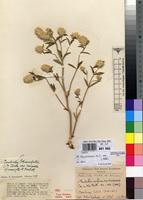
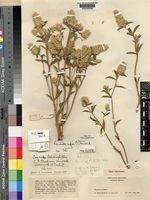
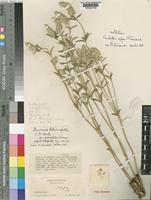
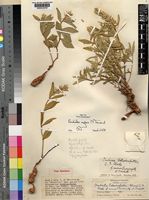
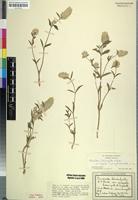
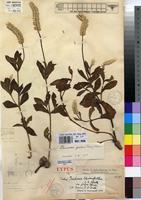
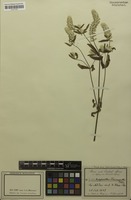
Isotype of Pandiaka schweinfurthii C.B.Clarke var. compacta Suess. & Overkott [family AMARANTHACEAE]
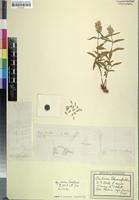
Pandiaka confusa C.C.Towns. [family AMARANTHACEAE]
Isotype of Pandiaka schweinfurthii Suess. & Overkott var. parvifolia [family AMARANTHACEAE]
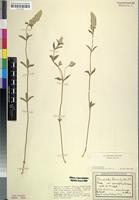
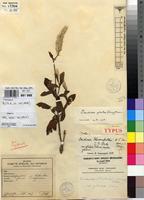
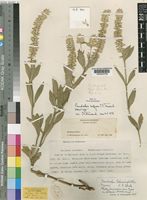
Type of Pandiaka schweinfurthii (Schinz) C.B.Clarke var. glabra Schinz ex Suess. [family AMARANTHACEAE]
Type of Pandiaka schweinfurthii (Schinz) C.B.Clarke var. parvifolia Suessenguth et Overkott [family AMARANTHACEAE]
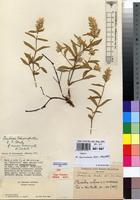
Isotype of Pandiaka schweinfurthii f. minor Suess. & Overkott [family AMARANTHACEAE]
Holotype of Pandiaka confusa C.C.Towns. [family AMARANTHACEAE]
Isotype of Pandiaka schweinfurthii C.B.Clarke var. minor Suess. & Overkott [family AMARANTHACEAE]
Pandiaka confusa C.C.Towns. [family AMARANTHACEAE]
Isotype of Pandiaka schweinfurthii Suess. & Overkott var. compacta [family AMARANTHACEAE]
Type of Pandiaka schweinfurthii (Schinz) C.B.Clarke var. glabra Schinz ex Suess. [family AMARANTHACEAE]
Filed as Pandiaka welwitschii (Schinz) Hiern [family AMARANTHACEAE]
Previous
Next

Name

Identification
Isotype of Pandiaka schweinfurthii C.B.Clarke [family AMARANTHACEAE ] Verified by Not on sheet, Pandiaka confusa C.C.Towns. [family AMARANTHACEAE ] (stored under name); Verified by Not on sheet,
Related name
  • Pandiaka glabra
  • Pandiaka confusa
  • Pandiaka welwitschii
  • Pandiaka schweinfurthii

Flora

Entry for Pandiaka welwitschii Schinz Hiern [family AMARANTHACEAE]
Herbarium
Royal Botanic Gardens, Kew (K)
Collection
Flora Zambesiaca
Resource Type
Reference Sources
Entry From
FZ, Vol 9, Part 1, page 28, (1988) Author: C. C. Townsend
Names
Pandiaka welwitschii Schinz Hiern [family AMARANTHACEAE], in Cat. Afr. Pl. Welw. 1: 894 (1900).—Baker & Clarke in F.T.A. 6, 1: 69 (1909).—Schinz in Engl. & Prantl Pflanzenfam. ed. 2, 16 C: 64 (1934).—Cavaco in Mém. Mus. Hist. Nat. Paris Sér. B, 13: 140 (1962).—Townsend in Kew Bull. 34: 426 (1979). Type from Angola.
Achyranthes welwitschii Schinz [family AMARANTHACEAE], in Engl. Bot. Jahrb. 21: 187 (1895). Type as above.
Achyranthes schweinfurthii Schinz [family AMARANTHACEAE], in Bull. Herb. Boiss. 4: 421 (1896). Type from Sudan.
Psilotrichum debile Baker [family AMARANTHACEAE], in Kew Bull. 1897: 279 (1897). Type from Angola.
Pandiaka debilis Baker Hiern [family AMARANTHACEAE], in Cat. Afr. Pl. Welw. 1: 984 (1900).—Baker & Clarke in F.T.A. 6, 1: 1 (1909). Type as above.
Pandiaka schweinfurthii Schinz C.B. Clarke [family AMARANTHACEAE], in F.T.A. 6, 1: 69 (1909).—Hauman in F.C.B. 2: 48 (1951).—Cavaco in Mém. Mus. Hist. Nat. Paris Sér. B, 13: 141 (1962). Type as for Achyranthes schweinfurthii.
Pandiaka welwitschii var. debilis Hiern Suesseng. [family AMARANTHACEAE], in Fedde, Repert. 44: 47 (1938).
Pandiaka kassneri Suesseng. [family AMARANTHACEAE], in Bull. Jard. Bot. Brux. 15: 67 (1938).—Hauman in F.C.B. 2: 46 (1951).—Cavaco in Mém. Mus. Hist. Nat. Paris Sér. B, 13: 145 (1962). Type from Zaire.
Information
Perennial herb, (15) 50–120 cm., taller forms much-branched with the lower branches increasingly widely divaricate; stem and branches more or less densely furnished with whitish to yellowish spreading to upwardly ascending hairs, quadrangular, the older parts more or less glabrescent and terete. Leaves usually obovate and rounded-apiculate, sometimes elliptic and subacute, broadly tapering below, those of the main stem and branches 1.2–8 × 0.6–3.5 cm., moderately appressed-pilose on both surfaces with hairs usually of varying lengths, darker green above and paler beneath. Inflorescences terminal on the stem and branches, sometimes more or less clustered at the apex of the stem by branch reduction, pinkish, conical when young but finally cylindrical, 3–10 × 1.25–1.5 cm. long, very dense, on a 0.5–4 cm. densely tomentose peduncle. Bracts lanceolate-ovate, 4–6 mm. long, membranous with an obscurely to distinctly green centre, more or less densely pilose centrally, diminishing to glabrous at the margins, tapering to the short acute arista formed by the excurrent midrib. Bracteoles similar or slightly narrower, 3–5 mm. long, more densely pilose, more longly (c. 0.5–1 mm.) aristate. Flowers truncate at the base and indurate, attached to the inflorescence axis by a white, annular callus. Tepals narrowly lanceolate; outer 2 greenish and more or less densely pilose centrally, 5–8 mm. long, with 3 (5) white nerves, the 1 (2) outer pairs much shorter than the midrib, which is excurrent in a short arista; inner 3 similar but slightly shorter and progressively somewhat narrower and less pilose, 3-nerved or the inner most occasionally with only uhe midrib showing; all usually slightly upwardly curving near the tip. Perianth and bracteoles falling together in fruit. Stamens 2.5–5 mm.; pseudostaminodes 1–1.5 mm., oblong to flabellate, fimbriate (or dentate only at the apex with the margins fimbriate), dorsal scale broader and fimbriate to subulate-dentate. Ovary obpyriform, c. 1.5 mm.; style slender, 2.75–4.25 mm. Utricle oblong-ovoid, c. 2 mm., the firm, flat apex with a transverse crest on each side of the style; seed c. 1.75 mm., oblong-ellipsoid, brown, shining.
Habitat
Mixed woodland on Kalahari sand; outside the Flora Zambesiaca region in grassland, along riversides, on rocky hillsides, apparently always on sandy soil.
Distribution
Zambia B 6 km. W. of Kabompo, 24.iii.1961, Drummond & Rutherford-Smith 7266 (K; LISC; SRGH).
Distribution (external)
Sudan
Cameroon
Zaire
Angola
Tanzania

Related Materials

  • Terms and Conditions
  • Privacy Policy
  • Cookie Policy
  • Cookie Settings
  • Accessibility
  • Help
  • Contact Us
  • Facebook
  • Twitter
ITHAKA

JSTOR is part of ITHAKA, a not-for-profit organization helping the academic community use digital technologies to preserve the scholarly record and to advance research and teaching in sustainable ways.

©2000-2026 ITHAKA. All Rights Reserved. JSTOR®, the JSTOR logo, JPASS®, Aluka®, and ITHAKA® are registered trademarks of ITHAKA.

╳