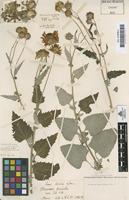
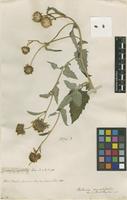
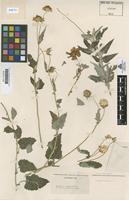
Pallasia serratifoliaSm. in Rees [family ASTERACEAE ] (stored under name); Verified by Not on sheet, Ximenesia encelioidesCav. [family ASTERACEAE ] Verified by cavanilles, Abbé Antonio José / Smith, J.E.,
Related name
Pallasia serratifolia
Ximenesia encelioides
Verbesina encelioides
Flora
Entry for XIMENESIA encelioides Cav. [family COMPOSITAE]
Herbarium
Royal Botanic Gardens, Kew (K)
Collection
Flora of Tropical Africa
Resource Type
Reference Sources
Entry From
Flora of Tropical Africa, Vol 1, page 253, (1877) Author: (By Prof. Oliver and W. P. Hiern.)
Names
XIMENESIA encelioidesCav. [family COMPOSITAE], Ic. ii. 60, t. 178.
Pallasia serratifoliaSm. [family ], in Rees Cycl. vol. xxvi.
Information
More or less hoary branched annual, 1–3 ft. high. Stem and branches pubescent-tomentose, striate. Leaves mostly alternate at least the upper ones, from deltoid to oblong, dentate, broad near the sometimes excavated base, green and strigulose above, hoary with whitish closely appressed tomentum below, 1 1/2–6 by 1–3 in. exclusive of the winged auriculate petiole of 1/2–2 in. Capitula 3/4–1 1/4 in. diameter, on peduncles ranging up to 8 in. Outer bracts of the involucre linear acute herbaceous, about 1/2 in. long. Receptacle convex. Achenes pilose.
Range
A variable widely spread species originally from Mexico.