JSTOR Global Plants Home
  • Home
  • Browse
  • About
  • Access
  • Account
    • Saved Items
    • Profile
  • Log in

Global Plants

Skip to Main Content
  • JSTOR Global Plants Home
  • Global Plants

    • Browse
    • About
    • Access
    • Account
      • Saved Items
      • Profile
Log in
  • Browse
  • About
  • Access
  • Account
    • Saved Items
    • Profile
Advanced Search

Compilation
Packera eurycephala

7 Images see all

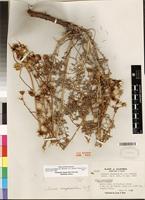
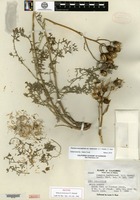
Type of Packera eurycephala var. lewisrosei (J.T. Howell) J.F. Bain [family ASTERACEAE]
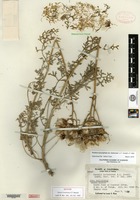
Packera eurycephala (Torr. & A. Gray) W.A. Weber & Á. Löve [family COMPOSITAE]
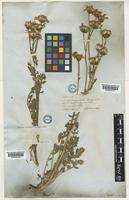
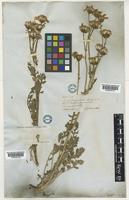
Syntype of Senecio eurycephalus Torrey & A. Gray [family ASTERACEAE]
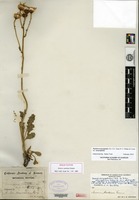
Isotype of Senecio lewisrosei J. T. Howell [family ASTERACEAE]
Isolectotype of Senecio austiniae Greene [family ASTERACEAE]
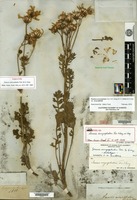
Isotype of Senecio lewisrosei J. T. Howell [family ASTERACEAE]
Previous
Next

Name

Identification
Packera eurycephala (Torr. & A. Gray) W.A. Weber & Á. Löve [family COMPOSITAE ] (stored under name); Senecio eurycephalus Torr. & A. Gray [family COMPOSITAE ]
Related name
  • Senecio lewisrosei
  • Packera eurycephala
  • Senecio eurycephalus
Common name
  • Widehead groundsel, Flora of North America Vol. 20
  • Lewis’s groundsel, Flora of North America Vol. 20

Flora

Entry for Packera eurycephala (Torrey & A. Gray) W. A. Weber & Á. Löve [family COMPOSITAE]
Herbarium
Flora of North America (FNA)
Collection
Flora of North America
Resource Type
Reference Sources
Entry From
Flora of North America, Vol 20,
Names
Packera eurycephala (Torrey & A. Gray) W. A. Weber & Á. Löve [family COMPOSITAE], Phytologia, 49: 46. 1981
Senecio eurycephalus Torrey & A. Gray [family COMPOSITAE], Mem. Amer. Acad. Arts, n. s., 4: 109. 1849
Treatment Author(s)
Debra K. Trock
Information
Perennials, 20–50+ cm, taprooted (caudices branched, ascending to erect, woody). Stems 1 or, usually, multiple, clustered, densely tomentose to glabrescent. Basal leaves (soon withering), petiolate; blades lyrate (lateral lobes 2–6+ pairs), ovate, obovate, or spatulate, 70–100+ × 20–30+ mm, bases tapering, ultimate margins irregularly and coarsely serrate-dentate. Cauline leaves gradually reduced (± petiolate, proximal and mid similar to basal, terminal lobes smaller than laterals; distal sessile, incised). Heads 5–20+ in open or compact (rarely), cymiform arrays. Peduncles bracteate, sparsely to densely lanate-tomentose. Calyculi inconspicuous (bractlets tomentose). Phyllaries 13 or 21, green (tips sometimes yellow), 8–10+ mm, densely tomentose proximally, glabrescent distally. Ray florets 8 or 13; corolla laminae 10–15 mm. Disc florets 35–50+; corolla tubes 3.5–4.5 mm, limbs 2.5–3.5 mm. Cypselae 1–1.5 mm, glabrous; pappi 6–7 mm. 2n = 46.
Distribution
w United States.

Related Materials

  • Terms and Conditions
  • Privacy Policy
  • Cookie Policy
  • Cookie Settings
  • Accessibility
  • Help
  • Contact Us
  • Facebook
  • Twitter
ITHAKA

JSTOR is part of ITHAKA, a not-for-profit organization helping the academic community use digital technologies to preserve the scholarly record and to advance research and teaching in sustainable ways.

©2000-2026 ITHAKA. All Rights Reserved. JSTOR®, the JSTOR logo, JPASS®, Aluka®, and ITHAKA® are registered trademarks of ITHAKA.

╳