

Compilation
Pachystigma rhodesianum
1 Images see all
Name
Identification
Pachystigma rhodesianum (S.Moore) Robyns [family RUBIACEAE ] Pachystigma pygmaeum (Schltr.) Robyns [family RUBIACEAE ] (stored under name); Verified by Verdcourt,B.,
Related name
- Pachystigma pygmaeum
- Pachystigma rhodesianum
Flora
Entry for Pachystigma pygmaeum Schltr. Robyns [family RUBIACEAE]
Herbarium
Royal Botanic Gardens, Kew (K)
Collection
Flora Zambesiaca
Resource Type
Reference Sources
Entry From
FZ, Vol 5, Part 2, (1998) Author: D. Bridson
Names
Pachystigma pygmaeum Schltr. Robyns [family RUBIACEAE], in Bull. Jard. Bot. État 11: 122, figs. 17 & 18 (1928). —Codd & Voorendyk in Bothalia 8 (Suppl. 1): 49, figs. 51, 52, 53 & map 4 (1965). —Fanshawe & Hough, Poisonous Pl. Zambia: 10 (1967). —Verdcourt in Kew Bull. 36: 541 (1981); in F.T.E.A., Rubiaceae: 765, fig. 135 (1991). TAB. 50. Type from South Africa.
Vangueria pygmaea Schltr. [family RUBIACEAE], in J. Bot. 35: 342 (1897). —Bews, Fl. Natal & Zululand: 198 (1921). —De Wildeman in Bull. Jard. Bot. État 8: 61 (1922). —Burtt Davy in Bull. Misc. Inform., Kew 1925: 37 (1925). —Marloth, Fl. S. Africa 3, 2: 193, figs. 83, 84 (1932).
Vangueria setosa Conrath [family RUBIACEAE], in Bull. Misc. Inform., Kew 1908: 224 (1908). —De Wildeman in Bull. Jard. Bot. État 8: 64 (1922). Type from South Africa.
Vangueria rhodesiana S. Moore [family RUBIACEAE], in J. Bot. 47: 130 (1909). —De Wildeman in Bull. Jard. Bot. État 8: 61 (1922). Type: Central Zimbabwe, Rand 1349 (BM, holotype).
Pachystigma rhodesianum S. Moore Robyns [family RUBIACEAE], in Bull. Jard. Bot. État 11: 119 (1928).
Information
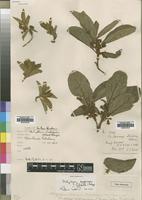
Perennial, erect or prostrate, subshrubby herb, 5–15(25) cm tall, usually with a long rhizome.Stems at first sparsely to densely setose-hairy but becoming glabrous; bark brown, finely fissured.Leaves paired, very rarely in whorls of 3; blades 4–9.5(16) × 1.6–4.7 cm, oblong to oblong-elliptic, elliptic or oblanceolate, obtuse, acute or shortly acuminate at the apex, cuneate at the base, glabrous to covered on both surfaces with dense seta-like hairs which do not in any way hide the surface, often quite scabrid; petiole 0–3(7) mm long; stipules scarious to thicker with a subulate appendage 2–6 mm long, from a base 1–2 mm long, densely setose or glabrescent.Inflorescences axillary, simple, 3–7(many)-flowered, often at ground level, densely setose; peduncles 5–6(12) mm long; pedicels 5–8 mm long, bracts scarious, usually several at base of inflorescence and conspicuous, 2–3 mm long and wide, obovate, obtuse.Calyx tube 1.5 mm long; limb-tube 0–2 mm long; lobes erect, 2–8.5 mm long, narrowly oblong or linear, usually setose.Corolla filiform-apiculate in bud, appendages up to 3 mm long; tube white or pale greenish-cream, sparsely setose, 4–8 mm long, subcampanulate to quite narrowly cylindrical; lobes green outside, 4–6 mm long including the filiform appendage, 2 mm wide, narrowly triangular.Anthers brown, exserted, 1–1.7 mm long; filaments short, about 1 mm long.Ovary 5-locular.Style slender, 5–9 mm long; pollen presenter pale green, cylindrical or coroniform, 0.75–1 mm long, slightly 5-lobulate.Fruit black or yellow-brown, 1.5–2 cm in diameter, subglobose, pear-shaped or oblique, with (1)2–5 pyrenes; pyrenes 1.1–1.5 cm × 6–8 mm, ellipsoid, obtusely subtrigonous, with a sharp point above point of attachment, rugulose.
Habitat
Open ground, short grassland, dambos, often on sandy ground, also laterite pans and on termite mounds
Altitude range
1170–2280 m.
2280
1170
Distribution
Malawi N Chitipa Distr., Mafinga Hills (Mts.), 2.iii.1982, Brummitt et al. 16247 (K).Zimbabwe C Makoni Distr., near Maidstone, fl. 5.i.1931, Fries, Norlindh & Weimarck 4102 (K; LD; PRE; SRGH).Zambia N Mbala Distr., escarpment above Lufubu R. Plain, fl. 19.ii.1957, Richards 8623 (K).Malawi C Dedza Distr., Chongoni Forest Reserve, fr. 6.ii.1968, Jeke 14 (K; SRGH) (see note).Zimbabwe E Chimanimani (Melsetter), fl. 24.xii.1948, Chase 1238 (BM; K; SRGH).Zambia S Mazabuka Distr., 1.6 km below confluence of Siamambo and Bunchele streams, fl. 6.ii.1960, White 6882 (FHO; K).Zambia W Luanshya, fl. 13.i.1956, Fanshawe 2704 (K; NDO).
Distribution (external)
Southern Tanzania
Swaziland
South Africa (North Province, North-West Province and Mpumalanga)
Notes
Although Robyns made a new subgenus Pseudopachystigma for P. rhodesianum the characters do not hold and it is clearly a synonym of P. pygmaeum. Jeke 14 cited above has leaves up to 16 × 7 cm, but is only a form of this species. Glabrous-leaved and hairy-leaved specimens occur in the same populations in many areas, but the similar South African species P. thamnus Robyns which is always glabrous has a different facies and is a distinct species. Well known as a plant poisonous to sheep and other stock in South Africa but not toxic in Zimbabwe (see Shone & Drummond, Poisonous Pl. Rhod.: 1 (1965)).