JSTOR Global Plants Home
  • Home
  • Browse
  • About
  • Access
  • Account
    • Saved Items
    • Profile
  • Log in

Global Plants

Skip to Main Content
  • JSTOR Global Plants Home
  • Global Plants

    • Browse
    • About
    • Access
    • Account
      • Saved Items
      • Profile
Log in
  • Browse
  • About
  • Access
  • Account
    • Saved Items
    • Profile
Advanced Search

Compilation
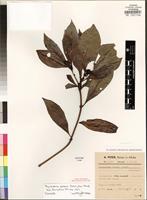
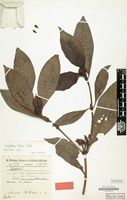
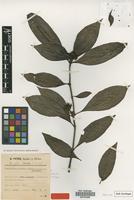
Psychotria peteri

7 Images see all

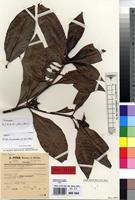
Type of Psychotria peteri E.M.A.Petit [family RUBIACEAE]
Type of Psychotria peteri Petit [family RUBIACEAE]
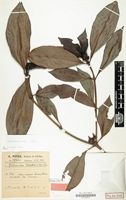
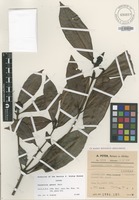
Isotype of Psychotria peteri Petit [family RUBIACEAE]
Isotype of Psychotria peteri E.M.A. Petit [family RUBIACEAE]
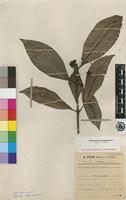
Holotype of Psychotria peteri Petit [family RUBIACEAE]
Holotype of Psychotria peteri E.M.A. Petit [family RUBIACEAE]
Previous
Next

Name

Identification
Psychotria peteri Petit [family RUBIACEAE ] (stored under name); Verified by Not on sheet.,
Related name
  • Psychotria peteri

Flora

Entry for PSYCHOTRIA peteri Petit [family RUBIACEAE]
Herbarium
Royal Botanic Gardens, Kew (K)
Collection
Flora of Tropical East Africa
Resource Type
Reference Sources
Entry From
Flora of Tropical East Africa, page 1, (1976) Author: B. VERDCOURT
Names
PSYCHOTRIA peteri Petit [family RUBIACEAE], in B.J.B.B. 34: 193, photo. 6/G (1964) & in Distr. Pl. Afr. 6, map 170 (1973). Type: Tanzania, E. Usambara Mts., near Amani, Peter 17764 (B, holo.)
Grumilea blepharostipula [family RUBIACEAE], [sensu T.T.C.L.: 498 (1949), pro parte, non K. Schum.]
Information
Shrub or small tree 1–7.5 m. tall, with glabrous branches. Leaf-blades elliptic, narrowly elliptic or broadly oblanceolate, 9–20 cm. long, 2.5–6.5 cm. wide, shortly acuminate at the apex, narrowly cuneate at the base, glabrous on both surfaces, but the stomata appearing as a dense close speckling beneath, thinly coriaceous, without nodules or sometimes (see note) covered with small nodules beneath; domatia absent; petiole 0.3–2 cm. long, glabrous; stipules ovate-triangular, 0.8–1.4 cm. long, obtuse at the apex, glabrous or pubescent at the base, soon deciduous. Flowers heterostylous, 5-merous, in capituliform 3-many-flowered inflorescences; peduncle 0–4 cm. long; secondary branches very short or up to 1.5 cm. long; pedicels obsolete; bracts ovate, elliptic or linear, 2.5–6 mm. long, up to 4 mm. wide but not forming an involucre, margined with hairs. Calyx-tube ovoid, 0.7 mm. long; limb funnel-shaped, tube glabrous, 2–2.5 mm. long; lobes triangular-ovate, 1–1.5 mm. long, hairy on the margins. Corolla green or cream; tube 4–5.5 mm. long, glabrous; lobes oblong-elliptic, 2.5–3 mm. long, 1.2 mm. wide, thickened and hooded at the apex, sparsely puberulous outside at the apex. Stamens with filaments 1.2 mm. long in short-styled flowers, 0.7 mm. long in long-styled flowers. Style 1.7 mm. long in short-styled flowers, 5 mm. long in long-styled flowers; stigma-lobes 0.5–2 mm. long. Drupes red, with 2 pyrenes, ellipsoid, 7–9 mm. long, 5 mm. wide, glabrous; pyrenes semi-ellipsoid, 7–7.5 mm. long, 3.8 mm. wide, 1.8 mm. thick, the dorsal face strongly 6-ribbed (including margins), ventral face flat. Seeds purple-red, 6.2 mm. long, 3.2 mm. wide, 1.5 mm. thick, ventral face plane, dorsal face strongly 6-ribbed; albumen ruminate on ventral surface, mostly or only in 2 ± median fissures (forming a U-shaped groove) and on the dorsal grooves.
Range
DISTR. T3,? 6 not known elsewhere
Altitude range
900–1000(-? 1900) m.
Distribution
TANZANIA Lushoto District E. Usambara Mts., 0.8 km. W. of Amani, 26 July 1953, Drummond & Hemsley 3468! & Kwamkoro Forest Reserve, 17 Jan. 1961, Semsei 3162!TANZANIA Tanga District Mlinga Peak, 18 Feb. 1937, Greenway 4901!
Notes
A specimen from N. Uluguru Mts., 31 Aug. 1913, Brundenberg 83 (?8) seems to be this species but is too poor for certainty; the T6 and 1900 m. cited above are solely derived from this specimen.

Related Materials

  • Terms and Conditions
  • Privacy Policy
  • Cookie Policy
  • Cookie Settings
  • Accessibility
  • Help
  • Contact Us
  • Facebook
  • Twitter
ITHAKA

JSTOR is part of ITHAKA, a not-for-profit organization helping the academic community use digital technologies to preserve the scholarly record and to advance research and teaching in sustainable ways.

©2000-2026 ITHAKA. All Rights Reserved. JSTOR®, the JSTOR logo, JPASS®, Aluka®, and ITHAKA® are registered trademarks of ITHAKA.

╳